
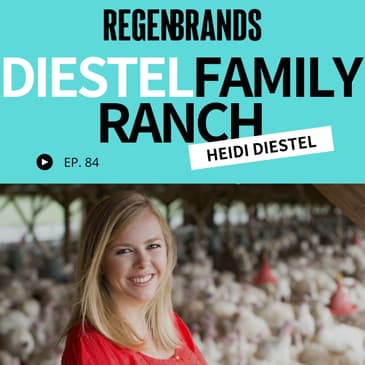
On this episode, we have Heidi Diestel who is a fourth fourth-generation turkey farmer and executive at Diestel Family Ranch.
Diestel Family Ranch has been raising turkeys since 1949, and they’re supporting regenerative agriculture with their Non-GMO, regeneratively raised turkeys that are certified Regenified™.
In this episode, Heidi schools us on their family’s journey raising turkeys and how their practices and products have evolved over the years, she gives us an in-depth look at how they raise their regenerative birds and source regenerative feed, plus she breaks down how they think about product innovation and what is coming in the future from Diestel.
Listen folks, that calendar says November, so it is time to start thinking about that Thanksgiving turkey. We went in-depth for a big-time Turkey 101 with Heidi today, and we were fascinated by everything we learned. We hope you enjoy this one as much as we did, and more importantly, we hope you’re serving a regenerative turkey at your holiday meal here in a few weeks.
Episode Highlights:
🦃 Four generations of turkey farming
🔪 Going from butcher shops to natural retailers
😂 Kyle’s obsession with Diestel turkey
3️⃣ The turkey farming trifecta: breed, feed, and time
⁉️ What’s a regenerative turkey?
✌️ Why regen turkey takes both fowl AND feed
🌽 Sourcing 650 tons of Regenified corn
↗️ Diversifying the product portfolio in the last decade
🍗 Creating products for the Thanksgivings of the future
🔥 A three-pronged playbook for regen poultry to scale
Links:
Diestel Becomes First Certified Regenified™ Turkey Brand
Smoketown Report: Unlocking Demand for Regenerative
Follow ReGen Brands on LinkedIn
Subscribe to the ReGen Brands Weekly newsletter
[00:00:12] Welcome to the Regen Brands Podcast. This is a place for brands, retailers, investors, and other food system stakeholders to learn about the consumer brands supporting regenerative agriculture and how they're changing the world. This is your host Kyle, joined by my co-host AC, who's going to take us into the episode.
[00:00:34] On this episode, we have Heidi Diestel, who is a fourth generation turkey farmer and an executive at Diestel Family Ranch.
[00:00:41] Diestel Family Ranch has been raising turkeys since 1949 and they're supporting regenerative agriculture with their non-GMO regeneratively raised turkeys that are certified Regenified.
[00:00:53] In this episode, Heidi schools us on their family's journey raising turkeys and how their practices and products have evolved over the years.
[00:01:00] She gives us an in-depth look at how they raise their regenerative birds and source regenerative feed.
[00:01:05] Plus, she breaks down how they think about product innovation and what is coming in the future from Diestel.
[00:01:12] Listen, folks, that calendar says November, so it is time to start thinking about that Thanksgiving turkey.
[00:01:18] We went in-depth for a big-time turkey 101 with Heidi today.
[00:01:22] And honestly, we were fascinated by everything that we learned.
[00:01:25] A ton of cool insights shared.
[00:01:27] We hope you enjoyed this one as much as we did.
[00:01:30] And more importantly, we hope you're serving a regenerative turkey at your holiday meal here in a few weeks.
[00:01:35] Let's go.
[00:01:38] What's up, everybody?
[00:01:39] Welcome back to another episode of the Regen Brands podcast.
[00:01:42] If you're checking your calendar today, folks, it is officially November.
[00:01:46] So we are talking turkeys with our friend Heidi Diestel from Diestel Family Ranch.
[00:01:51] So welcome, Heidi.
[00:01:52] Hi.
[00:01:52] Thanks for having me.
[00:01:54] This is our second take because my mic failed the first time.
[00:01:57] AC didn't do the weird accent on turkeys, unfortunately, because I wanted to call them out.
[00:02:02] But as AC said, we're talking Diestel turkey today.
[00:02:06] I am super excited.
[00:02:07] I've been consuming these products for well over a decade.
[00:02:10] So Heidi, really, really pleased to have you here to learn more about your company.
[00:02:14] But for those who are less familiar with the brand than me, give us a quick lay of the land.
[00:02:17] What sort of products do you produce?
[00:02:19] And where can people find your Diestel turkey today?
[00:02:22] Yeah, definitely.
[00:02:23] So we produce everything turkey, right?
[00:02:25] We've been farming since 1949.
[00:02:27] So 75 years in business.
[00:02:29] And we've got everything you can think of.
[00:02:31] Ground turkey, turkey sausage, deli meats, whole birds, of course, at the holiday.
[00:02:37] You can find us at your natural organic retailers, Whole Foods, Sprouts.
[00:02:42] A little dabble on Amazon, direct to consumer, if hunger root or imperfect is your jam.
[00:02:48] As you started listing the different types of turkeys, I had like a flash to Forrest Gump.
[00:02:52] And I was like, are we going to go fully down the rabbit hole here?
[00:02:55] Yes.
[00:02:55] Yes.
[00:02:56] All the turkey types?
[00:02:57] Half the time, I have to reference that movie because it sounds like, you know, both a double shrimp.
[00:03:03] I mean, I can do the accent.
[00:03:05] I know AC left his turkey accent out, which I'd like to know where that was from.
[00:03:09] But, yeah.
[00:03:12] Awesome.
[00:03:13] At some point in time today, we need to hear like the best gobble impersonation between the two of us.
[00:03:18] Oh, oh, oh.
[00:03:19] That has to happen.
[00:03:20] Oh, oh.
[00:03:21] Oh, you show me yours.
[00:03:24] Maybe I'll show you mine.
[00:03:26] Okay, we'll get there.
[00:03:27] We'll see how the vibe ends up.
[00:03:29] Or the jive because we're a bunch of jive turkeys.
[00:03:31] There's a lot of turkey jokes that we can do.
[00:03:33] Oh, jeez.
[00:03:34] I can't stop laughing.
[00:03:37] Okay.
[00:03:37] Oh, my God.
[00:03:38] Okay, I'll settle down.
[00:03:39] I'll settle down.
[00:03:40] So you mentioned all the types.
[00:03:41] You mentioned DTC.
[00:03:42] Oh.
[00:03:43] I don't know.
[00:03:44] Did you mention retail partners?
[00:03:45] Yeah.
[00:03:46] National distribution?
[00:03:48] Yeah.
[00:03:48] I mean, we're primarily on the West Coast, but we do have some national distribution.
[00:03:52] Yeah.
[00:03:53] Through Whole Foods and Sprouts.
[00:03:54] But I mean, all the way down to like your regional grocers, right?
[00:03:58] Like New Seasons in the Pacific Northwest and Nugget, Lenardi's, Dreggers in Northern California.
[00:04:03] You got some Raley's in there.
[00:04:05] Jimbo's down south, which is a phenomenal grocery store.
[00:04:08] So yeah.
[00:04:09] Oh, yeah.
[00:04:10] Awesome.
[00:04:11] Yeah.
[00:04:11] I was amazed by the amount of the depth of the product portfolio when I looked at the website again today before we hopped on, Heidi.
[00:04:18] It's just, it's insane.
[00:04:19] The amount of things you can do with turkey.
[00:04:21] It's a beautiful thing.
[00:04:22] Yeah.
[00:04:22] And also just the different breeds, the different kind of farming practices and how that translates into the different product specs.
[00:04:29] So we're excited to dive into all that.
[00:04:31] I'm ready for my turkey education today.
[00:04:34] Awesome.
[00:04:35] Yeah.
[00:04:36] Well, kick us off.
[00:04:37] Tell us about the origin story.
[00:04:38] You mentioned this farm or your family's been farming since 1949.
[00:04:41] You know, why turkeys to begin with?
[00:04:43] And what is that?
[00:04:44] I'm sure there's probably a few different iterations of like what the farm has been doing in 75 years.
[00:04:48] But walk us through that journey.
[00:04:50] Yeah, for sure.
[00:04:51] So my great uncle Ernest was farming in our county way back in the day.
[00:04:56] And honestly, turkey, I mean, they had apples and chickens and turkeys, you know, I mean, in 100 plus years ago, right?
[00:05:03] That is pretty normal to have really hyper-local food sources.
[00:05:10] And so, you know, turkey farming was just, it just was good money.
[00:05:15] You know, you could make a good living in it.
[00:05:17] And my grandfather, you know, grew up in the county, born and raised in Sonora.
[00:05:24] Went off to R.E.
[00:05:24] Hold on, you mentioned, you said our county.
[00:05:26] Is that O-U-R county?
[00:05:28] Or A-R-E county?
[00:05:31] The Tualney county, the county that we're in.
[00:05:34] Yeah, sorry.
[00:05:34] I reference it as ours because like it's, you know, part of my like life.
[00:05:41] I just wanted to make sure that there's not a county called R that I'm unfamiliar with.
[00:05:45] No, no.
[00:05:46] Just according to Heidi's law, but no.
[00:05:48] Got it.
[00:05:49] Okay.
[00:05:49] A couple.
[00:05:51] Kyle's in a jokester mood today.
[00:05:52] I know, I know.
[00:05:53] I better be careful.
[00:05:55] That was a legitimate question.
[00:05:56] That was not a joke.
[00:05:57] That was truly like, I'll show you.
[00:05:59] Like I put our county right here on my notes.
[00:06:01] That's pretty great.
[00:06:02] That's pretty great.
[00:06:03] Yeah.
[00:06:04] No, no, it's not ours, but it is Tuolumne.
[00:06:07] But a bit more difficult to spell.
[00:06:10] But yeah, no, I mean, turkey farming was just, it was a good way to make a living.
[00:06:14] My grandpa, you know, went off to the army.
[00:06:16] He came back.
[00:06:17] He was like, hey, I guess I'll farm turkeys.
[00:06:20] And he and his wife ran the ranch and they did a lot of contract farming, but they had the
[00:06:25] local community come out and buy birds direct from him.
[00:06:28] And at the time there's, you know, thousands of turkey farmers.
[00:06:31] Like it was a pretty common, it was a pretty common, you know, career, if you will.
[00:06:36] And he just had one ranch.
[00:06:37] And, you know, my uncle Ernest, like his entire perspective on farming was like, hey,
[00:06:43] give to the earth and the earth will give to you.
[00:06:45] Be right, you know, do right by the birds.
[00:06:47] The birds will do right by you.
[00:06:48] This was kind of like the foundational farming philosophy in the family.
[00:06:51] So, you know, my grandfather just kind of continued on in that sense.
[00:06:55] And, you know, it's really wild to think about like your food source.
[00:06:59] And, you know, my grandfather would before they had the mill, they put in the first mill in 1956.
[00:07:05] But prior to that, you know, he would haul birds on a flatbed pickup down to the San Francisco
[00:07:11] pier, sell off his birds to, you know, the chefs and the market down there and then run over
[00:07:16] to the ports and bring back the feed.
[00:07:19] And he would make those trips, you know.
[00:07:22] Wow.
[00:07:22] Yeah.
[00:07:23] And I mean, that was his, I mean, that was his life, right?
[00:07:25] Like, I mean, such hard work, so much labor.
[00:07:29] So that's kind of how the D stole, right?
[00:07:32] It was our last name, my grandfather's last name.
[00:07:34] That's really how the farm got started.
[00:07:36] And that was like the roots of who we are as people.
[00:07:41] That's incredible.
[00:07:41] Um, yeah.
[00:07:42] And it sounds like, you know, what's that drive time to go to SF?
[00:07:47] Oh, well, today, today it's like two, two and a half hours.
[00:07:51] I mean, then, you know, you're talking at least probably double.
[00:07:54] I don't know how fast those trucks drive.
[00:07:57] So, yeah.
[00:07:58] So at least a full day, if not more trip.
[00:08:00] Oh, yes.
[00:08:01] Yeah, for sure.
[00:08:02] I mean, at least, at least, right?
[00:08:04] Um, yeah.
[00:08:05] But, you know, my dad was, you know, born in Sonora.
[00:08:07] He was raised with the birds and, um, you know, he thought like, hey, we've got people
[00:08:12] coming to us and we take a handful down to the pier, but San Francisco's big.
[00:08:17] Northern California is a big place.
[00:08:18] He thought, you know, I'll, I'll, I'll take up farming and, you know, just haul the birds
[00:08:24] down and, you know, kind of the same idea.
[00:08:26] Right.
[00:08:26] And, um, he studied business economics at UC Davis after going to, you know, before he
[00:08:31] went to junior college and then transferred in.
[00:08:33] He met my mom who was born and raised in the San Francisco peninsula.
[00:08:36] She was studying to be a registered dietitian.
[00:08:39] And my grandfather was like, you're crazy, you know, get away from here.
[00:08:43] Farming is really hard.
[00:08:45] Like, you know, uh, where I'm speaking from today is our home ranch as we call it.
[00:08:51] And it's the ranch that my, my parents started with and my grandpa founded.
[00:08:54] And, um, yeah, my parents met and my dad had this crazy idea.
[00:08:59] Right.
[00:08:59] And so all of my mom's friends are marrying like doctors and all of this.
[00:09:04] And my mom's going to marry a turkey farmer from Sonora.
[00:09:06] You know, but they moved back, uh, they moved back to Sonora in the early 1980s.
[00:09:14] And, um, the, uh, our, our main office or our home office, if you will, is, um, was our
[00:09:21] home.
[00:09:21] So I, I was like raised in this house.
[00:09:24] The front was an office.
[00:09:25] The back was our house.
[00:09:26] Um, and we were turkey farmers, right?
[00:09:29] Like we just, we just did what had to be done.
[00:09:31] And at that time you have to realize that natural and organic foods were not what they are today.
[00:09:36] Right.
[00:09:36] You didn't, you didn't have certified organic.
[00:09:38] This wasn't even a program.
[00:09:40] Um, and so I grew up with a phone book and butcher shops, right.
[00:09:44] Speaking to butchers, people who really understood like the value of meat, um, of like the protein
[00:09:51] first before any of like health claims or attributes or anything like this.
[00:09:54] And it wasn't popular to be antibiotic free or vegetarian fed.
[00:09:58] It wasn't, you know, you know, you were kind of like, you know, you were a hippie in a way
[00:10:03] if, if you were doing this type of stuff.
[00:10:05] So those, those butchers said, Hey, I'll take five birds.
[00:10:08] I mean, literally like five, 10 turkeys at a time is how my parents built this business.
[00:10:14] Yeah.
[00:10:14] And has it always been antibiotic free, no hormones?
[00:10:17] Yeah.
[00:10:18] From the jump.
[00:10:19] Yep.
[00:10:19] From the jump.
[00:10:20] So, um, when my, when my dad took it over, he kind of looked at everything and he said,
[00:10:24] Hey, let's, let's do it.
[00:10:26] Antibiotic free and vegetarian fed because it's, it's wholly different than what is in
[00:10:31] the market.
[00:10:31] And he didn't really think it was actually that necessary.
[00:10:34] Right.
[00:10:35] With the way that like we were bringing the birds to market.
[00:10:38] So, and my mom being a registered dietitian, she's like, you know, 90s, low fat face.
[00:10:43] Like that was, you know, I mean, she was riding the wave.
[00:10:45] Right.
[00:10:46] So when my parents first moved back, my mom was actually working at the hospital.
[00:10:50] Um, right.
[00:10:51] Cause someone had to make the money.
[00:10:53] So she, she worked at the hospital in town and, um, slowly, but surely came over to do
[00:10:59] like, you know, sales and support the family business.
[00:11:01] But she had a whole career in, you know, dietetics.
[00:11:04] So she was very much aligned with like, Hey, let's do this the best way we know how with
[00:11:09] like highest nutrient profile, if you will, you know, best quality, best taste, um, best
[00:11:15] meat to bone ratio, the best value.
[00:11:17] So yeah, that's how it started.
[00:11:19] And then, you know, really the brand grew and was built on the, the coattails of the
[00:11:25] natural organic food movements with wild oats and whole foods.
[00:11:30] And, um, you know, uh, Rob, uh, Walter Rob, who, um, you know, was one of the founders of
[00:11:37] whole foods.
[00:11:37] My parents met in Marin, right.
[00:11:39] When he had his, his shop there and has been such an advocate of just what we do and such
[00:11:44] a supporter of my parents and now of us as fourth generation.
[00:11:48] So, you know, it's, um, we've been here, we've been here a while.
[00:11:51] And I think that's why the portfolio is so large of products.
[00:11:54] And, you know, what we do is, um, is still quite unique and it's, it's kind of funny to
[00:11:59] say that, but it's unique in its own way.
[00:12:01] What, what was the inflection point product Heidi to like get more into CPG away from
[00:12:06] the wholesale food service and butcher shop business?
[00:12:08] Was it just whole birds to retail?
[00:12:10] Was it something else?
[00:12:12] You know, it's funny because a lot of our business is still, you know, non-UPC items, right.
[00:12:18] Um, but you know, folks would call my parents and say, Hey, you guys call yourself a turkey
[00:12:23] company, but I can't get, you know, deli meat from you throughout the year.
[00:12:27] You know, it was really driven by the, by the shift in consumers habits and eating habits.
[00:12:34] And so, you know, we, we have still a whole deli portfolio.
[00:12:39] And then of course we have all the sliced, you know, deli that you can just buy packages
[00:12:43] of.
[00:12:43] Um, and we really started, you know, taking the bird and then breaking it down into all
[00:12:48] these different formats, but you have to remember too, like we're family owned and operated.
[00:12:52] We don't have, you know, we, we only have the resources we have.
[00:12:56] So, um, we had to really build out super thoughtfully over the many, many years.
[00:13:01] And, you know, it takes a lot of money, a lot of processing equipment, um, a lot of,
[00:13:05] you know, technology to, to put things into a package format in the perfect package for
[00:13:11] whatever customer, you know, you're trying to sell it to.
[00:13:14] So that, that took us quite a bit of time.
[00:13:16] Um, which is why that shift was like slow and very methodical.
[00:13:21] Um, and Turkey is also a super kind of funny protein.
[00:13:24] Like the way that culturally we surround ourselves with Turkey is quite funny.
[00:13:28] It's not, it's not like chicken and it's not like beef.
[00:13:32] So, you know, we had to really think outside the box to make our company successful when
[00:13:38] all we do is Turkey, right?
[00:13:40] We don't do chicken.
[00:13:41] You, you don't see a lot of people in poultry doing just Turkey.
[00:13:44] It's a bit of a death sentence in some, in some ways.
[00:13:48] Yeah.
[00:13:49] There's, there are so many questions I want to ask about the portfolio, the revenue split
[00:13:54] between the different packages.
[00:13:55] Like there's, there's, we can really go down that rabbit hole, but I don't think that's
[00:13:58] the best use of our time.
[00:14:00] That being said, I am curious about, you know, you mentioned the processing.
[00:14:03] Do you all do all your own processing and packaging onsite or do you have partners?
[00:14:07] What does that relationship look like?
[00:14:08] Yeah.
[00:14:09] So we do a mixture of both, right?
[00:14:11] So as, um, as we've needed to evolve into different categories and also, you know, technology
[00:14:16] has changed in like, you know, pre-sliced, you know, the way that you bring a pre-sliced
[00:14:21] product to market, you know, we found a couple of really key, um, people in the industry who
[00:14:26] are really good at what they do and super specific at what they do.
[00:14:29] And, um, so we do have a couple of folks we work with, but primarily a lot of the products
[00:14:34] we do are, um, is, is, is our own production facility.
[00:14:38] So we have primary and further processing, um, and we do a lot.
[00:14:42] And that's, that's really fun.
[00:14:44] Like that is such a joy for me to look at like our R and D processes and really break
[00:14:49] down and say like, okay, well, how is this different?
[00:14:51] And is it different?
[00:14:52] Right.
[00:14:52] Um, and like flavor profiles and just that innovation in our space is really fun.
[00:14:58] Cause like you, you're taking a protein that no one really thinks about unless you're thinking
[00:15:02] about like eating healthier or a sandwich or Thanksgiving.
[00:15:06] And you're like, Hey, let me surprise you with something that could be super awesome.
[00:15:10] And you could have it every day for dinner.
[00:15:12] Okay.
[00:15:13] Okay.
[00:15:13] This is, this is my time to shine here.
[00:15:14] We're talking about how to eat Turkey and this is my jam.
[00:15:18] So I grew up in a house where I had four, four kids and my sister, one of them did not
[00:15:25] eat any red meat.
[00:15:26] Okay.
[00:15:27] And we are like, you know, my last name is Kroll.
[00:15:29] We are like German Irish heritage.
[00:15:31] Our family meal was tacos, uh, which makes no sense.
[00:15:35] Uh, we always did ground Turkey tacos.
[00:15:38] And I was just at a bachelor party recently and I made ground Turkey tacos for everybody.
[00:15:42] And they're like, why, why are you making ground Turkey?
[00:15:43] And they were like, this is delicious.
[00:15:45] Oh my gosh.
[00:15:46] So there is definitely a stigma out there.
[00:15:48] Like, why do you eat ground Turkey?
[00:15:50] You know what I mean?
[00:15:51] That's kind of a, unless to your point, you're looking to be super healthy, but throughout
[00:15:55] my journey of consuming food, I used to, I was a rep.
[00:15:58] I'd be driving around Southern California going to different Whole Foods.
[00:16:01] And I'd stop in and just order like a half pound of diesel Turkey from the deli case
[00:16:05] fresh.
[00:16:06] Um, it was phenomenal.
[00:16:08] Like that in an apple was like lunch almost every day.
[00:16:11] Um, now that I'm home, you're completely shredded, right?
[00:16:15] The fuel baby.
[00:16:16] Is protein.
[00:16:17] Body fat.
[00:16:18] So burpees, turkey, fruit.
[00:16:21] Yeah.
[00:16:21] I see it.
[00:16:22] That's it.
[00:16:22] I can see it.
[00:16:23] That's it.
[00:16:23] Um, it's not the case.
[00:16:25] I wish.
[00:16:25] Um, but now that I'm home, I'll buy just the deli package.
[00:16:31] Meats and I'll, I'll like wrap up a pickled asparagus and eat that.
[00:16:35] Um, it's a phenomenal lunch.
[00:16:37] I still do.
[00:16:38] And then every year we buy a whole bird for Thanksgiving.
[00:16:40] I do.
[00:16:40] Awesome.
[00:16:41] So last year we did the, the heritage this year we do.
[00:16:44] We did the regenerative for the first time.
[00:16:46] And don't thank me.
[00:16:46] Thank you for making great Turkey.
[00:16:49] Yeah.
[00:16:50] Yeah.
[00:16:50] No problem.
[00:16:51] Uh, it's my pleasure.
[00:16:52] Yeah.
[00:16:53] That's great.
[00:16:53] Can I ask a quali, like a clarifying question real quick?
[00:16:57] Like what type of pickle?
[00:16:58] Are we particular on the pickle?
[00:16:59] Sorry.
[00:17:00] It's pickled asparagus.
[00:17:01] The brand is.
[00:17:02] Oh, okay.
[00:17:03] So you get like a, you get like two, two different slices of turkey.
[00:17:07] You set them on a plate.
[00:17:08] Yeah, I'm tracking.
[00:17:08] You, you set the asparagus and you roll it up like a little roll up.
[00:17:11] I feel like a child eating lunch.
[00:17:12] Yeah.
[00:17:12] No.
[00:17:12] It's delicious.
[00:17:13] I think there are going to be a lot of people rushing to the store right now to try this.
[00:17:18] And I'm with you.
[00:17:19] I think that's fantastic.
[00:17:20] It's a great way to have lunch.
[00:17:24] Yeah.
[00:17:24] I was, I was on a flight the other day, Kyle, doing almost the exact same thing.
[00:17:28] Like opening up the package of distal.
[00:17:30] Like, I know this is weird, but I haven't eaten and I'm hungry.
[00:17:33] So, you know, you get a few weird looks, but we can stick together.
[00:17:36] Especially on a plane.
[00:17:37] Yeah.
[00:17:37] Weird stuff happens on planes.
[00:17:38] I know.
[00:17:39] I know.
[00:17:39] I didn't want to do it, but like I was hungry.
[00:17:41] So there was no, there's nothing around that.
[00:17:43] There's nothing wrong with house and some, some turkey.
[00:17:47] We support that.
[00:17:50] And I'll, and I'll say my excuses.
[00:17:52] I was raised in the Midwest with where we had a little bit less distal product penetration
[00:17:57] availability.
[00:17:58] Fair.
[00:17:59] But I have, I have had the products at this point.
[00:18:02] They are phenomenal.
[00:18:03] Thank you.
[00:18:04] And Heidi, I don't know if this is a super hard question to answer or not, but you know,
[00:18:10] I want to, there's the, there's the, uh, the page on y'all's website called meet our
[00:18:14] birds, right?
[00:18:15] Where it kind of breaks down the different, very different birds available.
[00:18:18] And I would love to, for you to just educate our listener on that overall, and then maybe
[00:18:23] tie it into like the development of the brand over time and how that's evolved from like
[00:18:27] the original to the non-GMO, to the organic, to the regenerative now, like just give us
[00:18:32] that arc if you can a little bit.
[00:18:34] Yeah, for sure.
[00:18:34] So, um, yeah, it started with one Turkey, right?
[00:18:38] It was a distal Turkey, ABF vegetarian fed.
[00:18:42] Um, and that is like the quintessential bird of our brand.
[00:18:46] Um, in the, in the late, um, late 1980s, early 1990s, there started to be discussion about
[00:18:54] an organic style movement.
[00:18:56] Um, you know, a lot of produce, we have a lot of people in produce in the, um, um, Valley
[00:19:02] there, you know, a lot of people just in ag, right.
[00:19:06] But our family knew, and there's a lot of conversation around what it would mean to be
[00:19:09] organic.
[00:19:10] Um, so, you know, fast forward, my parents were helping set some of those standards for
[00:19:15] the, you know, the organic bird, the organic poultry standards.
[00:19:19] Um, and that bird, you could first label certified organic in 1999.
[00:19:24] Um, and so my parents really wanted people to understand, Hey, like the distal Turkey is
[00:19:29] the distal Turkey, like it's the OG, you know, there's nothing wrong with that.
[00:19:33] It's completely fantastic.
[00:19:35] But for those that are looking for something really pure, um, and, and, and perfect, right.
[00:19:40] Uh, perfect in air quotes, um, you know, here's the certified organic Turkey.
[00:19:45] Okay.
[00:19:46] And so we had both, we offered both.
[00:19:48] Um, and then, you know, my parents were, you know, looking back on, on just, you know,
[00:19:54] heritage, my dad growing up looking at like, you know, breeds, breeds have a
[00:19:59] always been very specific in our, in the distal world as it relates to size and that meat
[00:20:04] to bone ratio and the confirmation and the quality.
[00:20:07] Most producers will run like one breed, maybe two breeds because you have a conversion rate
[00:20:11] on, on speed and, you know, a ton of efficiencies if you just run more simple breeds of turkeys.
[00:20:20] But for us, you know, a 20 pound hen, we needed it to perform in taste and quality and
[00:20:25] meat to bone ratio as like a 10 pound, a 10 pound bird.
[00:20:29] Um, and so like my dad worked a lot in the breed side and we have a proprietary breed
[00:20:34] with our own genetics.
[00:20:35] That is, um, our petite that is six to 10 pounds.
[00:20:38] Yeah.
[00:20:39] And that Turkey will grow just as long as like a Tom or, you know, a heavy head and it will
[00:20:44] only ever be six to 10 pounds.
[00:20:45] And it's, it's, again, it just speaks to like, we're going to put these birds on the ground
[00:20:50] and we're going to know where they're headed when they come off the ground so that they
[00:20:54] have optimal meat to bone ratio and quality.
[00:20:56] And that finish, you really need the finish, right?
[00:20:58] So like that time.
[00:21:00] So as they were kind of looking at it.
[00:21:02] Well, I do mean to interrupt because I'm interrupting, but you keep mentioning meat to
[00:21:06] bone ratio.
[00:21:07] Tell us why that's important and what that looks like relative to other Turkey producers.
[00:21:12] Oh, for sure.
[00:21:13] Yeah.
[00:21:13] I mean, meat to bone ratio is like pure, pure dollars in your pocket to a consumer, right?
[00:21:18] Like how much meat can you carve off of a 20 pound hen of distal and how much can you carve
[00:21:23] off of a commodity bag of bones?
[00:21:26] Right.
[00:21:26] So, you know, you think of like men and women, most have like different bone structure, right?
[00:21:31] Some are thicker bones, bigger people, smaller people.
[00:21:34] It's the same kind of concept in, in our turkeys, right?
[00:21:37] Like we don't want to take a Tom that has like this big bone structure and is meant for,
[00:21:42] you know, a lot more muscle and meat and, and grow it as a 20 pound hen, which,
[00:21:47] which the industry does and sell it to you at 25 cents or 30 cents cheaper per pound.
[00:21:55] Okay.
[00:21:55] On a 20 pound bird, it's a couple of lattes at this point in the world.
[00:21:59] But you're going to have significantly less meat on that Turkey.
[00:22:03] Then if you, if you spent a couple extra lattes more and got a distal Turkey, like your meat
[00:22:09] to bone ratio is, is by far much better in a distal program.
[00:22:13] And that's specific to the breed.
[00:22:15] Um, and usually when you have optimal meat to bone ratio, usually when you have it, you
[00:22:20] also have the finish on the product, right?
[00:22:22] Because you've allowed that Turkey, the time.
[00:22:24] And as we all know, time, you can't, you know, you can't, you can't, uh, skimp on, uh, you've,
[00:22:30] you've given that bird the time to develop its fat naturally develop its flavor, you know,
[00:22:36] over time.
[00:22:36] So like mission critical, super important.
[00:22:39] But, um, yeah, my parents looked back and they were like, you know, we should be growing
[00:22:42] some like, you know, bronze and black feathered birds.
[00:22:45] Some, some of the heirloom varietals.
[00:22:47] Now we don't grow true heritage turkeys.
[00:22:50] Like there's the slow food movement with like, what is a heritage Turkey?
[00:22:53] And we tried, we, we did a few, we didn't love them.
[00:22:57] Like as a family, we didn't love the taste.
[00:22:59] We didn't love the way that they layered on their fat.
[00:23:01] We just didn't like the way that they performed.
[00:23:02] So, um, and it was just like a personal preference.
[00:23:06] Uh, and so we, we created what we call our heirloom varietal, which is a crossbreed.
[00:23:11] So still you have that really nice, rich old world flavor.
[00:23:14] It's just a very like rich and complex bird.
[00:23:17] Um, but you have a double breasted bird and you have one that has that optimal meat to
[00:23:21] bone ratio and performs the way we think of these still Turkey should perform.
[00:23:25] So my parents introduced that.
[00:23:28] And those breeds are a lot of the same breeds that like my grandfather was raising.
[00:23:31] So like, you know, we have a newspaper clipping from 1956 with my dad, like with one of those,
[00:23:37] you know, style turkeys on it.
[00:23:38] Right.
[00:23:39] Like, yeah, it's super cool.
[00:23:41] So, um, so we have our, our, and again, like genetics were a big thing.
[00:23:45] My dad had to like pick the right genetics, work on that breed line for a really long time
[00:23:49] to get it to where it would perform across the weight ranges and, um, and be what we, be what
[00:23:55] we needed it to be.
[00:23:56] And so, um, yeah, that was kind of what my parents really developed where like your ABF,
[00:24:01] your organic and your heirloom.
[00:24:03] We were off in college and doing all of our things.
[00:24:06] And, um, you know, I never had intentions of coming back to the family business.
[00:24:12] I was like, get me out of here.
[00:24:13] You know, like I'm going to go do something else, which my parents were super happy with.
[00:24:16] But, uh, my brother, Jason was like a quintessential farmer from the moment he came out of the womb
[00:24:22] and, um, Jason got back from college.
[00:24:25] He's four years older than me.
[00:24:26] He came back a lot more quickly and he was super interested in like the Joel Salatin model, right?
[00:24:33] Multi-species rotational grazing.
[00:24:35] And at the time that he was like getting really geeking out on all this stuff, uh, Whole Foods
[00:24:40] started developing the gap rating system, global animal partnership rating system.
[00:24:45] And so, um, it was about that time kind of coinciding.
[00:24:48] We had taken our home ranch and we had made it kind of like a trial period on, on half the property.
[00:24:54] It's a 60 acre property.
[00:24:56] So we were kind of like, Hey, we're going to try some things out, see what we can do.
[00:25:00] And Jason started doing a multi-species rotational grazing program.
[00:25:04] And we said, Hey, we'll, we'll take off like a, a, you know, very small percentage of our production
[00:25:09] and we'll make it gap step five plus because our primary processing sits on the same property.
[00:25:15] And we'll have like this really cool, super unique product, right?
[00:25:19] It was like one of two in the country.
[00:25:22] Um, and we did that for about a decade.
[00:25:24] Um, we had a lot of issues scaling it.
[00:25:26] It was, it was a fantastic program.
[00:25:29] It was so neat, but we couldn't really make it pay.
[00:25:31] And we had a really, a lot of issues scaling it.
[00:25:33] But Jason is really behind what our pasture raise program is that just recently in the last two to three years,
[00:25:40] we, we pushed into being our regenerative Turkey, uh, certified, regenerified.
[00:25:45] Um, and it's been so neat to see that transition, but it's also like uniquely very cool to look back and say,
[00:25:53] okay, it started with this original diesel Turkey.
[00:25:56] That's ABF.
[00:25:56] My parents kind of had their imprint with these organics and the heirloom varietals and getting the genetics really dialed in.
[00:26:03] And then, you know, you kind of see it pick up with Jason truly, uh, and our generation, our fourth generation in like that land stewardship piece.
[00:26:11] And almost kind of going back to the basics of like incorporating the land into farming practices, right.
[00:26:18] Um, as an, as a, as an additional component.
[00:26:21] I am fascinated by all this Turkey knowledge.
[00:26:24] This is actually so fun.
[00:26:25] Um, for the listeners at home, ABF is antibiotic free.
[00:26:29] Just flagging that for folks, Heidi, just like two or three questions on what you just shared.
[00:26:34] Um, so genetics matter a lot.
[00:26:37] Totally understood that you kind of got into talking about hens versus Tom.
[00:26:41] So question one is like the gender also matters.
[00:26:44] And how do you manage that is question one.
[00:26:45] Um, question two is like, I'm picturing you raising turkeys in flocks by these attributes or like by like the production process.
[00:26:55] Is it that segregated or are they all kind of together?
[00:26:57] And then there's some sort of like function down the line.
[00:27:00] Like those two.
[00:27:01] Yeah.
[00:27:01] No, you want to, you want to kind of raise them in flocks for sure.
[00:27:04] Birds of a feather flock together.
[00:27:05] That's real.
[00:27:06] You know, that's, that's, that's it.
[00:27:08] Um, yeah.
[00:27:09] So hens, girls, Tom's boys.
[00:27:11] Right.
[00:27:12] Um, you know, you kind of want to keep them in their, you know, their, their groups.
[00:27:16] Um, and yes, we do raise them like no antibiotics ever.
[00:27:20] ABF, uh, antibiotic free in, in kind of that group because the feed, right.
[00:27:25] That's going to them is, is the same, but different depending upon their, their programming.
[00:27:31] Uh, if you're using certified organic feed or not.
[00:27:34] Um, so, you know, we have a feed mill.
[00:27:36] We, we bring in the corn and soy that we source and mill it ourselves.
[00:27:39] Feed is, is a key component.
[00:27:41] Breed feed in time, right.
[00:27:43] And like the cornerstones of, of a, of a farm animal ag.
[00:27:47] Um, and so, you know, we're keeping those guys separate and then, and then raising them
[00:27:51] accordingly.
[00:27:54] I'm really curious.
[00:27:56] And this is a difficult question to ask.
[00:27:58] You know, oftentimes we'll ask our brands, you know, tell us about why your regenerative
[00:28:02] birds are different and raised differently than non-regenerative, like more commoditized
[00:28:06] systems.
[00:28:06] You all seem to run the gamut between, you know, baseline, which is still higher than most
[00:28:11] commoditized turkeys all the way up to regenerified, but help us understand what's happening on
[00:28:17] the ground between those different systems and those different flocks.
[00:28:20] So we can get a better understanding of why those are different and how the regenerative
[00:28:24] system in particular is making a positive impact on the environment.
[00:28:29] Yeah, for sure.
[00:28:30] Great question.
[00:28:32] Um, so we're going to step back and then we'll move forward because it's really important.
[00:28:38] We understand like our heritage in this industry.
[00:28:42] Yeah.
[00:28:42] When turkey farming, okay.
[00:28:44] Turkey farming in the day, right.
[00:28:45] Like back in the day, you, you, you got a barn that you're going to put them in.
[00:28:49] You're going to brood the turkeys in your, you know, when they're babies, right.
[00:28:52] You need to provide them warmth and security and a nice fluffy bed of, you know, fresh pine
[00:28:57] wood shavings, which we still do.
[00:28:59] Right.
[00:28:59] Like this is their babies.
[00:29:01] And then as they get older and their teenage years, you're going to let them outside.
[00:29:05] You're going to let them roam around.
[00:29:06] Right.
[00:29:06] And free range and range grown.
[00:29:08] These claims back in the day was a very genuine, right.
[00:29:12] Like get them out of the barn, bring them in at night.
[00:29:15] If it's cold or raining or, you know, whatever, they're going to come in, they're going to go
[00:29:18] out.
[00:29:19] But, you know, food was, was, uh, being manufactured, if you will, at a very high pace.
[00:29:27] And you have a lot of players in this market.
[00:29:29] Right.
[00:29:30] And you have a lot of people who are saying, Hey, I can do this faster and cheaper and more
[00:29:35] efficient.
[00:29:36] Uh, however that relates to their business, whatever more efficient means to that business.
[00:29:40] Right.
[00:29:41] And so they said, Hey, if I keep these guys inside, uh, or if I, or if I break, you know,
[00:29:46] if I, if I change some practices, if I at least cost my feed, if, if I, you know, do X,
[00:29:52] Y, and Z, I can shave off 20 cents.
[00:29:55] I can shave off 50 cents.
[00:29:56] Look at how much more efficient I am.
[00:29:58] I'm lowering the cost of goods.
[00:30:00] I'm lowering my price.
[00:30:01] I'm competing better in the market.
[00:30:03] Right.
[00:30:03] Right.
[00:30:03] Not necessarily bad, but just the evolution of food and, and of our industry.
[00:30:09] So when you think about like how distal started, right.
[00:30:13] Or you think about how anyone in poultry started, I bet you, if you talk to them, it's much different
[00:30:17] than where they are today because technology has changed and the needs of the consumer and
[00:30:23] the price that the consumer is willing to pay has changed.
[00:30:26] Right.
[00:30:26] And there's really nothing wrong with that per se, because, you know, you're, you're in
[00:30:31] business and it is your business.
[00:30:33] You have to be, you have to be growing.
[00:30:34] You have to be prosperous.
[00:30:35] You have to make money in order to sustain all your assets.
[00:30:39] Right.
[00:30:39] And, and all the things that you're doing and reinvestment in your equipment and all of
[00:30:43] this.
[00:30:43] So it's not bad, but it's, it's, it really has adjusted the way that product gets to
[00:30:48] market because of that consumer demand.
[00:30:51] So when we think about the ABF birds, you're right.
[00:30:54] Like the diesel program is drastically different than any conventional program, like very
[00:30:58] different.
[00:30:59] Um, and so, you know, there's that kind of like stepping point in which our barns are
[00:31:06] more like a, um, more like a screened in porch.
[00:31:11] Right.
[00:31:11] Um, then, then like a fully sided barn.
[00:31:14] Right.
[00:31:15] Um, and, and yet when you look at the ABF program, there are efficiencies there and there's a price
[00:31:21] point there that some people are willing to pay and are very comfortable with.
[00:31:24] But when you go to the regenerative and you say, Hey, I'm going to, I'm going to move this
[00:31:29] scale over to the regenerative.
[00:31:30] And we're going to look at how this practice is different.
[00:31:33] It's really getting back to basics.
[00:31:35] I mean, it's really going back to the fundamentals of where my grandfather and my great uncle
[00:31:40] Ernest were, you know, a decade ago, or excuse me, not a decade, a hundred years ago,
[00:31:45] right?
[00:31:46] Not 10 years ago.
[00:31:47] Uh, but so, so it's really getting back to basics and it's saying, wait a second, wait
[00:31:51] a second.
[00:31:52] Like not too many moons ago, we were really looking at the land, the environment, the soil.
[00:31:57] We were really thinking about like our impact on it.
[00:32:00] Like my grandfather used to like drive through the Valley and he would talk about like the
[00:32:04] almond blossoms and then tell us about the spring we were going to have.
[00:32:08] You know what I'm saying?
[00:32:08] Like I, I don't have this knowledge.
[00:32:11] Like he would taste like he grew tomatoes.
[00:32:13] We had a garden.
[00:32:14] Right.
[00:32:14] And I mean, he would like, he would just talk to you about like antioxidants and phytochemicals.
[00:32:19] He didn't use those words.
[00:32:21] He didn't say like technical terms, but he would tell you about like the sweetness or the tart
[00:32:26] or the acidity.
[00:32:27] Like it was so much more ingrained into like the soil and the land, um, than I ever have
[00:32:33] been, which is like kind of humbling in a, in a big way.
[00:32:36] So the regenerative programming is, is a step back in a way it's saying, wait a second, like
[00:32:41] let's look at our impact.
[00:32:43] But for poultry regenerative is confusing, right?
[00:32:46] Because it started with cattle, ruminant animals that had a really big impact on the land.
[00:32:54] Turkeys don't consume grass as their primary source of feed.
[00:32:57] Um, but they do have an impact.
[00:32:59] And so again, like when we were doing our step five program, we learned a lot in that program
[00:33:05] and we never understood what that would mean to our future in regenerative, but we had like
[00:33:10] this foundation of, you know, trial and error and an understanding of like, okay, how could
[00:33:16] our practices start to scale in order to be efficient enough to sell our product in market, um, but
[00:33:23] actually make a difference.
[00:33:24] And so, um, you know, multi-species we feel is really important for poultry because of
[00:33:31] what ruminants give.
[00:33:33] And then, you know, what the birds give.
[00:33:34] We also feel that it's really important and there's no third party that's requiring this
[00:33:39] right now to be regenerative, but in distal world, we, we do because we want to work towards
[00:33:44] this, but sourcing regeneratively grown feed.
[00:33:47] I mean, that's massive, right?
[00:33:49] Like huge.
[00:33:51] And you know, my brother, um, on that, on that note, what, what percentage of Turkey diet
[00:33:56] is feed versus forage for this pasture raised system?
[00:34:00] Oh, 90% feed.
[00:34:02] Oh yeah.
[00:34:03] Yeah.
[00:34:03] Your big majority is feed for sure.
[00:34:06] Right.
[00:34:06] Yeah.
[00:34:07] Yeah.
[00:34:07] I mean, they're outside.
[00:34:09] Don't get me wrong.
[00:34:09] They're, they're foraging and you know, that's a very natural characteristics.
[00:34:12] They're wearing down their beaks.
[00:34:14] They're, they're hanging out with the bugs and insects and seeds and whatever they can
[00:34:18] find, but the feed is their food for sure.
[00:34:21] Right.
[00:34:21] I mean, why not?
[00:34:23] I mean, if you had to hunt or if you could be fed.
[00:34:26] Totally.
[00:34:26] Why not?
[00:34:27] I think, you know, as all, most humans here in this country agree with being fed versus hunting,
[00:34:32] right?
[00:34:32] No, I think there are very few people here who go out and hunt every day for their own
[00:34:36] food.
[00:34:37] Right.
[00:34:37] But yeah, I just want to touch on that note with the feed.
[00:34:39] You know, a lot of folks I've spoken to in the regenerative space say that, you know,
[00:34:42] it's impossible for a monogastrate like a turkey to be regenerative.
[00:34:46] But to your point, if you've got a regenerative input with the feed, I think that really solves
[00:34:50] that problem.
[00:34:51] Right.
[00:34:52] That, that benefit to the land doesn't just take place on your land.
[00:34:55] It takes place with all of the partner farms that you're sourcing from.
[00:34:58] Yeah.
[00:34:58] Well, I also think though, that I would really challenge that thought.
[00:35:01] Like that's kind of silly to say that something could be in agriculture and not contribute
[00:35:06] to land stewardship.
[00:35:08] Like I don't, I don't see that.
[00:35:10] But maybe what, what we should do is reframe, reframe the comment and say, Hey, maybe, maybe
[00:35:16] birds don't have as large of an impact on the land as a, as a, as a cow, right.
[00:35:23] As a ruminant animal because of sheer size and mass and what they do to the environment.
[00:35:28] But just because the turkey or the chicken or, you know, a caterpillar has a smaller footprint,
[00:35:34] that does not mean that their, their piece in the ecosystem is any less vital.
[00:35:40] I totally agree.
[00:35:41] Because to your point, if you harken back to nature, pre-agriculture days, every species
[00:35:45] had a positive benefit on the ecosystem, right?
[00:35:47] So there is the potential for any species to have that impact if it's being raised with
[00:35:51] the right level of intention.
[00:35:52] And that feels like what you all are doing with this program.
[00:35:55] Yeah.
[00:35:55] Yeah.
[00:35:56] And I think it's highlighting, right?
[00:35:58] Like how we can show up and be a really good land steward and really challenge ourselves
[00:36:03] to think beyond Turkey and think beyond like just our little corner of the world.
[00:36:10] Right.
[00:36:10] Um, I mean, we need more producers thinking this way.
[00:36:13] If we really want to adjust the landscape of, you know, farm animal ag, we need more people
[00:36:20] to incorporate and be thoughtful about their practices and where they're sourcing their
[00:36:24] feed and we need more change than just, than just our brand.
[00:36:28] I mean, we're a very, very small producer in the scope of our industry.
[00:36:32] We're very happy with what we do and we don't have the desire to be everything to everyone,
[00:36:37] but we definitely understand that like we need more scale in this, in this thought pattern.
[00:36:44] Yeah.
[00:36:44] I want to talk a little bit more about the feed you guys.
[00:36:47] Perfect segue there.
[00:36:48] My understanding, I want to state my understanding of the feed that y'all stores hiding.
[00:36:52] You can correct me if I'm wrong.
[00:36:53] Um, and then I would love for you to explain to the audience, like the complexity and the
[00:36:56] operational, uh, variability of that.
[00:36:59] So you have GMO feed that goes to the, to the regular birds.
[00:37:04] You have a non GMO organic feed that goes to the non GMO organic birds.
[00:37:08] And then you have a non GMO regenerified feed that goes to the regenerified birds.
[00:37:12] Correct?
[00:37:13] Yeah.
[00:37:13] Yeah.
[00:37:13] Just about, uh, the non GMO regenerified feed.
[00:37:16] We have not been able to source a hundred percent as regenerified.
[00:37:19] Um, but we're working towards it.
[00:37:22] So we actually have like a fourth sliver in there, which is just non GMO project verified.
[00:37:26] It's not certified organic, but it is non GMO project verified.
[00:37:30] And is the reason you haven't been able to source that because like the supply simply doesn't
[00:37:33] exist or what's the primary hiccup there?
[00:37:36] Yeah.
[00:37:37] A little bit of both.
[00:37:38] Um, we definitely have to make inroads and finding those, um, crop farmers.
[00:37:42] We want to be able to visit those farmers and like know and understand their practices before
[00:37:47] we source from them, which can be challenging, right?
[00:37:50] Because it's like the feed cycling and when they're doing their harvest and when we need
[00:37:54] the feed, it's very complex.
[00:37:56] Um, but you know, there's a lot of people in the world of, um, sustainability, uh, who are
[00:38:03] like, you know, carbon credits or, or, you know, part of it, like a climate program, something
[00:38:07] like this.
[00:38:08] And there's really, there's nothing wrong with that per se, but like, we want hands in the
[00:38:12] soil, right?
[00:38:12] Like we want, we want to see, we want to see that benefit.
[00:38:16] Um, and that's just like the perspective we're coming from.
[00:38:20] Well, I mean, as a consumer, I very much appreciate the fact that you're not looking
[00:38:23] to put a sticker on a box and say, Hey, we're doing something good.
[00:38:26] And it actually is meaningful for the end product and actually has an impact on the land.
[00:38:31] Yeah.
[00:38:32] Yeah.
[00:38:32] And my brother went out to Illinois to visit.
[00:38:35] We, we sourced 650 tons of corn that was from, um, you know, a regenerified certified, uh,
[00:38:41] crop farmer.
[00:38:42] And my brother went out and, you know, you have to understand like, we're learning.
[00:38:46] Like this isn't something that you just wake up.
[00:38:49] And because you've been in farming for this long, you just know how to do these things,
[00:38:52] right?
[00:38:52] Like we're learning just as much as anyone else is.
[00:38:55] And Jason went out there and he was like, I didn't know what I was thinking.
[00:38:58] Like, I didn't know exactly what I was going to see.
[00:39:00] He's like, but it was incredible, right?
[00:39:02] Like the, the soil, the, the depth of it, the roots, the, the quality of it.
[00:39:08] Like it, it's just incredible.
[00:39:09] So as we've gone along though, like we've, we've really embraced this concept of, you
[00:39:15] know, testing the feed, right.
[00:39:16] For nutrient density, testing the product for nutrient density, like looking, you know,
[00:39:23] land stewardship.
[00:39:24] Yes.
[00:39:24] Right.
[00:39:24] Like we have our data.
[00:39:25] We're looking at that over your year and five year metrics.
[00:39:28] You're, you're seeing the improvement in the, in the land to be regenerified, but you can
[00:39:32] just, you could just stop there.
[00:39:33] Okay.
[00:39:34] But for us, like, again, we're, we're little farmers who are kind of geeking out on it.
[00:39:38] Like we want to see the nutrient profile of the corn.
[00:39:41] We want to see the nutrient profile of the meat.
[00:39:43] We want to see how far we can take this and how much different we can make our products
[00:39:49] because right.
[00:39:51] We are consuming them ourselves.
[00:39:53] Why don't we want to consume something that has a higher nutrient density?
[00:39:57] That was a healthier bird.
[00:39:58] Why don't we want to have these practices in our world that support like the future generation
[00:40:03] of farming versus just, you know, making a buck today, stamping the label on it and calling
[00:40:08] it quits and, and then moving on.
[00:40:10] Right.
[00:40:10] And I'm not saying anyone's doing that.
[00:40:11] I'm just saying like, there's a difference.
[00:40:14] And I, and I think the reason I, I, I, I point that out is because there are a lot of
[00:40:18] commodity products with claims in the market.
[00:40:21] Right.
[00:40:21] No doubt.
[00:40:22] And, and it, and it's unfortunate and it's fortunate, right?
[00:40:25] Like there's so many great things about how many people have, have stepped into the organic
[00:40:29] profile.
[00:40:30] And, and I commend everyone for moving in that direction.
[00:40:33] I think that's wonderful, but there's still, you know, check the boxes, pieces of that,
[00:40:38] but you're like, man, I wish, I wish everyone did it with the intention of what it really
[00:40:41] means.
[00:40:42] And not sometimes, you know, the, the washing that can happen.
[00:40:47] For sure.
[00:40:48] I'm, I'm curious.
[00:40:49] I want to, I want to dive into the nutrient density piece of this and speak a little bit
[00:40:53] tactically from like a marketing standpoint.
[00:40:54] You all, like we discussed have a wide range of different birds that you sell.
[00:40:58] How are you all positioning regenerative and what, what have you learned?
[00:41:02] As you mentioned, we're all still learning.
[00:41:04] How are you messaging and marketing that bird differently to your consumers?
[00:41:08] Number one.
[00:41:09] And then number two, from a nutrient density standpoint, what, what have the results been
[00:41:12] so far and who are you working with?
[00:41:14] I know a lot of people are working with like Utah state.
[00:41:16] I'm curious, you know, what, what that information looks like so far on the nutrient density set.
[00:41:21] Yeah, it's really, it's really early.
[00:41:24] It's really early to, to, to make any like super definite, you know, like super definite
[00:41:31] decisions off of it.
[00:41:32] But we are working with Utah state on the nutrient density piece.
[00:41:36] And we, we have seen in, in the data, you know, our regenerative bird performing better
[00:41:43] in the omega three, omega six ratio.
[00:41:45] Uh, we've seen it perform better in the antioxidants, um, higher antioxidants, um, which is really
[00:41:52] cool.
[00:41:53] Uh, and I think, you know, we've seen some really interesting feedback even on the corn.
[00:41:59] Right.
[00:41:59] Um, and just like the quality of that corn, which we know, like the quality of the feed
[00:42:04] is going to impact the quality and the health and the vitality of the bird.
[00:42:07] I think what's like one of the most interesting pieces of this is like, as humans, we don't
[00:42:13] yet fully have the knowledge or the ability to make the jump between the nutrient density
[00:42:21] of the bird, the nutrient profile of the bird and what that means for, for you as a, as a,
[00:42:27] as a human, right.
[00:42:28] We're getting there.
[00:42:29] We're definitely stepping closer to it, but we don't quite have that connection.
[00:42:33] And so, um, that was like, as we've been going through, that's been something I've,
[00:42:37] I've been really interested about because right.
[00:42:39] My mom's a registered dietitian.
[00:42:40] So like, we're sending her all of the, all of the information we're like, mom, you know,
[00:42:45] tell us what you think.
[00:42:46] And, you know, like having all these dinner discussions around like words I've never said
[00:42:51] in my life.
[00:42:51] Right.
[00:42:52] And, um, and it's funny because like, we think about, you know, again, like, oh, I, I want
[00:42:57] to have a really good diet.
[00:42:58] I'm going to eat spinach and blueberries for the antioxidant load.
[00:43:02] And that's going to, you know, I don't know, support my metabolic rate or however these
[00:43:06] things, you know, kind of work together.
[00:43:07] Um, but like for protein and for, for, for these Mac, for this macro, we don't quite,
[00:43:14] we don't quite know genuinely.
[00:43:15] We think it's better, right?
[00:43:17] We all want to assume it's better, but we still have to, we still have to, you know, improve
[00:43:21] the analytics to, to really make that jump.
[00:43:23] So for now, what we're saying is, and how we're positioning it is like, listen, this,
[00:43:27] we know this is better for the land because here are the metrics that show that.
[00:43:30] Here's the data that shows that we know that this bird is healthy.
[00:43:33] Um, and we know that like this omega six, omega three ratio, and we understand these
[00:43:38] antioxidants are better.
[00:43:39] And we know that the health of the bird and the nutrient profile of this bird is better.
[00:43:43] Um, and we're just kind of really leaning on the, um, the action, right?
[00:43:49] The, the, the actions speak louder than words.
[00:43:51] It's the, here's all the things we're doing by action.
[00:43:54] Here's how we're sourcing the feed.
[00:43:56] Here's how these birds are raised.
[00:43:58] Here's, um, you know, here's, here's kind of what we're doing.
[00:44:01] It's been really challenging to message regenerative.
[00:44:04] And I don't think that people fully understand it.
[00:44:09] And I don't know that anyone's doing a particularly perfect job of articulating it because it's
[00:44:15] incredibly complex.
[00:44:16] So we're just letting our actions show.
[00:44:18] And we're just trying to give as much insight into what it means to be regenerative.
[00:44:23] Here's the birds in a barn.
[00:44:25] Here's the birds going out onto the pasture.
[00:44:26] Here are, here's the biodiversity we've introduced into the land.
[00:44:30] Here's, you know, year one with two types of grasses.
[00:44:34] Here's year three with six types of grasses.
[00:44:36] You know, here's why this matters.
[00:44:38] Here's the corn and soy, or excuse me, the corn, the 650, you know, tons of corn.
[00:44:43] Here's the farmer.
[00:44:44] Here's Greg.
[00:44:45] Like, you know, and, and having that show up and just helping people come with us on
[00:44:50] this journey, um, versus trying to like put it in a perfect bubble and market it in a,
[00:44:56] in a really like strategic or perfect way.
[00:44:59] I mean, we're farmers first.
[00:45:00] We're not, we're not marketers, but we feel like the journey is as much, um, uh, is almost
[00:45:07] more interesting than just like the marketing or the words on the package.
[00:45:12] The, the copy and the tone and the attitude on the website is so good.
[00:45:17] I love it so much.
[00:45:18] Um, and it's very authentically like expert farmer friend, like, but fun.
[00:45:25] Right.
[00:45:25] Um, so I think you guys are nailing it with that overall brand.
[00:45:30] And I think bringing more of that atone to the regenerative marketing, I think is going
[00:45:34] to be key because, um, you know, Brian at Smoketown had this awesome report, this white
[00:45:39] paper and his, his big kind of takeaway or recommendation is like the farmers are the
[00:45:44] source of trust with the consumer.
[00:45:46] Yeah.
[00:45:46] So grounding the messaging in that with the farmer as a source of trust, I think there's
[00:45:50] a lot of opportunity there.
[00:45:51] So yeah.
[00:45:53] Yeah.
[00:45:53] I think that's awesome.
[00:45:54] And the, we, we call that sass AC on, you know, like the sass.
[00:45:59] There you go.
[00:46:00] The sassy dial.
[00:46:01] We like that.
[00:46:02] Just to give the audience an example of the sass.
[00:46:04] Oh, sorry.
[00:46:05] Before the podcast started, but on the website, it's not quite the first thing you see, but
[00:46:09] you scroll down to the second section.
[00:46:10] It says, give the other bird the bird.
[00:46:13] Oh.
[00:46:13] I mean.
[00:46:14] Which is, I mean, that's, that's high sass.
[00:46:16] That's high sass.
[00:46:17] Well, that is a high sass.
[00:46:19] But see, I don't know if everyone always reads all the words, right?
[00:46:22] So like, this is, this is what I thought would be fun is like, let's have a little bit of
[00:46:27] playfulness because it's turkey.
[00:46:28] Like it's turkey, you guys.
[00:46:30] It's not anything that cool.
[00:46:33] And if you read it, then, you know, you'll just get a chuckle.
[00:46:36] Why not?
[00:46:37] Right?
[00:46:38] Yeah.
[00:46:38] There are some lines in there, but I still, I still catch me by surprise.
[00:46:42] I'm like, oh, good Lord.
[00:46:43] Who approves this?
[00:46:44] Like it's time to cheat on your other white meat.
[00:46:47] That one.
[00:46:48] It is.
[00:46:52] The, uh, the part about like, there's no embarrassing shady practices unless you find
[00:46:56] Jacob's prom pictures.
[00:46:58] That was.
[00:46:58] Yeah.
[00:46:59] Yeah.
[00:46:59] Jason's prom pictures.
[00:47:00] Yes.
[00:47:00] Which I will, I will find.
[00:47:02] We have them somewhere.
[00:47:05] Um, Heidi, I don't, I don't know if this is confidential or you'd be willing to share
[00:47:09] with us like at a high level, but an interesting curiosity I have to frame the commercial
[00:47:13] conversation is like, how much of the business is whole bird versus like value added and how
[00:47:18] much of the business is like whole bird seasonal Q4 holidays versus everything else?
[00:47:23] Like very.
[00:47:24] Yeah.
[00:47:24] That's a good question.
[00:47:26] You know, it's kind of hard, right?
[00:47:27] Because, um, we grow the whole bird.
[00:47:31] Like we grow, like when we're growing turkeys.
[00:47:34] Yeah.
[00:47:34] We're always growing.
[00:47:35] Like we always think of it in a whole bird dynamic.
[00:47:38] Yeah.
[00:47:39] Um, so I'll say that like, it's probably like a 60, 40 split for like,
[00:47:43] like year round products and then holiday products.
[00:47:45] Right.
[00:47:45] Um, so we've, we've done a lot over the last, um, 10 years, the fourth generation to, to,
[00:47:53] to try to strategically grow our business in a fashion that we could with the assets that
[00:47:58] we have.
[00:47:59] And also like, you know, minimize that, that peak at Thanksgiving to the best of our ability.
[00:48:05] Right.
[00:48:05] Um, and really transition, um, that holiday piece into our, our, our heirloom birds and
[00:48:12] our regenerative birds really working to scale those programs, um, versus just, um, you know,
[00:48:19] kind of being at the whim of, of how competitive the turkey space has gotten at the holidays.
[00:48:25] And you got to think about this too.
[00:48:26] Like retailers don't, you know, they're not making money on the holiday turkey.
[00:48:30] Right.
[00:48:31] Um, and they're selling it, you know, as a, as a, as a way to get people in the door and
[00:48:36] get the rest of their basket ring.
[00:48:38] And so, um, that's a tough spot to be as a turkey producer when, when quality is like
[00:48:43] a cornerstone.
[00:48:44] Um, and you know, it's not massive volume part of your business.
[00:48:48] It's like, Oh, we can't just lose money with you on that guy.
[00:48:51] Sorry.
[00:48:51] Exactly.
[00:48:52] Yeah.
[00:48:52] It's, it's huge.
[00:48:54] It's huge.
[00:48:54] And you're, you're taxing all of your resources and all of your production facilities to make
[00:48:58] it for this one specific holiday.
[00:49:00] So yeah, you have to be really thoughtful about that.
[00:49:03] And, um, you know, luckily again, for us, family owned and operated, like, you know, we
[00:49:07] sit around a dinner table and say, well, what do we want to do?
[00:49:10] Right.
[00:49:11] And like, how do we want to show up?
[00:49:12] And like these, you know, give the other bird, the bird is the way we want to show up
[00:49:16] sometimes.
[00:49:16] You know what I mean?
[00:49:17] Um, so for better or for worse, it's out there, but, um, no, I mean, I think like for
[00:49:23] us, we've just really been thoughtful about like, Hey, let's grow that year round business.
[00:49:26] That's what keeps the lights on.
[00:49:28] You know, that's what keeps all of our team members employed.
[00:49:30] That's what, you know, make sure that we support ourselves throughout the year.
[00:49:33] And then let's show up and really grow, um, the, the holiday business in a way in which
[00:49:38] a lot of our competitors can't and, or just don't want to, you know?
[00:49:43] Um, and I think like holiday, holiday trends are shifting.
[00:49:47] I mean, they've shifted a lot since COVID.
[00:49:49] Um, they were already headed this way prior to COVID.
[00:49:52] I think COVID just kind of spurred it along.
[00:49:54] And, you know, you have to think about like the days of buying a, you know, 32 pound turkey
[00:50:00] to put in your oven, to have 40 people show up at your house for this big meal.
[00:50:06] Right.
[00:50:06] I mean, that's not, that's not the way people necessarily are having Thanksgiving any longer.
[00:50:11] So, um, you have to be thoughtful of that when that's a huge piece of your business.
[00:50:15] And you have to think about the innovation and how people are going to consume your product
[00:50:19] in this really particular time of year.
[00:50:22] So, yeah, I can say that as somebody who's started purchasing a whole bird turkeys for
[00:50:27] Thanksgiving, maybe three or four years ago, I'm so glad I don't have to buy a 30 pound
[00:50:31] bird.
[00:50:32] That, I, when you said that was a holy cow, that is a huge chunk of expense, right?
[00:50:38] Yeah.
[00:50:39] Yeah.
[00:50:39] Yeah.
[00:50:40] You also have to have a specific oven, Kyle.
[00:50:42] You have to have the right oven to put that turkey in.
[00:50:44] No doubt.
[00:50:44] I don't have that type of oven.
[00:50:46] Not even close.
[00:50:48] Clearly, Heidi, you guys have added a ton of really cool value added products over the
[00:50:52] last decade, like you were talking about.
[00:50:54] I'm really interested.
[00:50:55] I was really interested to see the primal blend, you know, which I think is pretty recent.
[00:51:00] And the beak to feather approach there, right?
[00:51:04] Yes.
[00:51:04] What else are y'all thinking about from that and from like future products and future product
[00:51:09] development and innovation?
[00:51:10] Yeah, for sure.
[00:51:11] You know, we're really kind of focused in on what we can do to utilize the whole animal.
[00:51:19] So the primal was definitely a key component of that.
[00:51:22] And also make turkey like really easy and accessible to consume in like a weeknight meal.
[00:51:28] So we have a product that's launching here shortly that will be a turkey tenderloin that
[00:51:35] is marinated.
[00:51:37] Yeah, it's marinated and it's in a cooking bag.
[00:51:40] And so in 15 minutes, you can have 12 ounces of pure meat like on your table.
[00:51:47] It's pretty cool.
[00:51:48] Yeah.
[00:51:48] You just took a hole in the cooking bag and you pop it in your toaster oven or your real
[00:51:53] oven in 15 minutes and you got 12 ounces of really lean, mean meat.
[00:51:57] But, you know, things like this that like, you know, we're going to take the bird, break
[00:52:01] it down and find a way that we can compete.
[00:52:04] Right.
[00:52:04] That price point has to compete with chicken.
[00:52:06] We need a reason why people are going to go and pull to the turkey side versus the chicken
[00:52:10] side.
[00:52:11] But, you know, this is these are things we've been we've been working on.
[00:52:16] Turkey carnitas, right?
[00:52:17] Fully cooked turkey carnitas that you can just eat up and yeah, throw throw down.
[00:52:23] That is another one that I think is going to be really, really great.
[00:52:28] But just looking at the dynamics of everything and saying, like, how do we insert turkey into
[00:52:34] more meal, you know, more meal times?
[00:52:37] Deli meat is something I think we're really going to work on over the next kind of few
[00:52:41] years and see how we can innovate in deli, you know, and really look at like the eating
[00:52:47] performance of deli and like how Kyle was talking earlier about, you know, wrapping up deli
[00:52:51] meat around a pickle or something like this or his pickled asparagus.
[00:52:55] I mean, we eat like this now, right?
[00:52:58] Like, I mean, I think there are so many people that are conscious about what they're consuming
[00:53:01] and they want it really clean and really tasty.
[00:53:04] And, you know, the industry kind of goes the other way with like fillers and sodium and salt
[00:53:09] and sugar and all of this.
[00:53:10] You know, we're going to we're going to see what we can do there to bring to bring more
[00:53:14] like real genuine meat to the market.
[00:53:17] Yeah, there's like two trends you highlighted there that I don't know, this is the way I
[00:53:20] call them.
[00:53:21] Maybe no one else would use this language, but like busy mom meals was those first couple
[00:53:25] like to me that are going to be in need.
[00:53:28] And then this transition away from like a real sit down meal of a lunch to this like endless
[00:53:34] snacking and desire for more protein.
[00:53:37] It's like, how do you what do you do other than just give somebody a slice of turkey, like
[00:53:41] you're saying, which is still great.
[00:53:42] And obviously, we'll eat two pounds of but you know, what else is there?
[00:53:48] Yeah, super cool.
[00:53:49] Yeah.
[00:53:52] Agnostic of product development or inclusive of since you just kind of talked about it a
[00:53:55] little bit, but just general future the next three, five, 10 years, like when y'all sit
[00:54:00] at the dinner table and you think as a family, like where's this brand growing?
[00:54:03] Where's growth going to come from?
[00:54:04] You know, what are you focused on?
[00:54:05] Like, tell us what the future looks like.
[00:54:07] Yeah, you know, I think for us, we're really going to look at the holiday and continue to
[00:54:12] innovate in ways that our consumers and shoppers want to consume Thanksgiving.
[00:54:18] And I think that's going to look really different than what it is now in 10 years.
[00:54:22] I think it's going to look really different.
[00:54:23] So, you know, we've had a few items like our cooking bag holiday roast.
[00:54:28] It's a 2.75 pound, you know, net weight UPC item.
[00:54:32] And that has gained so much traction over the last couple of years.
[00:54:37] And I think it's thoughts like this that are going to be, you know, where can we add value
[00:54:42] to the next generation's meals at the holiday?
[00:54:46] And capitalize on the fact that lucky for us, they're having Thanksgiving like more than
[00:54:51] once a year, right?
[00:54:52] Most people in our generation or younger are having Thanksgiving or Friendsgiving or some
[00:54:56] type of a holiday celebration two and three times in a season.
[00:55:02] And so creating products that are approachable and easy that, you know, maybe they don't have
[00:55:07] the bone because, you know, nobody wants to deal with that cleanup.
[00:55:10] This type of thing.
[00:55:11] I think that's going to look really different.
[00:55:12] I think really focusing in on the regenerative bird, the heirloom varietals, you know, keeping
[00:55:19] those programs front and center because they are so unique.
[00:55:23] And what's crazy to me is there are so many people out there wanting these programs, asking
[00:55:29] for these programs, calling us to say, this is the turkey that I want.
[00:55:33] But retailers don't want to necessarily take the risk in retailing them.
[00:55:37] Yeah.
[00:55:38] Right.
[00:55:39] They need product that turns.
[00:55:40] So they're only going to have ADF and organic and they're going to kind of water down those
[00:55:44] offerings and be like very stagnant.
[00:55:46] There's only a few retailers that are really looking and saying, ah, you know, we do have
[00:55:51] this smaller percentage that want this higher quality, higher attribute program.
[00:55:55] So finding those retailers marrying up, you know, what their needs are, what our needs are
[00:56:00] and how our brand can add value.
[00:56:02] And I think as we evolve, and I think for any brand or any company, like adding value to
[00:56:07] your products and your programs and your lineup of products is really the key and the ticket.
[00:56:12] Right.
[00:56:13] And we'll take that wherever it goes.
[00:56:15] I mean, the online platform has been a huge component to the whole.
[00:56:19] And I think when you think about what online grocery looks like, I think we have to think
[00:56:25] a little bit bigger because most full service cases don't even carry turkey anymore.
[00:56:30] Right.
[00:56:31] They don't even offer it.
[00:56:32] Right.
[00:56:32] So like, how will you educate the next consumer about how to cook a boneless roaster bone and
[00:56:37] breast when they can't even access it except for like four weeks out of the year?
[00:56:41] Yeah.
[00:56:41] You know?
[00:56:41] So I think that, you know, we're going to, we're going to find some partners and be really
[00:56:46] thoughtful and creative in, in, in categorically making our turkey like more accessible to the,
[00:56:54] to the population and really making sure that like the bird is, is front and center.
[00:56:59] The real bird is front and center for folks.
[00:57:02] So yeah, it's going to be a fun, it's going to be a fun drive, but I don't think for us
[00:57:05] it's about specifically the number of doors or, you know, these, you know, Hey, I've got
[00:57:11] to be national in 15,000 doors.
[00:57:13] Like we can do this in a more creative way.
[00:57:15] Yeah.
[00:57:15] I love it.
[00:57:17] And that train of thought you went down just really resonated with like, man, what does
[00:57:21] Thanksgiving look like in 10 years when like all the millennials and Gen Z's like really
[00:57:25] have to own the meal and how many of us are like scared to cook a whole bird?
[00:57:31] Like I would have no idea where to start.
[00:57:34] Yeah.
[00:57:34] And so.
[00:57:35] I had a conversation just yesterday with a guy who was like, you know, he's a pretty
[00:57:40] beefy dude, you know, by me, like this is his, this is his jam.
[00:57:43] And he's like, yeah, yeah.
[00:57:44] He's like, I really had to man up and, you know, like spatchcock the turkey.
[00:57:48] I was like, was that a problem for you?
[00:57:51] You know, like, you know, he was like, well, yeah, like I, you know, I had to hear like
[00:57:56] bone cracking and I'm like, okay.
[00:57:58] Yeah.
[00:57:59] So yeah, it is.
[00:58:01] And, and I'm excited for it.
[00:58:02] I think like the companies that are going to do well, are going to embrace these, these
[00:58:06] cultural changes and they're going to find ways to innovate and, and have a good time.
[00:58:11] Um, and yeah, just see what works.
[00:58:13] Right.
[00:58:13] Like, I think being afraid of the change or, you know, thinking that like, oh my gosh,
[00:58:17] it's horrible that, you know, uh, the whole body, whole Turkey, which we still do a ton
[00:58:22] of is, is somehow going to kind of go away.
[00:58:25] Well, I mean, we got some pretty large people in the industry report annual declines for like
[00:58:30] the last decade.
[00:58:31] Like it's going away.
[00:58:32] Right.
[00:58:32] I mean, whether we want it to or not, we don't have as many people roasting a whole,
[00:58:37] um, raw Turkey as before.
[00:58:39] And I think that's okay.
[00:58:40] Like that these things change and the bird can be in another beautiful format that is
[00:58:45] just as great or maybe better.
[00:58:48] So you have such a beautiful combination of like admiration for the historical context
[00:58:54] and also like the urgency and desire to improve for the future, like for y'all's business
[00:59:01] and also just like Turkey farming in general.
[00:59:02] So like, it's just awesome.
[00:59:04] And just want to thank you for that.
[00:59:05] Thank you.
[00:59:06] Yeah, absolutely.
[00:59:08] Which good segue to our final question, which we asked everybody, uh, which is, which is
[00:59:12] a rather large one.
[00:59:13] Um, how do we get regen brands to have 50% market share by 2050?
[00:59:19] How do you think?
[00:59:19] Oh, golly.
[00:59:24] I'm going to think about that here for a second.
[00:59:27] Um, yeah, so I think we've got to incentivize.
[00:59:32] I mean, it starts with, I mean, for poultry, let's speak for poultry, right?
[00:59:35] Yeah.
[00:59:36] I don't know.
[00:59:36] I don't know everyone's, um, bag of bones there, but, um, for poultry, uh, we've got to
[00:59:43] incentivize our crop farmers to, to transition into a regenerative mindset, right?
[00:59:50] It's a philosophy of farming and we've, we've got to reach more of these folks, young, young
[00:59:56] farmers, right?
[00:59:57] That are going to have a career in crop farming that starts, that starts home, right?
[01:00:03] Like soy, uh, soybean meal, corn, that that's all got to start at the grassroots.
[01:00:09] I mean, that's number one.
[01:00:10] So however we can do that, um, I think is going to be mission critical.
[01:00:14] Um, because again, like I don't think you can do a regenerative program in poultry and not
[01:00:19] address the feed.
[01:00:20] Um, and then I also think that we've got to going, you know, from the grassroots of the
[01:00:26] feed all the way to, all the way to the retailers.
[01:00:29] We've got to find a way to help retailers understand that the, the monetization of a slot, this expectation
[01:00:38] of performance because of data, like how, how many slots have to perform in this A level platform
[01:00:47] or how many could perform for the future, right?
[01:00:51] What, you know, what starts today and it sails today are not necessarily right.
[01:00:57] Indicative of in a decade.
[01:00:58] And if we're only going to look at this narrow lens of every slot has to perform an X, Y, and
[01:01:04] offer no other platforms for brands or, you know, people like ourselves to sell our products,
[01:01:11] either create a new platform where it's accessible and it has visibility to the shopper or be
[01:01:17] more thoughtful about these slots and how they have to perform and give these products an
[01:01:22] opportunity to grow and mature.
[01:01:24] Natural organic foods didn't get here overnight.
[01:01:27] We, we did it over, you know, 30, 35 years of showing people the benefits of consuming food
[01:01:33] that is, that is grown in a more thoughtful manner.
[01:01:37] So we're going to have to yield a bit, right?
[01:01:39] And I think what, I think retailers who get to that desk more quickly are going to find
[01:01:45] is that this younger population genuinely care and are willing to put their dollars behind
[01:01:53] brands that they feel aligned with and are willing to, um, actually say what they're,
[01:01:58] you know, do what they're saying, say what they're doing.
[01:02:00] Um, and they will, they will purchase this, but it's not going to be, it's not going to,
[01:02:04] it's not going to happen overnight and it's not going to happen straight out of the gates.
[01:02:07] And I think if, if we continue the mindset where it's like this slot has to perform by X or
[01:02:12] you're out, well, then you're going to be left with like regenerative captain crunch or
[01:02:17] something, you know?
[01:02:18] And, and, and, and then we're going to miss, we're going to miss the mark, which is why I
[01:02:22] think it's really important for producers to think more thoughtfully about like their go-to-market
[01:02:27] strategies. Like why, why do we spend so much time trying to convince the really large
[01:02:32] conglomerates and the, in the retail giants of the world to like, give us a chance and
[01:02:36] spend all this money with them to promote and pay for the slot and get the distribution
[01:02:42] with broad line distributors who really don't care about you as, as a partner and, and just
[01:02:48] bleed out all this money. Uh, when you've already, when you've already invested so much
[01:02:52] in the process, nah, there's a better way. There's a better way. And thankfully for us,
[01:02:57] we have, uh, we have a digital space that amplifies what you do and we have a digital space to like
[01:03:05] reach more people. So if we want this to be, you know, 50% by 2050, I think we're all going
[01:03:12] to need to really think more creatively about how we get our products to market and that,
[01:03:16] that go-to-market strategy, because right now, um, you know, the performance is the metric
[01:03:22] and database selling is wonderful, but there is also data that is yet to be curated. So what do
[01:03:31] we say about that? I love that so much. I was scribbling on some, some quick notes, like to
[01:03:37] summarize all that, right? Like poultry regeneration takes speed and foul is takeaway. Number one,
[01:03:43] takeaway number two is like, if we're going to ask farmers to have greater context and creativity
[01:03:48] in these rare systems, we need to ask retailers and distributors to embrace that same level of
[01:03:51] context and creativity. Totally. Like with the size of these assortment assortments now at retail,
[01:03:57] there's no excuse. You can satisfy these multiple kinds of demands of what we need for today and
[01:04:02] kind of building for the future. Um, and then the third one that you started actually on there at the
[01:04:07] end, kind of like using the digital world as a pathway to increase consumer consciousness and
[01:04:12] awareness, right. To tie into actual product purchase. Yeah. Love that. That's a playbook.
[01:04:17] Yeah. Well, you summarize it beautifully. Yeah. Thank you. Well, this has been so fun, Heidi. Uh,
[01:04:25] so happy to have you on the pod and just so pumped to kind of put this out in the world right around
[01:04:28] the big Turkey holiday. So thanks for being with us and thanks for the work that you're doing.
[01:04:33] Oh my gosh. And right back at you. Like, thanks for giving us a voice and a platform to talk about what
[01:04:37] we're doing because it takes all kinds. So, um, just yeah, right back at you. A lot of,
[01:04:41] a lot of gratitude for you and Kyle. Cool. Thank you. Appreciate you.
[01:04:48] For transcripts, show notes, and more information on this episode, check out our website,
[01:04:53] regen-brands.com. That is regen-brands.com. You can also check out our YouTube channel,
[01:05:00] regen brands for all of our episodes with both video and audio. The best way to support our work is to give
[01:05:06] us a five-star rating on your favorite podcast platform and subscribe to future episodes on Apple
[01:05:11] Podcasts, Spotify, and YouTube. You can also subscribe to our newsletter, the regen-brands weekly,
[01:05:17] and follow our regen-brands LinkedIn page to stay in the know on all the latest news,
[01:05:21] insights, and perspectives from the world of regenerative CPG. Thanks so much for tuning into
[01:05:26] the regen-brands podcast. We hope you learned something new in this episode and it empowers you
[01:05:30] to use your voice, your time, your talent, and your dollars to help us build a better
[01:05:35] and more regenerative food system. Love you guys.