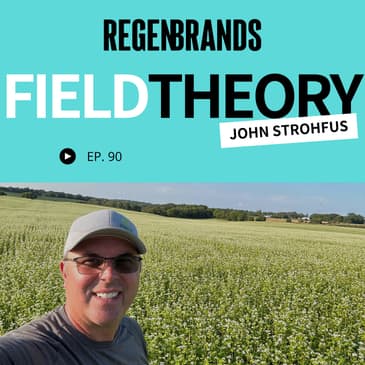
On this episode, we have John Strohfus who is the Founder and CEO of Field Theory and Minnesota Hemp Farms Incorporated.
John is supporting regenerative agriculture as a row crop farmer managing 1,000 acres in Minnesota, by working as a broker and supply chain builder with multiple brands, and by selling CPG products in the Field Theory brand that contain regeneratively grown ingredients.
In this episode, John educates us on what really matters to farmers, gives his take on conventional regenerative versus regenerative organic, and breaks down what it takes to find, aggregate, and broker regenerative ingredients for other brands.
This was a super fascinating conversation and a great one to start of the new year. John’s three-pronged perspective as a farmer, broker, and brand builder really unlocked some amazing insights. We were pumped to have him join us and hope you learn as much as we did.
Episode Highlights:
🔥 Perspective from a farmer, broker, and brand builder
🌱 Bringing hemp back to Minnesota in 2016
🚜 What’s holding farmers back from going regen?
🎯 Why we need more demand for “conventional regenerative”
👏 The lasting impact of Simple Mills’ direct trade sunflower program
🏆 What John likes about the Soil & Climate Initiative verification
⚙️ Building new direct trade regenerative supply chains
😯 Why linking regen practices to nutrient density might not work
🤔 Is CPG harder than farming?
🚀 How private label demand could help boost regen adoption
Links:
Minnesota Hemp Farms Incorporated
Regenerative Organic Certified
Follow ReGen Brands on LinkedIn
Subscribe to the ReGen Brands Weekly newsletter
[00:00:12] Welcome to the Regen Brands Podcast. This is a place for brands, retailers, investors, and other food system stakeholders to learn about the consumer brands supporting regenerative agriculture and how they're changing the world. This is your host, Kyle, joined by my co-host, AC, who's going to take us into the episode.
[00:00:34] On this episode, we have John Strohfus, who is the founder and CEO of Field Theory and Minnesota Hemp Farms Incorporated. John is supporting regenerative agriculture as a row crop farmer managing 1,000 acres in Minnesota, by working as a broker and supply chain builder with multiple brands, and by selling CPG products in the Field Theory brand that contain regeneratively grown ingredients.
[00:00:59] In this episode, John educates us on what really matters to farmers. He gives his take on conventional regenerative versus regenerative organic, and he breaks down what it takes to find, aggregate, and broker regenerative ingredients for other brands. This was a super fascinating conversation and a great one to start the new year. John's three-prong perspective as a farmer, broker, and brand builder really unlocked some amazing insights, and we're pumped to have him join us and hope you learn as much as we did. Let's go.
[00:01:32] What's up, everybody? Welcome back to another episode of the Regen Brands Podcast. Very excited today to kick off the new year with our first recording of the new year with John from Field Theory. So welcome, John. Hey, thanks for having me, guys. Great way to start the year. Yeah, we're super excited, and I'm particularly excited because I ask the same question every single episode, and this time I get to do it a little bit differently. So this is totally novel for me, so I'm super pumped.
[00:01:57] So, John, you are both, I guess, you are many things, but you are representing a brand today, an ingredient supplier, and a farmer. So most of the listeners are going to be unfamiliar with all three of those entities. So if you can, give us a quick lay of the land of each one. You know, what is Field Theory the brand? What sort of products do you have? Where can people find you today? What sort of ingredients do you supply to other businesses, and what do you actually grow on the farm? Okay. Lots of questions.
[00:02:28] I can do everything but your taxes. How about that? Okay. Well, I mean, it's tax season, so I could use the help, but if you want to start with the other things, that's why you're here. Yeah, so, you know, from a traditional CPG perspective, Field Theory has some baking mixes, and then we have some hemp products. And those baking mixes are made with hemp. They're also made with upcycled food ingredients, spent grain, number one.
[00:02:57] And those lines, along with the hemp part lines, really are three and four hero products. And we're in about 500 to 600 stores right now. We just got to add with a grouping of Kroger stores. So we'll be adding about 350 stores just after the first of the year here. We're making product actually right now. So that's kind of a great way to start 2025. Yeah.
[00:03:25] And then on the ingredient side, you know, we're serving up buckwheat, sunflower kernel. We're doing some wheat. We're working with some sorghum. Pretty much, you know, anything that comes my way opportunistically, you know, we're taking a serious look at. And really, that's the focus of that.
[00:03:51] As a food ingredient company, Field Theory is helping brands connect with a more intimate supply chain and one that's focused on regenerative sourcing. Not all of our ingredients are regenerative sourced because we have, you know, mass commodity plays that come our way as well. But for brands that are looking for value add, purposeful sourcing, that's why they're coming to Field Theory versus other suppliers. Totally makes sense.
[00:04:21] Love that you're doing that work. I'm excited to dig into that a little bit more. I think that covers the relatively, like, doozy first question I threw your way. So, I mean, it's a great at-bat and I appreciate that. I'm curious. You mentioned spent grains for the baking mixes, correct? Correct. Can you elaborate a little bit more about what does it mean to be a spent grain? Yeah.
[00:04:43] So, basically, you know, breweries are taking wheat and oats and kernza, which I know you guys are connected in with a bunch of information on kernza, which is a great regenerative grain. Those are being used in the manufacturing of beer and spirits. And that mash is essentially usually discarded after the fermentation process. And it might go into livestock feed. It might just go to landfill.
[00:05:13] And we are working with a great company that I actually invested in about four years ago called Net Zero. Sue Marshall. Minnesota connection here. Great company with Net Zero. They built some proprietary technology to recapture not only spent grain, but other products, too, like collagen from eggshells and things like that. So, really in the food waste reduction upcycling movement.
[00:05:40] But with respect to our products and spent grain, so the spent grain goes in as a wet mash, essentially, and it gets dried. And there's a kill log, five-step kill log process. Five log kill step process, sorry. And that comes out, and then we mill that in with our wheat and then blend it with our other products. And that goes into the upcycled baking mixes.
[00:06:09] And one of the benefits of not only food waste reduction, but it's a water reduction because we're using less wheat. We are, you know, subjugating or avoiding the water consumption used to grow those acres of wheat. Totally. Totally. And I guess from, like, a total food utilization perspective as well, you know, we talked about we have to be able to grow as much food in caloric capacity to feed the world.
[00:06:36] Where if you can take a food that's used once a second time for the same caloric benefit, like, that's another awesome reason to do this, you know, spent grain upcycled food movement. Right. Absolutely. Yeah. Hell yeah. I love it. One of many, many things we're excited to dive into today. And I'm pumped to have you on, John. We've been connected for a while, following each other on LinkedIn and been kind of long awaiting this conversation. You know, John is a farmer himself. Like Kyle mentioned, he helps brands with supply chain and ingredient sourcing and he has his own brand.
[00:07:06] So we really feel like you have a super unique perspective, like the exact kind of perspective we want to be uplifting on this show. But, John, take us back. Like, how did this all get started? Did you start farming first originally? For those that don't know, John's in Minnesota. So just to throw that out there, did you start the brand and then the farm and then the ingredient sourcing? Like, what was the chronology of all this and what's the origin story? Yeah. Well, I just had my 50th birthday a couple months ago. Hey. Happy birthday. Yeah. Thank you.
[00:07:35] I'm still alive and kicking. And someday I'll let you know what I want to be when I grow up. So, you know, I say that kind of jokingly, but I have always been, you know, entrepreneurial ever since I was a kid. You know, I remember being 10 years old and started a very, very, very small driveway seal coating business.
[00:07:59] So, you know, steel coat on the neighbor's driveway and I think I got paid $15 and they supplied the stuff. So, you know, that's sort of how I was always wired. But, you know, our farm, when I was growing up as a kid, my dad worked full time off farm. He was the executive at Coca-Cola. We kind of joke about Coca-Cola built our farm. And it's about 100 acre farm and we've had horses.
[00:08:26] So, we had horses our whole life and, you know, agriculture is very central around us. And, you know, we grew hay for our own horses, but we didn't row crop farm. My dad was a North Dakota farm kid. So, I feel like I'm second, third generation farmer, depending how you, you know, count. But my neighbors up until a couple years ago, they would say, John's not a farmer. Yeah.
[00:08:54] So, that's sort of how I was brought up. I never thought I would be in agriculture. I definitely never thought I'd be in the food industry. I was a sales guy, an entrepreneur, right? So, I went off to school and I was a marketing major and a microcomputer minor. And then I graduated. I spent about 19 years in the IT industry working for Accenture, the global consulting company.
[00:09:19] I got to see, you know, a lot of things, lead a lot of teams, do a lot of different cool things and also learn about business. But I never thought that those things would be part of what I'm doing today. And like a lot of things, you know, we had my dad passed and I had to figure out what are we going to do with the family farm? And I was growing less and less interested in my IT career.
[00:09:48] And about that time, we had the opportunity to grow hemp in 2016. So, my dad passed in 2008. I took over the farm in 2010. And then I started looking at our farm and, you know, how can we do things differently? We had a bunch of horse boarding still. We had 60 horses that we board to this day. You know, that's a full-time job for most. My wife kind of runs that business now.
[00:10:15] And, you know, it was just like looking at it like as a new business, something that, you know, your dad used to own and now you own it. What are you going to do? How are you going to make it better? And I started that entrepreneurial process, right? So, we had friends that bought beef cattle and we'd go in on that. And then they said, well, why don't you just have the five head of beef on your own farm? Yeah. Well, that made sense. So, then we started doing that. And now, you know, we sell beef to about 40 customers direct sourced.
[00:10:45] So, things just kind of evolved. And then in 2016, I was looking for, you know, I took all our rented land back. So, we started operating that ourselves. And then hemp came along in 2016 as the first opportunity to do that in Minnesota. I knew nothing about hemp. Absolutely. Totally ignorant. I really, I'm not ashamed to admit that I didn't know anything. Typical IT guy, you wanted to do something that was new and cutting edge, John.
[00:11:14] You know? Yeah, right. And, you know, I just said, I want to be the first person to do it. And, you know, I don't know if that was a little bit of ego or just younger energy or what. But I just knew that people, really great things happen when you are the first to do them. And certainly, I wasn't the first to grow hemp ever. But since the 1950s, yes. And so, I just said, you know, let's grow hemp.
[00:11:44] Let's see if we can market it. Let's see if we can get some processors online to process it for us and take the Canadian model and sell bulk hemp food. 100% food focused. Never had any CBD, you know, things in, you know, of interest at the time. And CBD really wasn't big. Certainly, you know, not where we're at with cannabis at large right now. And then I said, so we created Minnesota Hemp Farms Incorporated.
[00:12:13] And I said, I want to have a brand also and put this on the shelf, you know, so. And in that first 12 months, you know, we created the brand field theory. We did all the logo work and really just a real small team of people I knew or got introduced to. And we did it. So we put, you know, we grew it. We put it in a bulk bag and offered it for sale to, you know, brands if they wanted it.
[00:12:42] And we put it in our own brand. And, you know, I wasn't in a lot of stores, but I had the product and I could sell it. And, you know, then we started knocking down doors. And again, I didn't know anything about the food industry. So I learned all about food safety and all the hard knocks essentially in that first year. Obviously, still learn more every day about those sorts of things. But that was the genesis was hemp. And then now, you know, two things happened.
[00:13:11] And one, we started being asked to grow other crops. You know, John, can you grow this on your own farm? And I said yes to that. The other thing that happened was I started working with a good friend of mine to farm more land. And we rented more land. And now, as of today, we're farming about 1,000 acres. About 100 of that is organic. And that's on my own farm here.
[00:13:40] Most of the land that we operate is rented. And so we grow, you know, corn, soybeans, alfalfa. And then in organic, we're growing sunflowers, red beans, buckwheat, sorghum, as I mentioned. Anyway, I'm getting a little off track, but we started growing. We started operating a farm, you know, at a bigger scale.
[00:14:04] And then in the food business, customers started asking more about what we could grow and be in that direct trade supply chain for them. And then they also, it's totally backwards. I'm not ashamed to say, you know, our customers started asking us about regenerative. And I was like, what's regenerative, right? I mean, I know what sustainability is, and we heard, you know, sustainability and that for a long time.
[00:14:33] But, you know, that term was actually really new to me. And I was farming. So about when did people start to ask you about regenerative? Like, give us a year if you can. I would say, well, a lot of it stemmed from our work with the Simple Mills Sunflower Program. So organic, regenerative, direct trade, Simple Mills Program was the first. And we're coming up on, I think it's year five of that is our next production.
[00:15:03] Five or six, actually. No. So circa 2019, 2020 is when you're starting to get some inquiries about regen. Yeah, exactly. And, you know, I loved it. You know, I'm like, oh, okay, I get this. It's, you know, sustainability applied essentially more directly at the farm level. That's kind of how I interpret it. And I said, yeah, we can do these things. And, you know, some of those things, we had done some of those things already, like with cover cropping.
[00:15:32] But we looked at it and started to do more. And then I said, aha, this is how Field Theory Foods is going to be able to get their foot in the door and differentiate ourselves from, I'll call them the bigs. You know, if you want, you know, wheat flour or whatever, you go to an Arden Mills or a Bay State or something like that. If you want something that's really special, unique, with transparency to it, you come to us.
[00:16:00] And so that was sort of the model that, and nothing against those companies, by the way. They're great companies. And I hope they buy some product from us on the wholesale side. You know, that was the difference. You know, how are we going to be? We're not going to be always the cheap commodity play. And there's no money to be made really in that unless you're moving millions and millions of pounds. So how can you offer something that's a higher value?
[00:16:29] Did I answer that? Was that one question? No, man, that was great. I mean, you're doing a lot, so it was going to be a long answer. And I think you tied it all together really well and made a ton of sense to me. I mean, you're clearly wearing a lot of hats. But as we've seen, like, over and over again in all this work, like, the interconnectedness, whether it's the same person or different people, of these various stakeholders when we're trying to build these return of supply chains, like, they have to be way more connected and way more aligned. And I think you're a great example of that.
[00:16:58] And, you know, it's so cool. Like, we got to get Simple Mills on the pod. We haven't had them on yet, but they're definitely on the list and we will. But even though they have very few regenerative products with, like, actual regenerative claims, they've done some really amazing work with people like yourself and really standing up regenerative supply sheds, like, especially up in your neck of the woods in Minnesota. And for those that have listened to the Pacha bread episode, John is the farmer that helped them stand up that buckwheat supply chain that we talked about in that episode. So, yeah, man, really cool.
[00:17:28] Made a ton of sense and just love what you're doing. Yeah. Pacha is huge, right? That was a game changer getting us into buckwheat. And, you know, hats off to those guys because that was just a whole new opportunity for us to bring in other growers on our network as well. Well, John, I'm really curious to get your take on, I mean, you obviously farm literally a variety of different plants.
[00:17:52] You're playing in both commoditized conventional spaces and regenerative and organic and all those different cross sections. So, number one, how do you manage that from an on-farm perspective? How do you feel about it? We'll start there. We'll just start there before I ask you, like, a nine-prong question. So, like, what is it like managing that on-farm and how do those practices differ? And how do you keep it all segregated and, you know, identity preserved? Yeah.
[00:18:17] So, from an on-farm perspective, you know, you have to think about we didn't row crop farm until about seven years ago. So, literally, the plight of the farmer, I consider myself, you know, I can easily put myself in the shoes of a young and emerging farmer. If you're 18 to 25 years old and you're sitting there going, what do I want to do when I grow up?
[00:18:44] And you go, I want to be a farmer, right? That's almost at the level, like, that we were at because, yes, we had some infrastructure. We had some tractors and equipment. It was all small and it wasn't, you know, purpose-built for row crop corn and soybeans. So, that's a whole maybe different podcast about some challenges that we have in the ag industry and how, you know, I just said I turned 50, how people younger than me are going to survive.
[00:19:14] I think regenerative is a great swim lane for that. But our farm didn't really have the infrastructure, so we actually rent, you know, storage space from a neighbor, retired farmer. I send a lot of our specialty stuff, you know, from the organic side. That goes straight to the processor as fast as we can. They maintain that identity preservation and segregation for us.
[00:19:39] And then, honestly, you know, we're a lot of mostly conventional on the traditional farming side. And there's not a lot of food ingredients that's coming from the conventional side right now. So, that's, you know, what I like to do is talk a lot about this organic versus conventional because we only have so much organic land.
[00:20:01] And I would move almost all of our corn and soybeans into the specialty crops if I had direct trade buyers for those commodity. So, the short answer is we don't have to do a lot of separation on farm because we don't have a lot of these specialty products. We have most of them in the organic system, which is a smaller footprint. It's easier to manage.
[00:20:23] And then, you know, we're all contracting and working with our farmer friends who I've known a long time and get to know more every day. So, that's the source. And then, we're working in the identity preservation from each of those farms. And, John, just the organic premium, even on the commodity side, isn't enough for you to transition the 900 acres of, like, conventional to organic, even if it's just not food grade, like, commodity corn and soy?
[00:20:51] So, every farm is different and unique. And we farm 20 miles outside of Minneapolis. So, we're urban farmers. So, we have, you know, we've got fields that are, you know, 8 acres, 5 acres, 15 acres. And there's 2 or 3 houses that we have to contour farm around. A huge pain, frankly. So, people say, you know, how much do you farm? I said, not a lot of acres, lots and lots of fields. Like, I think, you know.
[00:21:22] Right. Your acres to field ratio could be improved. Yeah. Like, so, like, on 1,000 acres, you know, we probably have 40 to 45 fields. Our large field is 120 acres. And it's split between water runs and tree grows and creeks. So, it's still not a good use of track of land.
[00:21:43] Unlike farther south in the state, north in the state, west in the state, out of the metro area, where, you know, you can drive a tractor in a straight line for a half mile or a mile, turn around, come back. So, the efficiency level, much higher. Yeah. Yeah. Yeah. So, and also, it's rented ground.
[00:22:04] So, trying to, you know, talk about cover cropping and regenerating soils that you have a one-year lease or even a three-year lease is really, really hard. So, we would still love to do more of this, but it comes back to the customer.
[00:22:24] Who wants to buy, you know, whether it be sunflower or wheat or buckwheat or sorghum from a conventional farm grown in a regenerative manner? Then, as soon as I get that, yes, then we're converting acres over. But it's also access to markets. And, you know, we live right on the Mississippi River. So, our corn and soybeans go on the river down south to New Orleans, most of them. Yeah.
[00:22:51] I'm really curious to get your take on this, you know, as both a brand and a supplier and a farmer. You mentioned you were hoping to see more demand for conventional, non-organic regenerative product. When customers are coming to you and asking for something like this, are they attaching any sort of certification to that ask? Or is it just, you know, hey, can you implement these regenerative systems? Are they relying on you to tell them what is and isn't it regenerative? Like, what does all of that look like? Kyle, are you ready for the long answer again?
[00:23:22] I'm ready, man. Well, it sounds like not enough people are asking him for that in general is the first problem. That's the first problem. People aren't asking for that because they're programmed now, I think, with regenerative organic certified. You know, that's like what has from the buyer's perspective in these brands, companies larger or small, you know, regenerative is better and I want it certified. So then it's ROC.
[00:23:48] I just go back to, you know, you can have philosophical differences about what's best for the planet, what's best for our soil. But this is what I like to have people keep in perspective. Organic is one to two percent of the world's farming production. The rest of it is done in the conventional manner.
[00:24:11] So do you want to make the one if you think organic is the best, do you want to make sorry, regenerative organic would be the best. If you think organic is second best, wouldn't you rather focus on 98 percent of the world's soils and make them a little bit better than taking two percent of a good practice and making it better?
[00:24:38] I mean, you can make it really simple, right? A plus is you use a cover crop. A negative is you use a chemical. So are you doing less tillage? That's a plus. Are you using cover crops? That's a plus. Do you have a new customer so you can grow another crop? That's a plus. Oh, you're still using a chemical? Yes. OK, that's a negative. But are you using less of that chemical than you did because you're able to do this other stuff? Bam, you got another plus.
[00:25:08] So that's four pluses and one minus in conventional. If you go into the organic system and it's actually not that significant because a lot of these practices are being done already and the scale is just so much, much larger. Yeah. So that was maybe one or two answers. And then, you know, what certification? You know, again, I mentioned ROC.
[00:25:34] Nothing wrong with ROC, but it's regenerative focused only. And the one that we have sort of worked most closely with is a soil climate initiative. Number one, because they were created with a lot of farmer input for the framework. So and then they're open to conventional certifications as well as organic. And probably the most important thing is a farmer.
[00:26:01] It doesn't cost me anything to get into that program like some of the other programs that have like a three or four thousand dollar cost of entry. Also, all the paperwork and so forth. And it's also it's it's aspirational. So it's saying I'm going to baseline you where you're at today and then I'm going to measure you and you're making a commitment to do these things. And we're going to measure and make sure that you are doing those things.
[00:26:28] But it's not like some of the others where they're saying you have to do this or you're not regenerative. That, you know, that turns a lot of farmers off. So I think SCI in that sense is much more open. I'll say it that way. And then, you know, regenerifies out there, too. And I think they're got more of the soil climate type of mindset than ROC. But there's a lot of them out there right now.
[00:26:56] And, you know, it's not that one's better than the other. It's how do we kind of make sense of this? And when a customer comes to us looking for regenerified or ROC, you know, can we talk to them when we have so climate initiative verified and convince them that, you know, these are very similar. So, you know, what is their point of differentiation? And is that really important to the brand and that buyer?
[00:27:26] Yeah, tons of tons of good stuff for us to unpack. And just an audience note, we've talked about the Soil and Climate Initiative before, and we've often abbreviated it as SCI. And it actually used to be called the Soil Carbon Initiative, but they've updated the name. And the actual, like, seal on pack is the Soil and Climate Health Initiative verified seal, which there's not a ton out there yet in the marketplace. But there is some of the brands that we've had on, like Pacha and Roots Potato Chips, and I know more on the way.
[00:27:54] And we love the work that the SCI crew is doing. And like you said, John, they're really going after, you know, being inclusive and aspirational, which we feel like we need. And it's not an either or conversation. It's like everyone we just talked about, we need all of them to do good work and to succeed. And we need to make sure there's a pathway for all of them and that the market can, you know, activate different pathways, right? I'm still not super convinced that the consumer is going to be able to fully understand and articulate all of those pathways.
[00:28:24] But if we could get the consumer to understand just the umbrella of regenerative and let those all sit underneath that umbrella, I think that's possible. But it's super interesting to hear you kind of speak to it with all your different perspectives. And, you know, it's almost like I'm hearing you say it really is the brand and the customer demand, right? Having that customer, that is the initial impetus of what can you do overall, which, you know, is confirmation bias for us.
[00:28:53] But it's very validating because it's like that's why we started this whole podcast was we can talk to her glue in face about farmers adopting practices. But if no one's going to pay them for it and they can't send the product anywhere, like it doesn't it doesn't matter. And you're another good example of like there's a reason why you're farming a thousand acres and only 100 of it is organic with regenerative practices and 900 of it is conventional with regenerative practices. Because, you know, I live it right. So if anybody be doing more of it, it would be me.
[00:29:22] And so I think that hopefully for the listeners, you know, that raises some eyebrows because, you know, the farmers want to do this. They I mean, I was just said I was also I'm doing one other thing. I was elected to the Minnesota Soil Health Coalition Board of Directors. And we just had the the big soil health event a couple of months ago.
[00:29:51] And I was telling some of my brand friends, I said, can you focus some on the next two years on conventional regenerative sourcing? Because I'm in a room with like 500 farmers and there's not one of them here that really wants to continue growing standard conventional corn and soybeans. None of them. And I said, why? Why is that? Why don't farmers want to continue to grow those things?
[00:30:17] Because we're going broke, you know, I don't know what the specific number is, but we're talking hundreds of thousands of dollars a loss in the 24 crop year. High inputs, low prices. And unless you're a marketing whiz who's smarter than me, you're going to get sandwiched in that and you're going to lose money.
[00:30:40] So the farmer, you know, is talked about, you know, makes money in two out of a five year cycle. I don't know how many people are that disciplined with their own bank accounts to lose money for three years and then save it all in the two when they hit the lotto. So there's a lot of problems in the farm production and they want to grow. They don't want government payments.
[00:31:04] They, you know, they want to grow a crop, whether it's corn, soybeans or any specialty crop for a market price that that pays them a decent rate of return for what they're doing. All the food brands, you know, you can relate to cost of goods. The farmer, you know, what we do, right, in food brands, we say, hey, what's all the stuff to make my stuff? And yeah, I'm going to shave a few pennies here and whatever. And I get to buy, you know, $2 a unit. And then let's see, I want to make a 50% margin.
[00:31:34] And then because I got a discos, promos, et cetera, et cetera. But I know I need to make at least 25%. I can't. The farmer is like, okay, I need to buy all this stuff. I go buy it. I plan it and now I harvested it and I know how much I have, which I had not a lot of control on how much I have, what my yield is and my product I made. And then, hey, you know, what day is it? And now how much are you willing to pay for it?
[00:32:02] And that might be totally upside down from when you started the growing process. And so, you know, most people don't understand how sandwiched the farmer is in that life cycle. And so anything that they can do to diversify, even if it's only 10% of their production, you know, they're looking to try it. They just, they want the market. And so that's another huge thing that we do is we bring markets to these farms that don't have those markets today.
[00:32:32] Best example, 100 miles south of me, there's three growers that are growing sunflowers. They're growing some for the Simple Mills program. They're growing some more for the 7 Sundays program, which is another huge brand committed to regenerative. And they have absolutely no market. There's nobody in the five adjacent counties that are growing sunflower. So we brought that market to them.
[00:32:59] And the reason we did it is because they're doing the practices in a regenerative manner. And our brands wanted to meet and talk to and go on those farms and see how their stuff is made. And that's why we're sourcing from them. And they're also getting a little bit of a premium for that, too. That'll totally make sense. I want to kind of double back to the original question. You mentioned farmers are going broke, so they don't want to continue to grow these super commoditized crops because they're stuck in that sandwich you described.
[00:33:29] Have you noticed in your own farming when you start to adopt regenerative principles on a conventional land, does that eventually lead to a reduction in inputs? Does the soil actually rebound and require less input to make it a little bit more profitable? I'm going to give you the honest answer to that. I think because there's a lot of – I could give you the rah-rah answer.
[00:33:56] The truth is that I don't think we have enough data around that. I can tell you anecdotally what I believed before when we just had hay acres that were in hay production for five or six years. And then my neighbor who rented from us, my dad, put it back in corn and soybeans. That corn is always the best after alfalfa. And so that's crop rotation, crop diversity.
[00:34:25] That's a tenant from farming from yesteryear. That is still true today. Why is it true? Okay, this diversity aspect of it. So, you know, crop rotation is almost like a regenerative principle now, you know, akin to cover cropping. But I asked some other farmers in the neighborhood who are using rye as cover crops in the corn and bean rotation.
[00:34:51] And I said, tell me how much I can save and convince my farming partner that if we just started cover cropping with rye, we can use less nitrogen on our corn. And he said, well, I don't really think so. He said, you know, because the rye takes some nitrogen, so you're going to have to actually maybe put more synthetics in. But you're getting the organic matter. So you're getting that nutrient cycling is happening.
[00:35:17] So if you take a longer term view, your soil is going to be overall more healthy and be able to do more with less inputs and more for itself. The other huge thing that I want people to know is that farmers are always going to chase yield. You always, as a brand, want the highest gross sales, the most stores. You're always going to chase that.
[00:35:47] And, you know, people know that now, you know, it's not all about the store number. It's about how much money you made in those stores versus how much money you lost in those stores. The same is true with yield. So we're always chasing 200 bushel, maybe even 300 bushel corn in certain areas. But we actually might make more money at 180 bushel corn with less inputs.
[00:36:11] But farmers that are, you know, in it to win it, so to speak, they might start to do all these cover crop things and they might still put on as much synthetic fertilizer or more because it's exponentially boosting yield. So companies and brands that are interested in measuring from an input reduction perspective, I think they might be disappointed in that story because farmers are going to do what they do to make more money.
[00:36:40] It's not to say that we're doing worse for the soil. We're still doing better for the soil. But inputs in the conventional system could still be at a plateau or increase a little bit. I super appreciate that response because it's not at all what I was anticipating to hear. And it was so informed, like it just it's so eye opening to hear, like the realities of what's actually taking place on farm. So I just appreciate you educating us.
[00:37:06] You know, I do think, though, to put the happy face on it for the others that are listening or disappointed me with the more direct answer. In a lot of cases, I do think that those inputs will go down because in certain areas, the soils can only produce certain height of yields and they're just going to overall be doing their work with nutrient cycling better.
[00:37:32] So if we have those covers, we have new crops that we're rotating in and out. So, yes, you could get if you wanted the same yield, I believe in using those practices, you over time would be able to reduce your inputs.
[00:37:47] One of the hugest input reductions I see in the conventional side is in the chemical side because the fungicides, pesticides, herbicides, those are going to be different, different needs. And in some cases, fungicide actually problems might increase because we're introducing early on a bunch of new bugs and things like that in the soil. So some of our corn that we grow might be actually more susceptible early on to some of those things.
[00:38:17] So there's a little bit of balance back and forth. But I think generally speaking, chemical usage will go down significantly with these practices. Yeah, I mean, it's fascinating and it's super nuanced. I guess if I tried to summarize it into as short as possible, it's like we have early data that isn't super robust, that long-term regenerative systems make input reductions happen and increase farm profitability.
[00:38:45] But it's obviously not convincing enough data or robust enough data to where we have every farmer out there adopting it, right? But that's almost separate from the annual decision that you will have to make as a farmer, which is I still have to go somewhere with this crop. So if I'm going to no-till, if I'm going to cover crop, if I'm going to reduce inputs, if I'm going to do whatever, I still have to sell this for a number that doesn't completely lose my ass or I can make some money on. So it sounds like there's times where that decision is linked and there's times where that decision is like not really linked, right?
[00:39:13] And in the shorter term, it's probably less linked. And then over the longer term, it's more linked. I think in a lot of ways, we as people, I'm a data guy too. Like I would love to know way more about what's going on than I do and I'd like to see the report and drill into it, right? And draw anecdotal relationships. I think, though, as people, we seek too much data sometimes.
[00:39:44] You know, it is a lot of, you know, we're working with nature. It is a lot of art. It's like informed science, right? Or informed art. And there are Facebook groups across, you know, the country and the world. One of them is Tillage Kings. And I can tell you that the folks in Tillage Kings, you know, there's no tillers in there. There's guys with the moldboard plow still. There's hardcore regenerative cover croppers in there. I'm in there.
[00:40:13] And we're all trying to learn. So they're asking these questions. And, you know, there's farmers that are, you know, 75 years old in there. And there's farmers that are 20 years old in there. And they're saying the opposite information. So how can that be true? How can they both be saying something and it's completely opposite? Like the sky is blue. No, it's not. It's white or it's brown or whatever. So each farm's different. Each practice is different.
[00:40:42] If you no till for three years, you might have more compaction than you did when you started no till. Okay? We don't like to talk about that. So then do we plow it up or do we use more covers to get rid of the compaction? Those are both choices to make at year three if you're no tilling and you have compaction. And one is a faster fix. And you might have to do that on your farm for the economics of it. And then you get back to no till.
[00:41:09] Or you can take a longer view with the cover crop because you've got the ability to graze cattle. You know, so some people have those options. Some people don't. And we shouldn't get so prescriptive, I guess, as a summary. Like you need to do it this way. And I've heard leaders of large brands before a group of farmers say we're not going to tolerate the farmer not doing it the right way. And I was really off put by that. And I think they made a huge mistake because there is no one right way.
[00:41:39] Right. Yeah. Well, it's an interesting segue into something I'm super curious about. And I think we haven't really talked about on an episode, John. And I'd love for you to shed some light on it, which is the ingredient sourcing and supply chain development side. Like maybe not every single detail, but could you walk us through like you get the call from Pacha and they're like, hey, we need an organic buckwheat supply chain that also has a return of certification. Then what happens? Do you start growing some? Do you call farmers? Do you have your own processing facility?
[00:42:09] Do you have to find a facility? How does it work from a timeline perspective? Like just give the listeners a peek into like how these transactions and supply chains like actually come together. I think that'd be a super unique perspective to share. You don't mind. Yeah. I think let me give you two examples. So help me remember the second one. I'll start with Pacha because you brought it up. And then I'm going to give you, I'm just going to say a super large retailer who does a lot of private label. Okay. Okay.
[00:42:40] To remain nameless. Yeah. Got to cover those NDAs. You know, Pacha was great, right? So they called and they said, hey, you know, we got connected to you and, you know, we are doing this. We're sourcing buckwheat bread and we want this to be regenerative certified. And so the good news is I had grown buckwheat on my own farm a couple of years ago versus like when Simple Mills called originally about sunflower.
[00:43:10] I was like, yeah, I want to do it and we can do it. But I had never done it. And so it was a little bit more stress. So I'm like, yeah, I know how buckwheat's grown. And then also because we had been doing that work for four years or so at the time, five years, I had the grower network now to reach out to. And I said, you know, and they were like, yeah, I grow buckwheat. Or do you want to grow buckwheat? And so I said they said yes. And I said, here's the catch.
[00:43:37] You have to get certified, regenerative certified. And so I knew their practices and what they were doing in organically anyway. And I said, you know, we got to get connected to the Soil Climate Initiative and get you signed up. And they're like, well, yeah, but, you know, it's going to take me a couple of years to get certified. And I said, no, I said, you can get certified in this year one because your farm is going to be baselined. And I said, you're doing all those tentative things that are important.
[00:44:06] So you just have to essentially attest to your commitment and then they're going to check in. Right. So that is, you know, for Pacha, I said, yeah, I can do this fast. You know, we can do this fast because I have the growers who are authentically doing this. I selected the certification program that was best suited to get the immediacy of it.
[00:44:31] And then the processor, to answer that, I worked with the same processor we did for our sunflowers. So that was all in place. The catch was they had never done buckwheat, de-hauled. And so then I worked with another processor for short term up in Canada that had worked with us on hemp seed. And they were de-hauling some buckwheat. So we did it up there first.
[00:44:56] And then we moved it back here into North Dakota at the primary facility. So that was really kind of a real fast, you know, accelerate to a lot of acres. You know, so we went from kind of my home farm to a couple thousand acres very quickly. Concerning, though, because we have created a problem for ourselves because Pacha is just using the buckwheat groat.
[00:45:25] And there's a lot of waste of the small particles and so forth. And we can make that into an awesome buckwheat flower. But hopefully someone's listening out there in procurement for some big brand. You know, we don't have the person calling right now saying, I need, you know, five truckloads a year of buckwheat flower. If they did, that solves for me the other part of the revenue side to make us whole.
[00:45:52] Because actually right now we're doing this and we're actually losing money having that amazing customer and regenerating, you know, a couple thousand acres of buckwheat. And we're kind of losing money. We've got things in the works. We've got some sales that are starting in this area. But, you know, it's not easy. And there is for us in the middleman and whether it's me or another processor, aggregator or supplier, they are taking risks too.
[00:46:22] I'm more willing to do that because our whole business is being built around it. That risk and this idea of regenerative. But that also might explain why the adoption isn't huge right now. Because the suppliers and the processors and the ingredient sellers today, you know, they don't know if they can really do this because of the risk side. Right.
[00:46:48] It's almost like the supply chain infrastructure is not set up for this new, I don't even want to call it decommoditized, but this more niche market that is developing. Yeah. These little like side offshoot businesses, like you said, you've got a buckwheat grow business opportunity, but now you've got to figure out what to do with the flower. Yeah. Yep. 100%. So PSA, anyone who needs certified organic and certified SCI buckwheat flower, call John. You can contact him directly or ask us for his contact info.
[00:47:18] Right. We've got to call Bob's Red Mill, man. I mean, they do. They've got tons of buckwheat, right? They sell all sorts of buckwheat stuff. They do. They would be fantastic as a customer. I think we'd work very well together. Before you talk about the retailer, I want to ask one follow-up question of what you just laid down. And by no means do you need to reveal the actual unit economics. I'm just trying to ask a dumb question so I can understand kind of the algebra of putting this together.
[00:47:44] Do you talk to Pacha up front about like a unit price and say like, hey, we're going to buy 50 pound bags and we need the 50 pound bags to show up at XYZ dollars a pound or something. And then, you know, you have to backtrack with your growing operation, the other farmers and the processor to just make those unit economics work. And it's just like kind of basic backtracking algebra. Or is the pricing and unit economics like development different than that? It's I think it's a hybrid and it's a conversation.
[00:48:14] So this is really a great question. And it's a great for me. It's critically important to have a dialogue. So, you know, especially with the big customers, if I am lucky enough to get to the right procurement person who might buy buckwheat flour and they say, okay, well, send me your spec and what's your full truckload pricing?
[00:48:37] If I send that to them cold like that and I do it where I really want and should be to not lose as much money or actually, you know, break even or after a bid make money. I know that I'm going to be 25 to 50 percent out of market. And it's an immediate. I pay five cents less. See you later. Yeah, that's not a good fit because that's a commodity buyer who isn't appreciating the value of it.
[00:49:07] The right conversation is, you know, here's where we think the market is. Are you telling me where the market is because you've been buying from a non-regen source? Okay, it's a dollar 20. And I want to be at a dollar 75 to be whole. And oh, my gosh, that's going to kill our cost of goods. And we can't get into these retailers because of it. And, you know, we have investors, et cetera. So then it's, you know, where is that? And then maybe you land at a dollar 50. Right. So that's the dialogue.
[00:49:36] And then it's to say that's because I think I can sell the other parts of the co-product business. But these things need to be in balance. Same with sunflower. Kernel versus oil. Whole seed versus oil. Meal versus oil. It all has to be in balance. And people that are, you know, on the brand side, they don't really understand all of that nuance unless they're in that processor silo.
[00:50:07] That really makes a lot of sense. I'm curious to get your take on, you know, the buyers who might be looking at a conventional regenerative crop. Right. Are they are you really looking to sell based on like the altruistic benefits of this is a more sustainable crop? It's helping to mitigate climate change. It's utilizing less water. Or has there been any specific nutrient density testing on this conventional region ag product? And if so, is there a significant difference that can also be used to help to sell this product into these potential marketplaces? Sorry, potential marketplaces. Yeah.
[00:50:37] Let me cover one last thing on that point because it ties into this. The other point that I make to some of these larger customers who are interested in the regenerative side and they get price shock. You know, maybe it's just, you know, maybe it's just even commodity side where they want to support field theory because of the aspirational goal around supply chain being regenerative.
[00:51:07] But they don't really care about it. They don't have a market use for it right now to do on label. But they just like to buy from us. And then the price is too high. You know, pure commodity wheat. I'll make that one up. Yeah, we can go find you wheat from guys we know. But, you know, it's no one's going to make any money at that. And, you know, just keep buying from your wheat guy.
[00:51:28] The difference is, though, if we have a high value product that we offer and they want or that we don't offer right now but we can do for them, that's probably a better discussion because we've done it two times now. Some flowers and buckwheat didn't do it and then delivered. I say, can you give me some of your commodity business and pay a penny more a pound because you use 10 million pounds of this flower.
[00:51:58] So if I'm involved in the brokerage side or commodity sourcing side and I can make a penny a pound, they're not going to miss it. They're making a commitment to me, but that might be, you know, on an annual basis, that might be $20,000 of revenue that I can then subsidize the high value regenerative thing and bring that $1.50 price down to $1.30.
[00:52:24] So now we're within 10 cents of what their commodity play is because they gave me revenue opportunity on the other thing. So I lose money all the time. I'm looking at the aggregate. You know, what is the company making across all this? You know, can we make a penny here? Maybe we can make 10 cents over there and then maybe we're going to lose some money over here. But if we take this all together, does it help us accomplish our goal and get to a product that is sought after in market?
[00:52:54] I think that's a beautiful way because everybody constantly talks about the razor thin margins in farming. And you're literally advocating for one penny. You couldn't ask for a smaller figure to be paid in cash. You know, so that's pretty astounding. And you painted a really good picture of like why that one penny can be so monumental, right? Because you're dealing with such huge quantities. And I'll give you the facts. You know, I had to learn this the hard way. You know, but a lot of this stuff is straight up traded.
[00:53:22] You know, we're sourcing from known sources now and we're selling to long-term customers, right? So it's not like, hey, I need 10 truckloads of this and it's transactional. We're done. But the average margin for a broker is around 3%, maybe 5%. You know, so that might be a penny. It might be 5 cents. Sometimes it's 10, depending on the price of the unit. But the point is, it's really super slim margin.
[00:53:50] And, you know, most brands, if you guys said you're going to make 5% in your company, that's your margin. And they're like, click, no way. I mean, can't do it. I mean, what kind of horrible business model is that? So now I say, you know, if your broker is just supplying you with this anyway and they have no connection to the ingredient, you know, we at least give a continuing guarantee and a value add. And we take ownership of it, pay for it, and then we sell it. So if we broker something, we're actually owning it and reselling it.
[00:54:20] And they don't do it because they don't take possession. That 3% or, in a good day, 5% that would come to us, you know, what's the benefit that we're doing with that versus your standard broker that you might, you know, love and is a great guy to take you out to dinner every once in a while. But it doesn't help you in the other, you know, if you have aspirational things in the regenerative space.
[00:54:44] And there are, you know, some regenerative brokers out there now, so I'm not diminishing that. The industry needs brokers. They're hugely important. I'm just saying, you know, when we say no over here, you know, let's look at the macro. You buy 15 other things, you know, give us a little piece of this pie and maybe we can actually make this happen at a good commercial.
[00:55:06] John, what's the look into your crystal ball and say, like, what's the highest leverage, most transformational single thing that could happen to further develop these conventional regenerative markets? Is it that tying to nutrient density that Kyle mentioned? Is it labels like SCI and Regenified just being able to create a premium like what organic and rock has? And rocks really just has it because it's organic, right?
[00:55:33] Like, what's the thing that if the market decided it was going to happen, it was going to work? Because I think we largely see two paths. We see people making regenerative products that are premium and they're realizing the unit economics and the fact that they're selling a premium product. Or we see mainly big multinational brands making regenerative commitments and trying to get farmers to adopt practices. But they're saying we're going to sell the same products at the same prices. So this additional cost to the farmer is not going to end up in our unit economics, right?
[00:56:02] It's like, what's the rub there, I guess? Like, what's the one thing that might break that down? Well, Kyle actually asked a question last time. You brought up here again, nutrient density. I'm fascinated by nutrient density. I, you know, the nutrient density alliance and, you know, I want to, if I could spend all day and just focus on that stuff, I would do it.
[00:56:26] I think probably this, and, you know, Tina Owens, she's helped with that white paper and, you know. She's the nutrition rock star of the world. Yeah. I mean, she's one, she might be the smartest person I know. But, so hats off to Tina. Yeah. If you're listening somewhere. You know, but she makes this point really well in the study that, or the outcome of that white paper. I think the summation point was, look, we shouldn't be talking about regenerative.
[00:56:56] We should be talking about nutrient density because to be nutrient dense, you're probably going to be regenerative. So I think that is probably right. I would, I'm not going to dispute the findings of that paper because I know a lot of work went into it, a lot of good discussion. I am fascinated about this, though, as a farmer, because I know every farm is different. And you're starting with different levels of fertility. God has blessed certain areas better than others.
[00:57:26] There are heavy metals in some areas and not in others. There's environmentals. And so the question that I don't understand is, you know, around nutrient density is, if you talk about wheat, we're talking about usually protein. That's the measure of quality. Is it high protein wheat? And then what are the falling numbers of the wheat? Rye would be similar. Oats possibly to our typical grains. That's how they're graded. And protein is the measure.
[00:57:55] So if I was doing everything right for 10 years, cover cropping the hell out of all this stuff and I had great crop rotation and then I grew wheat, would my protein level that year be the highest? Or would it possibly be lower? Just because it was too warm. It wasn't cold enough for wheat. And I got a low protein number.
[00:58:19] So I might have, what I'm saying is, we might have poor soils farmed in the terrible way that no one would like. And the protein that you're, as a quality maker, might be better than the best organic or non-organic cover cropping, you know, superstar. Yeah. So what are we measuring? You know, is it all the other stuff that, you know, is outside of protein?
[00:58:42] You know, the vitamins, the minerals, you know, the amino acid profiles and all these other things that make that up. But, you know, we have to get a lot more data, in my opinion. And then what I fear is that we'll be marketing nutrient-dense crops from soils that, you know, aren't that good. But they're, for whatever reason, hitting nutrient-dense profiles.
[00:59:09] And then there's a lot of really great farmers doing things in a great way. And then the measurement of their crop actually might not be what we would consider more nutrient-dense. Yeah. I think generally, you know, if you had to make anecdotal and general statement, the farming practices should support higher nutrient density.
[00:59:34] I emphatically believe that, but how the data comes about, I think, is decades to us. John, I love and hate everything you just said for so many reasons. But in particular, and this is what I'm so grateful about to be, you know, included in a podcast like this is I get to learn so much. And as I've, you know, what episode are we on? This is episode 90. You know, in the 90 episodes of doing this, I keep realizing how complicated our food system is.
[01:00:04] And the way you just spelled that out, because, you know, let's take General Mills, for example, who sources oats from, I don't even know how many thousands of acres, hundreds of thousands of acres across probably the planet. So to your point, if they're focusing on nutrient density, you know, are all of those different systems, even if they're using the exact same regenerative practices, going to yield the same, quote, level of superior nutrient density across the board?
[01:00:28] And the answer is obviously no, just because of different soil types, different climate systems, different, you know, heat waves. Different seed, different genetics. Yeah. I mean, it's so, so, so complicated. So as much as like in my mind, my simple mind, I'm like, hey, just optimize for nutrient density and it solves the problem. But you just blew a hole in that theory, which is a very valid, you know, you poked a good hole. Well, I think so. Yes, you have summarized.
[01:00:56] It's a it's a big problem when we talk about scale, because it's really easy to, you know, go in your garden, do everything amazingly awesome. And then you do it for two years. You get your soil, everything perfect. Then you grow a tomato and you go take a tomato to the lab and it's the most amazing tomato ever. But is it going to feed, you know, two or three hundred thousand people that way? You know, so we have to have scale in mind.
[01:01:23] But yeah, I mean, things are complicated. Okay, so we've spent a ton of time talking supply chain, farming practices, different markets, developing markets, and really got another rabbit hole. We are Regen Brands podcast. So let's bring it back to the brand. Tell us a little bit about your experience launching the brand field theory and what those retailer conversations have looked like. What have you learned in some of that process? I'm going to I'm going to probably upset a lot of people again. Yes, John.
[01:01:53] You can like that on the show, John. Don't worry about it. We got your back. And I should I should have my wife on the podcast to talk about this. You know, the CPG business, it's a horrible business. It is so horrible in a couple of different ways. It costs so much money. It's so hyper competitive.
[01:02:15] And, you know, then you get into distribution and you guys could have, you know, what you're on 90 what you could have probably 100 podcasts about the horrors of, you know, brand distribution and all the challenges there. John, I hate to interrupt you, but I just I need to know just in one word, what's harder to be a farmer or a CPG brand? Equally, you probably lose more money in CPG. And you can lose a lot of money in farming really quick.
[01:02:45] Wow. OK, sorry to derail you. I just need to get a hot take there. So I would say the silver lining in the farming side, which supports it, is that you generally have assets. Most people talk about, you know, farmers become rich when they stop farming and sell their assets. Otherwise, they're, you know, losing money along the way. But, you know, I'm self-funded with everything we've done. Right. Right.
[01:03:13] And and that and that's not really true. Like, you know, my my dad left me some money when he passed, unfortunately. And, you know, hopefully I've used that for good purpose with my family and doing what we're doing here. But, you know, at scale, it's me and it's my wife and our bank account trying to do this. I never wanted to go. You know, people ask me a lot, like, you know, well, are you funded? You know, how do we invest and things like that?
[01:03:39] I've never wanted to take on all that money, although I would like to pay myself a nice salary. That would be great. And I live off of some savings. But I didn't want to be beholden to people dictating what we're doing because this is so fast moving. I mean, when I started in 2016, eight years ago, I think. Yeah. You know, it was all hemp and I didn't know anything about anything of these other commodities that we're working with and specialty regenerative stuff.
[01:04:09] And, you know, the term pivot, I don't know how many times I've pivoted, we would have done quite a few 360s for sure in that time. So, you know, that's helped us be nimble and be immediately responsive to new opportunities. But, you know, CPG is hard, right? You got to get the product and then, you know, hopefully, you know, it's a good product that you're making. It's differentiated and unique. And then you got, you know, branding and packaging and all that.
[01:04:38] But then at the end of the day, you have to go in this horrible process of retailer by retailer. And, you know, whether you have a sales management team in-house or brokers and you're knocking on doors and you're saying, and then it's like, yeah, send me samples. And then I had this vision of an office filled with hundreds of boxes. And did they even open the box in my same room? Right.
[01:05:05] And then, you know, again, probably topics for many other podcasts. You get in the door and then, you know, what's the sell through? What's the velocity? And so, you know, we went from one product, hemp hearts, to, okay, we need the oil and the protein. It was everything we had in bulk. We can just put it in the CPG bag and there it is. And so now at least we can go to a food show. We can have five SKUs and we have organic and non-organic.
[01:05:34] But guess what? You know, hemp protein doesn't really turn in a bag, you know, because there's all these blended proteins that you can put in your smoothie. Hemp seed oil, which I've marketed through Field Theory as a culinary oil, specialty oil, like an avocado or, you know, something like that. Instead of how it had been marketed as, you know, in the health and wellness section in the refrigerated cooler with a really ugly brown bottle. Guess what?
[01:06:04] That didn't work really either because not a lot of people know about hemp seed oil. So in the hemp SKUs of CPG, you know, we were pushing hemp is good for you. Hemp is good for you. Hemp is good for you. And it's the same thing we were saying in the bulk side of the business. And a lot of people know that and they buy bulk hemp from us and they put it in their formulas. And then I always tried to introduce new innovative ways like you have a pancake. Why don't you put some hemp protein in there?
[01:06:34] You can do it. It doesn't have to taste gross. It doesn't it can give you this protein bump. And then I said to myself, why aren't we demonstrating that in other products? So that was how the upcycled baking line started. I said, I want to have upcycling in there. I want to have hemp in there because it's demonstrative of the value of the hemp ingredient. And that was core to our business. And then I want it to taste really good and be different.
[01:07:02] And so that was, you know, the pancake and then the chocolate muffin. And then I made a huge mistake. Because, again, I don't know anything about food, guys. I'm, you know. You're just a farmer supplier brand. But, you know, none of us know anything about food. It's why I keep learning. I'm just like an IT guy. And, you know, yeah. Anyway, little beknownst to me, you know, pancakes and muffins, well, you can bake them both.
[01:07:31] They sit in different categories. Okay. So now I have the brokers out there doing pitches on pancakes, pitches on muffins. And then they're like, oh, this is awesome. You know, tastes good. You know, it's a great story. You know, we want to support this. Yeah. Guess what? Well, what other SKUs do you have for pancakes? What's your line extension?
[01:07:55] And after two years of that, you know, I kind of went back to, because our velocity wasn't very good in some of these areas, pulling the stuff back, SKU rationalization. So now we have pancakes, muffins, and then the hemp hearts and conventional and organic. So those are the four that we're really going to market with right now.
[01:08:16] You know, as I said, we got the Kroger subsidiaries, the Kroger specialty brands, you know, is picking us up about 350 stores. That's for pancake and muffin. And then the thing is, so what's next? How do we do the line extensions? And so now we want to build out, hopefully after the success there, we get that flywheel moving, and then we can build out the line extensions there. But not necessarily everything will have hemp in it. Not everything will be upcycled.
[01:08:45] You know, the daunting task of being another tortilla chip on the aisle, you know, haunts me. But I eat a lot of tortilla chips, and I would love to have that, you know, in our brand. And there's things that you want to do and then things that you should do.
[01:09:02] But basically, the other thing that I really wanted to do is, you know, you hear retailers talking about their sustainability, regenerative, carbon reduction goals, all this kind of stuff, right? So I want them to have our attention somehow and know what we're doing in the middle to support all these brands that are on their shelves that they love, and they love what they're doing and how they're sourcing it.
[01:09:30] Well, guess what? They're sourcing it from us. And I would love for them to have knowledge of that and then say, okay, let's bring this brand in because they're so important to all the other brands that are on their shelf. And then more importantly, back to that dialogue, if these sustainability, regenerative goals, carbon reduction, whatever you call them, are important to them, let's partner and say, look, we only have one pancake mix. We only have one muffin mix.
[01:10:00] You know, we probably shouldn't do blueberry because I'm not that smart, but I know that there's in most stores, there's like four brands of blueberry muffins. So what kind of muffin number two do you want? And we'll go create it. And we're so small that we can create this stuff and have it to market in like three to five months. I mean, super, super fast.
[01:10:24] So if we get the right retailers who want to support this stuff, you know, that's how I want to build out our line extensions for those initial products. I think it's a great call. The collaborative innovation route, you know, start small with a handful of close retailers who believe in the mission, get some input and develop what they want to see to differentiate themselves to have success in that initial marketplace. And then you've got some sort of tried and tested unit you can take elsewhere. Right.
[01:10:52] So I think that's a brilliant model and move. So just commend you for that idea. Yeah. Yeah. I can't even understand your frustration, John. I don't want to speak for you. So feel free to correct me if you feel differently. But like my perspective as the person listening to all these people and kind of aggregating the opinion or the assessment or whatever is like regenerative today economically has been a good win.
[01:11:19] Like it's made the rich richer, like the rich that were already regenerative and we could easily slap the label on and Whole Foods could make the claim. Like it was great for them because there really wasn't any change and there was no real cost and there's no real building that occurred. But people at the Vanguard that are really building and really have skin in the game and maybe haven't made a ton of money or aren't super profitable from it yet have yet to really see the multi-stakeholder buy-in from retailers, distributors, processors, whoever, depending on what stakeholder they are, that they deserve.
[01:11:49] And look, that's just free market capitalistic society. Like that's what we live in. There's a degree of that that we can't control. And I think one thing we're always trying to ask ourselves is like, what's the proper way for us to advocate for that without really asking for charity and then get specific enough with like whatever the advocacy or requests are so we actually can change some stuff. Like instead of saying we need to have these more conversations, it's like retailers should take 3% less margin on regenerative products.
[01:12:16] Like we need to codify it and make it programmatic and we just, we still are not anywhere near doing that. Well, one of the biggest challenges that I see again, sitting from, you know, the brand side is one thing that's a broker calling sampling and buyers, right? Or brand curators. And then there's the whole private label business, which is more aligned with our sourcing side. And, you know, we work with some coal packers, right?
[01:12:45] And so we'll get calls. This really large retailer that does a lot of private label, they want 20,000 bushels worth of ROC certified oats. And they want to do a packing run in three months. Can you do it? And I'm like doing math, right? And then I'm like, and this was a couple of years ago. Yeah. I'm like, yeah, I can do it.
[01:13:12] I can, you know, I know where half of that is and then I can probably find the other, but I don't really think there's a lot more. And then they say, oh yeah, by the way, this was just like in the oat flake. And then they want quick oats and steel cut and, you know, a couple more oats. And they all want to be, and I said, well, what's the volume in that? Well, 20,000 each. I was like, okay, so now we're talking about over 100,000 bushels of ROC oats. And I said, I guarantee you that that does not exist in the world.
[01:13:43] And so to my point earlier about the adoption of ROC, great job in their marketing branding people. And so now this particular retailer who's doing private label, they're all in on it. They're like, I want to buy everything and I want everything to be. But that just illustrates that they don't understand the practicality of the supply chain. And so then I think about the other labels.
[01:14:08] So, well, maybe if they weren't so fixated on organic, they could look at every single one of their SKUs being regenerative certified. And so that's what they're doing. In that private label brand. And that would be hundreds and hundreds and thousands of acres of different crops and commodities that could be tooled, change the farming practice, get the certification and do it.
[01:14:36] And we can't do it in one year, but we could probably do a lot of it in two. And so that's sort of the education side up the stack. And then, you know, the last thing on that point is the private label buyer, they don't know anything about the shelf brand sourcing people.
[01:14:58] So if they're talking to us through an intermediary of a Copac or something like that, but if we're in the percussion and they're saying, you know, hey, oh, this is great. We can get regenerative oats in our private label brand. And then the buyer, when we come along and let's say we put oats in a bag on the shelf, you know, because they want it branded, you know, we could give them a hell of a deal, right?
[01:15:28] Because I'm making all this money supplying the commodity for the private label and then I'll put it on the shelf almost for free, basically. And our brands should have more value because they know that that's also a regenerative play. But no, there are other established players there. And the main point is in those big companies, they don't talk to each other. Right. You know, this buyer is segregated from this buyer and that buyer.
[01:15:54] And then the sustainability people, they're probably like in 52 offices down the hall and they're not in the important buying meetings. Yeah. Absolutely. I want to reiterate something that you've mentioned twice now and just about the scale of, you know, 1.5, you know, roughly 1 to 2% of all arable land in the world is organic, right?
[01:16:16] And to your point, making that 1 to 2% 50% better by making it regenerative organic or providing some level of market validation for conventional regenerative products and making that other 98.5 or 98% of all arable land maybe 10 to 20% better. That's right.
[01:17:02] That's right. And it's going to help us lose less money this year. But I'd rather sell a specialty crop that's regenerative verified in my conventional system and not need that check. So that is another just hugely critical thing. The farmers want other things to grow. How is the food industry at large going to give them other things to grow?
[01:17:29] And then another huge point that came up in my mind when you were talking about some other things is the importance of in this commodity play where we might make a penny, but we get the business. You know, so then it's a shift of, you know, where is that supply coming from? And how important is, I like to talk about North American grown because Canada is so hooked in and such an awesome, you know, value trading partner and Mexico too.
[01:17:58] So if you think of North America versus foreign, right? You know, we have a huge patriotic energy in this country, no matter what political side of the aisle you're on right now. And, you know, why aren't we using more food grown in our own country? Farmers, you know, ethanol system got built the way it is.
[01:18:25] You can have a mix of clean energy, green energy, ethanol is part of it, nuclear is part of it, all that. But if we start taking that away and we start moving away from ethanol, you know, what are the farmers going to do? They're growing corn and they're going to grow, you know, stupidly, myself included. We're going to grow corn every year, no matter how much money we're going to lose on it in some way. So we need to give them something else to grow.
[01:18:53] And there's a lot of things growing along around the world. And there's a lot of companies that are using foreign sourced ingredients and they're doing it for a lot of different reasons. Either they can't get it reliably here or they need to meet a cost of goods. But let's work with them and start blending that. So if they're buying 90 percent of something from over there, we can grow it here. We can grow anything here pretty much.
[01:19:19] So let's start having a conversation with them around a certain percentage of North American grown. Well, I think I think you just answered the final question there, John. And like most episodes, the whole episode is probably an answer to the question. But my summary of what you just said there is like the food industry and the government need to create a pathway for farmers to grow food and grow it regeneratively. Right. Like there's a link to this there.
[01:19:50] But super informative conversation, man. This has been awesome. I will take us home with the final question, which you're happy to to, you know, expound whatever else is left that we haven't covered yet. How do we get regen brands that 50 percent market share by 2050? Just get started. Every brand owner has ingredients that they buy and just get started. That's what I'd say to my farming friends, too.
[01:20:20] I would talk. I talk to them about organic and I say, you don't have to convert your whole farm. It's probably impossible from a physical labor perspective. Start with one percent of your thousand acre farm. Then move it to 10. Maybe you never go over 10, but get started. Capture some additional value. Diversify. We talk about diversity in investing. Talk about diversity in cultures and people.
[01:20:47] Why are we not being diverse in our sourcing models? And they it's hard work. It's paradigm shifting. Sometimes it's more expensive in the short term, but not the long term. And there's companies out there now to help them do that. So let's get started. John raises his hand. Yeah. He put his hand in the air. Yeah, we're here. John, I love that answer. And it actually reminds me. You must have hands do that. Okay. Yeah.
[01:21:17] Unless they're watching on YouTube, which is some people. Sorry, John. Some people do that. You know, who's got time to watch? I mean, no. For those who do it, awesome. Great. I just, you know, I look terrible in front of my screen all the time. Anyway, I really like that answer. Just start, you know. And I think it actually reminds me of something Christy Lewis said. Who AC, was that episode one? That was episode one. So 190 linkage. Yeah, we're going like full circle here, literally.
[01:21:42] And if memory serves correct, what Christy talked about is like, look at the LOI. And if you can't afford to go full regen on your primary ingredient, find something else down the list and reach out and work with that supply chain and just go one by one. So I think it's a great, great concept. And it doesn't have to be, you know, AC mentioned this to me when we first met. It's like progress over perfection. You know, you don't have to be 100% rock today. You know, can you get one ingredient to be conventional regenerative? Or sorry, conventional regenerative.
[01:22:13] So it's a great answer. And I really think that's what will move the needle, you know, is just starting to transition. Yeah, 100%. This has been amazing, man. Thanks so much for joining us. Great way to kick off the year. Really appreciate you. Thank you. Thank you guys so much. I appreciate everything you do. I love all the brands that are plugging into you and getting voices on your platform. And just so appreciative. Thanks again. Appreciate you, John. Thanks, man.
[01:22:41] For transcripts, show notes, and more information on this episode, check out our website, regen-brands.com. That is regen-brands.com. You can also check out our YouTube channel, Regen Brands, for all of our episodes with both video and audio. The best way to support our work is to give us a five-star rating on your favorite podcast platform and subscribe to future episodes on Apple Podcasts, Spotify, and YouTube. You can also subscribe to our newsletter, The Regen Brands Weekly,
[01:23:10] and follow our Regen Brands LinkedIn page to stay in the know of all the latest news, insights, and perspectives from the world of regenerative CPG. Thanks so much for tuning into The Regen Brands Podcast. We hope you learned something new in this episode, and it empowers you to use your voice, your time, your talent, and your dollars to help us build a better and more regenerative food system. Love you guys.