
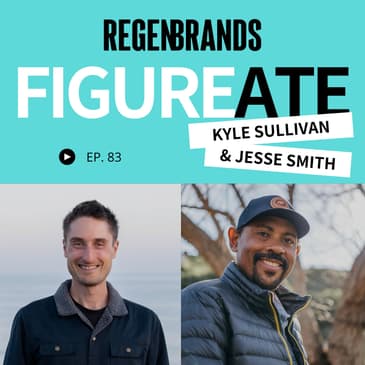
On this episode, we have Kyle Sullivan & Jesse Smith from Figure Ate Foods and the White Buffalo Land Trust. Kyle serves as the Director of Marketing and Communications while Jesse serves as the Director of Land Stewardship.
Figure Ate is supporting regenerative agriculture with their persimmon vinegar and beef biltong products, and the Figure Ate brand is a part of the larger White Buffalo Land Trust non-profit that is stewarding the 1,000-acre Jalama Canyon Ranch and serves as a global hub for regenerative land stewardship, ecological monitoring, research, education, training, and enterprise development.
In this episode, we learn about why developing demand-building enterprises supporting ecological stewardship is a major key to regenerative success, Kyle and Jesse share the journey of launching the brand, formulating the initial products, and selling across multiple sales channels, plus we learn about some new projects and products they have in the works.
Episode Highlights:
🌎 Creating a global hub for regenerative agriculture
⁉️ Why does a non-profit have a food brand?
👉 Building enterprises that support ecological stewardship
🤯 The ecological complexity at the Jalama Canyon Ranch
🍶 Why persimmon vinegar was product #1
🔥 Developing domestic Elderberry supply + new products
😡 Dealing with legal and regulatory challenges in marketing
💪 Leading with nutrition claims on packaging
👀 New biltong flavors coming soon
💫 The quorum of energies that will scale regenerative
Links:
Partnerships for Climate-Smart Commodities
State of Regenerative CPG Report
Follow ReGen Brands on LinkedIn
Subscribe to the ReGen Brands Weekly newsletter
[00:00:12] Welcome to the Regen Brands Podcast. This is a place for brands, retailers, investors, and other food system stakeholders to learn about the consumer brands supporting regenerative agriculture and how they're changing the world. This is your host Kyle, joined by my co-host AC, who's going to take us into the episode.
[00:00:34] On this episode, we have Kyle Sullivan and Jesse Smith from Figure Eight Foods and the White Buffalo Land Trust.
[00:00:41] Kyle serves as the Director of Marketing and Communications, while Jesse serves as the Director of Land Stewardship.
[00:00:49] Figure Eight is supporting regenerative agriculture with their persimmon vinegar and beef biltong products, and the Figure Eight brand is a part of the larger White Buffalo Land Trust nonprofit that is stewarding the 1,000-acre Jalama Canyon Ranch
[00:01:03] and serves as a global hub for regenerative land stewardship, ecological monitoring, research, education, training, and enterprise development.
[00:01:11] In this episode, we learn about why developing demand building enterprises supporting ecological stewardship is a major key to regenerative success.
[00:01:20] Kyle and Jesse share the journey of launching the brand, formulating the initial products, and selling across multiple sales channels.
[00:01:27] Plus, we learn about some of the new projects and products that they have in the works.
[00:01:31] This was a fun one, y'all.
[00:01:33] Jesse and Kyle are dropping some serious knowledge throughout and sharing a true peek behind the curtain of what building and growing Figure Eight looks like.
[00:01:41] Let's dive in.
[00:01:44] What's up, everybody?
[00:01:45] Welcome back to another episode of the Regen Brands Podcast.
[00:01:48] Very excited today to have our friends Jesse and Kyle from Figure Eight joining us.
[00:01:52] So welcome, fellas.
[00:01:53] Thanks so much.
[00:01:54] Great to be here.
[00:01:55] Yeah, great to be here.
[00:01:57] If Kyle was here, he would say, we're stoked to have you because that's a signature phrase at this point in the podcast.
[00:02:02] But it is just me today and we are equally stoked to have you even with Kyle not being with us.
[00:02:08] But for those that aren't familiar with Figure Eight, give people a little bit of lay of the land of just what y'all make.
[00:02:13] Where can people find your products today?
[00:02:15] Sounds great.
[00:02:16] Yeah, we're Figure Eight and we are actually unique in that we are a part of White Buffalo Land Trust, which is a nonprofit in the space.
[00:02:24] And we make three different SKUs currently.
[00:02:27] We have two different flavors of beef biltong and then we also have a persimmon vinegar.
[00:02:32] So kind of a unique spread.
[00:02:35] Yeah, I have not tried the persimmon vinegar yet, which feels like a sin and a shame.
[00:02:39] We got it. We got to fix that. I've had both the biltongs. They're phenomenal.
[00:02:43] And I will say that the video montage on the homepage of like the salads and the uses of the vinegar, I'm I'm ready for some persimmon vinegar.
[00:02:51] I never thought I'd say that, but I'm I'm ready for some persimmon.
[00:02:53] Well, you might have tried it without knowing it because we do use the persimmon vinegar in the manufacturing of our beef.
[00:02:58] So we can talk about that later.
[00:03:01] Nice. Perfect. Perfect. Cool.
[00:03:03] Well, you know, Kyle, you just mentioned that Figure Eight is part of this bigger organization, White Buffalo Land Trust, which is a 501 C3 nonprofit.
[00:03:11] Y'all have a big ranch in Santa Barbara County.
[00:03:15] You're doing all kinds of fun stuff. So, Jesse, maybe fill us in on kind of the entire origin story of this of this bigger organization and also the food brand itself.
[00:03:23] Yeah, for sure. Thanks for teeing that up. So, White Buffalo Land Trust was founded in 2018.
[00:03:30] And as you mentioned, a nonprofit really devoted to the practice promotion development of regenerative agriculture.
[00:03:37] We recognize, you know, we were in a unique time that people were really taking a deep look at ecological health, human health, economic health and kind of how agriculture played a critical role in the middle of all that.
[00:03:51] And so through the lens of soil, water, biodiversity, human health, we really look to impact these fields of food, fiber, medicine production.
[00:04:02] You know, our organization really put out a theory of change where we always wanted to be direct land stewards ourselves.
[00:04:09] We wanted to have our feet on the ground, our hands in the soil.
[00:04:11] We wanted to be doing the work that we felt was needed to be demonstrated.
[00:04:17] And so, you know, we started with a flagship farm back in 2018, a small, you know, 12 acre ranch, mostly focused on perennial agroforestry orchard crops.
[00:04:29] But through that lens, we were able to engage with our community.
[00:04:32] We were able to bring out farmers and ranchers.
[00:04:34] We were bringing out students, policy advisors, teachers of all kinds, you know, and just getting people's hands in into the work.
[00:04:43] But we also recognized that there was a much larger impact that could be had that needed to be had for our organization.
[00:04:49] And that kind of kicked off with the capital campaign in 2019 to acquire the rights to steward Halama Canyon Ranch, which is the thousand acre ranch here in northern Santa Barbara County.
[00:04:59] And that's really now our Center for Regenerative Agriculture and where the rest of our fields of focus really take shape.
[00:05:05] So beyond the land stewardship, we really have a deep investment in our continual learning, our research, our monitoring, our data collection.
[00:05:14] And with that, we know we need to share everything we learn.
[00:05:18] So our education, our training, our community engagement programs.
[00:05:22] And then after that all kind of rolls up into our kind of product development and enterprise, knowing that this stuff needs to be in the marketplace.
[00:05:30] So, you know, we've built an amazing team that kind of cover all those different fields of focus.
[00:05:35] You know, we kick started our food brand very early on in the company.
[00:05:41] You know, much of the kind of origin stories of that food brand extend back actually prior to the founding of White Buffalo Land Trust.
[00:05:49] And happy to kind of open that up here in this discussion if it is of interest.
[00:05:55] But the core of it really being that Figure Eight was designed in a way to highlight what we felt was a priority within the field of regenerative agriculture.
[00:06:05] Priorities such as the re-perennialization of our food system and climate appropriate tree crops, the proper integration and management of livestock through holistic and adaptive managed grazing.
[00:06:19] And the kind of human health component of how we preserved, how we processed food, how it was stored and what we were trying to address through the kind of nutrient needs of a diverse human population.
[00:06:36] So, you know, there's a lot in there. There's a lot of ups and downs. There's a lot of wins and bumps and bruises.
[00:06:42] But for the most part, it has been quite an enjoyable ride because of the fact that our community, our customers have really responded well to not only the mission of the organization, but the products and offerings of the food brand itself.
[00:06:57] Love it. Yeah. And that certainly resonates with, I think, our work because we feel like this whole branding piece and building these food brands has to be a part of this whole regenerative thing.
[00:07:07] You know, whatever that whatever that looks like. So two questions come to mind.
[00:07:13] What what what all are you all doing at the at the ranch just in terms of agriculture production wise?
[00:07:19] And then, two, can you can you fill us in on some of more details on the origin story of the brand of like why was a food brand such an integral part of the overall vision for the work that why Buffalo wanted to do?
[00:07:30] Yeah, for sure. So the the ranch itself, as I mentioned, a thousand acres.
[00:07:35] There's actually a closed caption catchment watershed at the top of the San Ynez watershed here in northern Santa Barbara County.
[00:07:43] And it's really depicted by this tapestry of ecological sites that span kind of pasture grassland, oak woodlands, coastal sage scrub, repairing corridors.
[00:07:57] You know, where streams flow, you have a different vegetation pattern where there's more water and in the managed agroforestry of orchards and vineyards.
[00:08:05] And that that patchwork very indicative of Santa Barbara County, California, Mediterranean climates around the world.
[00:08:13] I like to say we're topographically diverse, which means we're really hilly.
[00:08:18] You know, we don't have a lot of flat land, so we don't do a lot of annual cropping.
[00:08:22] But that also plays a lot into why we identified this this land base, because agroforestry and adaptive managed grazing was a big priority for us.
[00:08:31] So we do run grass fed, grass finished beef operation here.
[00:08:35] We finish north of 130 to 150 head of cattle a year.
[00:08:42] We work with another amazing regenerative beef producer and direct consumer institutional seller beef company here in California called Richly Regenerative.
[00:08:55] So we're one of their suppliers.
[00:08:58] We also manage a vineyard.
[00:09:00] It's a small five acre vineyard, mixed Chardonnay and Pinot Noir.
[00:09:04] But it had historically been conventionally managed vineyard.
[00:09:08] And we've been able to demonstrate over the last three years what a transition process to a regenerative organic certified vineyard would look like.
[00:09:16] And so we're actually in the final throes of that application process right now after that three year transition process.
[00:09:22] Everything from cover crops to compost, bringing sheep and goats into the vineyard to graze, biological inoculants, hedgerows, habitat creation.
[00:09:32] But primarily it makes great wine.
[00:09:36] And we have a fantastic partner with some wine making aficionados down here in Lompoc, Sashi Mormon, Rajat Par with Sandy Wines.
[00:09:47] And Sandy Wines makes our private label that's an estate designated vintage.
[00:09:51] And they've done some great accolades for our wine in the last few years.
[00:09:56] So that's exciting.
[00:09:59] And then there's a host of smaller and emerging enterprises that we're working with other partners to focus on.
[00:10:06] Our sage scrub where we're managing for fire mitigation and habitat creation while also distilling essential oils and hydrosols to go into kind of bath and body with Flamingo Estates.
[00:10:19] You know, we're making soaps and candles and facial toners and stuff like that.
[00:10:24] And some of the things that we have on the horizon that we're really excited about are elderberries, a native crop, perennial tree crop, very drought resistant, climate appropriate.
[00:10:35] And so we have a five year project that we just kicked off that's USDA grant funded to focus on elderberry production, processing, product development, all within the central coastal region.
[00:10:45] Oh yeah.
[00:10:47] Forest farm mushrooms and agave are on the docket next, but we'll talk about those at a future podcast.
[00:10:52] Jesse's running out of room on the page to like list everything off.
[00:10:56] There's a lot going on.
[00:10:58] Man, y'all are managing some amazing complexity there.
[00:11:02] For someone that's probably less ecologically literate than you, you two.
[00:11:07] Sage scrub.
[00:11:09] Give me an education on sage scrub.
[00:11:10] I'm not familiar with that.
[00:11:11] And then the watershed catchment or the word you use there at the top, Jesse, define that for us.
[00:11:17] Yeah, for sure.
[00:11:17] So please pull me back if I'm throwing around any terminology that needs to be unpacked.
[00:11:23] But coastal sage scrub is just a vegetation composition.
[00:11:26] So there's specific native species of sages, of chamis, of oak, of elderberry, of poison oak.
[00:11:38] You know, and so it has a very distinctive growth pattern, height, density, and relationship to native pollinators, birds, and mammals and predators.
[00:11:50] And so it's incredibly valuable for an ecological sense.
[00:11:55] However, it has been a point of contention amongst both ranchers and developers or, you know, within the what's called the WUI, the wireland urban interface, just because it burns fast and it burns hot and it's not great forage.
[00:12:12] So ranchers much rather prefer some nice pasture to feed their cattle on.
[00:12:16] And if you have some development or built infrastructure near it, it's kind of a worrisome proposition to have it too dense or not managed.
[00:12:24] And so what we're trying to do is maintain its ecological kind of contribution and benefit while also finding enterprises in order to manage it appropriately.
[00:12:34] And that's, you kind of talk to us managing complexity.
[00:12:37] Much of what we do here is kind of a call and response with the land itself in which we do our best to identify what each ecological site, the kind of grass, oak, sage, riparian, like what it is needing, what ecological function is maybe lowered or has a higher potential, and what enterprise could be prescribed in order to address that.
[00:12:58] And so the elderberries and the riparian, the cattle and the grasslands, the oils and the sage, the mushrooms and the oaks, like those are all enterprises and products that we feel can be supportive of our stewardship of those parts of the land.
[00:13:15] And that's why when you deal with this Mediterranean climate and this patchwork, this tapestry, there's so much opportunity and potential, but it is a complex management proposal because it's not just one thing.
[00:13:26] Mm-hmm.
[00:13:27] Mm-hmm.
[00:13:27] Well, that's music to our ears because this is all about how we create market demand for all this stuff that we're growing on the land regeneratively.
[00:13:35] Was there a specific thing like that that inspired Figure 8's origin, or was it just broadly like the idea that that was coming down the line?
[00:13:42] Like where did the Figure 8 story kind of tie into the ecological story?
[00:13:47] Yeah.
[00:13:48] Yeah.
[00:13:48] So maybe I'll back up prior to even Figure 8 and share a little bit about the journey that led us there.
[00:13:56] So my wife, Anna Smith, and I used to manage with her family and our friends kind of a multi-enterprise farming operation just south of Santa Barbara, a place called Casitas Valley Farm.
[00:14:13] It was a multi-generational, multi-family member, multi-enterprise.
[00:14:17] We started with a organic creamery making artisan cheeses, fresh and aged cheeses.
[00:14:23] We managed orchards of 16 acres of avocados, four acres of persimmon, three acres of apples.
[00:14:31] We ran a heritage breed piggery where we were feeding our heritage pigs off of the organic way from our creamery, the fruit from our orchards, the brewer's mash from the local breweries.
[00:14:42] And then we had an amazing kind of bio-intensive market garden mushroom and microgreen operation, all with kind of integrated education.
[00:14:51] So it was a 50-acre property in total, but there's so many different layers to it.
[00:14:57] And I would say that there was two or three main learnings that came out of that that kind of inspired Figure 8.
[00:15:04] One was this experience that we had running the creamery in which we were buying organic milk from Northern California, usually from either Strauss or Clover Stenetta.
[00:15:19] You know, they were, you know, larger but organic family-run dairies.
[00:15:23] And our tank was 600 gallons.
[00:15:25] We'd drive it down the coast and we'd bring it into our creamery and our vat was 300 gallons.
[00:15:29] So we had two batches we could make.
[00:15:31] The first one was into fresh cheese.
[00:15:33] We made curds.
[00:15:34] We made fetas.
[00:15:35] You know, we made some gloomy rind bris for a while.
[00:15:37] We had a famous organic olive oil submerged feta with herbs and spices.
[00:15:43] It's like the best spread in the world.
[00:15:45] But then our second batch was aged cheeses, jacks, cheddars, stuff like that.
[00:15:50] And, you know, cut to, you know, a couple days after all the whirlwind of processing.
[00:15:55] And one batch is continually getting less valuable as it creeps its way to spoilage in a few weeks.
[00:16:02] And the other one is getting more valuable as it sits there in a non-refrigerated room with wooden planks and dries into this amazing aged cheese that can survive outside of refrigeration as long as the rind is on.
[00:16:19] And it just struck us as we were running around trying to sell fresh cheeses at farmers markets around Southern California, like how important, like the process of preservation was and the natural process of fermentation, distillation, curing, drying.
[00:16:36] And so that was like a big differentiator in just our understanding of the time and energy it took to create a value-added product and which category you wanted to be in when you were spending money to keep the cooler running for the fresh cheeses, the amount of money we spent on ice, just taking the fresh cheeses to farmers markets.
[00:16:53] Like, it was just like, and then how much we actually, you know, just had to give away or feed to the pigs or eat ourselves.
[00:16:59] Like, you know, there's always a little bit of surplus you just can't get through.
[00:17:02] Whereas every aged piece was, you know, valuable to the end.
[00:17:06] So that was like one big thing.
[00:17:08] And then the second one was our persimmon orchard, you know, avocados, you never really have an issue with selling, right?
[00:17:15] Everybody takes avocados off your hands.
[00:17:17] And, um, apples, you know, even the stuff that, um, you couldn't sell, um, as a perfect crisp eating apple cideries would buy, you know, you, you could, you can make some from, some from, but the persimmons had this really interesting in between when, which they were one of the most productive tree crops on the property.
[00:17:36] They use, uh, the same amount of water per acre for our persimmon orchard in a year as the avocados did in a week.
[00:17:44] Wow.
[00:17:45] And, and, and they had a bumper crop every year.
[00:17:48] They had very little in the way of pests and they're just this amazing, sweet, nutritious superfood.
[00:17:55] And, and, and I use that just because of the history of persimmons throughout, uh, cultures, uh, throughout Asia, China, Japan, Korea, and, and what they were, uh, representing.
[00:18:06] Um, uh, and we just kind of recognize after we would harvest all our persimmons that we could only sell like the top 20%.
[00:18:14] You know, we're sitting there polishing for whole foods, polishing for this market, and you get this perfect flat.
[00:18:19] That's all people want.
[00:18:21] Maybe there's some purchases for the tablescape, you know, and during the holidays and the rest, you're, there's really something, uh, um, to be said for the fact that you don't have any regional processing to, to value out.
[00:19:02] Right.
[00:19:04] And that kind of, and that kind of, uh, uh, changes from the time.
[00:19:07] And that kind of went from there.
[00:19:08] My, my cousin is half Japanese.
[00:19:10] He, he lives in Japan.
[00:19:11] He came out and he was just like, man, everybody makes persimmons and vinegar in Japan.
[00:19:15] They've also made persimmons and leaf tea.
[00:19:16] They use the barks, like, you know, it was this whole thing.
[00:19:19] And we, we started with a grant, um, it's a USDA grant called the value-added producers grant.
[00:19:24] This was pre-White Buffalo Land Trust that allowed us to create a business plan, a marketing plan, a production plan, run a feasibility study.
[00:19:33] And that was already in hand when we started White Buffalo Land Trust in 2018.
[00:19:38] And our founder and president, Steve Finkel of White Buffalo Land Trust, and I really kind of sat down at the time and recognized that we wanted a longstanding economic incentive for the nonprofit to be in the food space and have a stake in the game of kind of bringing products to market and having a business card out there with products on shelf for our mission.
[00:20:02] And the persimmon vinegar just checked a lot of the boxes for us.
[00:20:07] It was something that, like I said, had a natural preservation process because it was fermented, had almost an indefinite shelf life outside the cold chain or still finding, you know, clay crafts of vinegar at the bottom of the ocean and sunken ships or, you know, tombs and stuff like that thousands of years later.
[00:20:24] And it's still vinegar, you know, and and it's an aid in other natural food preservation.
[00:20:31] So when we started looking at kind of diversification of our product line and we knew that not only climate appropriate perennial tree crops was one focus, the other one was being focused on animal integration, holistic managed grazing, adaptive management.
[00:20:46] Finding a preserved meat product that uses salt and vinegar and air to preserve this amazing, delicious, high quality meat was a natural fit for kind of the expansion of our of our mission and impact.
[00:21:04] And although they seem like they're such desperately different products and product categories and different shelves for us, there was a natural synthesis.
[00:21:12] And so we do use our persimmon vinegar in the the preservation aiding process of making the the built on as well.
[00:21:22] Wow. Yeah, that's so awesome.
[00:21:25] Yeah. And it's we've talked about this a lot on the podcast.
[00:21:28] You touched on it there at the end, Jesse.
[00:21:29] It's like there is this disconnect between the CPG status quo kind of like categorical operations and the ecological context of a lot of these production systems, especially if we're trying to enhance or sustain their biodiversity.
[00:21:45] And I don't know if we've fully like passed over that bridge to really figure how those two can continue to kind of be a little bit better wedded.
[00:21:54] But we need to because we have to make it easy for the producers that are making, you know, that are that are really enhancing or sustaining those bountiful systems to have some sort of commercial offtake for for those systems.
[00:22:07] That isn't so complexly different businesses or business lines that it doesn't make sense at all.
[00:22:15] This as a as a guy who just came out of the throes of nonprofit legal counsel and formation is the food brand a subsidiary of the C3?
[00:22:26] Is it a separate thing that, you know, is like partly owned by the C3?
[00:22:29] Like what is the actual setup of figure eight versus white buffalo?
[00:22:33] Yeah, I mean, it's very cut and dry and clear is that figure eight is 100 percent owned by the nonprofit white buffalo land trust.
[00:22:42] It is it's all part of the same 501c3.
[00:22:46] It's it's just a DBA.
[00:22:48] Gotcha.
[00:22:49] So it's all in one.
[00:22:50] We do, you know, keep our organization and team mostly separate.
[00:22:55] I mean, we are running it as a CPG brand.
[00:22:58] But right now there is no kind of private capital or equity ownership or anything like that within the food brand.
[00:23:04] It's all just some good nonprofit.
[00:23:06] Nice.
[00:23:09] And Kyle, forgive me if I'm wrong here, but you were involved, I think, all the way from the get go of like formation, brand identity, like initial logo, visual system.
[00:23:18] Correct.
[00:23:19] Am I?
[00:23:19] I came in just after that, actually.
[00:23:22] But I kind of took it from there at that point.
[00:23:24] Yeah.
[00:23:24] Yeah.
[00:23:25] So what was that early journey like of really standing this thing up for the first time, especially alongside or within side of white buffalo?
[00:23:32] Yeah, for sure.
[00:23:33] I mean, the so when I started, the persimmon vinegar was the sole product that we were working with.
[00:23:39] And so at that time, we had gotten some distribution into different retailers, specifically like around Southern California and throughout California region mostly.
[00:23:49] And then we had it available on the website and was just kind of that slow organic process of kind of building from scratch online.
[00:23:57] And it started to get the word out there.
[00:23:59] And I think, you know, what really helped us initially was all of the different programs that we were holding as white buffalo as well.
[00:24:07] So to be able to, you know, tell the story that Jesse just told and like have that kind of broader experience and connection to where that product is coming from was a great entry point to get it into people's hands and kind of start to spread the message.
[00:24:22] It's just, you know, from people's word and sharing it and telling their friends and kind of getting it out there.
[00:24:29] So it's been an organic process of getting that product out there.
[00:24:33] And then shortly after that, about a year later, we launched the beef built on.
[00:24:40] And that was kind of like you said, like two different product categories.
[00:24:46] So as we're like looking to the food system as it's currently set up, it's two very different processes for who are your buyers at the retailer?
[00:24:54] Are they, you know, reviewing that product category at that time or even willing to bring in a new product?
[00:25:00] So it did present several challenges to try and fit our ecological complex model into the, you know, systems that be.
[00:25:09] So, but we've, we've had some great partners along the way that have taken the product in.
[00:25:15] Air One was one of the first and they'd carry it into all their stores down around LA.
[00:25:21] And it's from the, really it's, we found that just when people taste it and get it in their hands, it speaks for itself.
[00:25:30] And I think that that is really something that, you know, any brand should really be aware of is the flavor component is so key at the end of the day.
[00:25:38] If, if someone can't enjoy what it is that they're buying at the store, they're not going to come back.
[00:25:43] So I think we were fortunate from that standpoint that the, the product could stand alone and speak for itself.
[00:25:49] And in, in that vein too, we submitted it to the good food awards in 2023 and ended up winning in our, in the snacks category for both flavors out of like 2000 entrants.
[00:26:04] So yeah, really honored to be a part of that program.
[00:26:08] And, and that's a blind taste test that also has kind of the ecological like elements built into the backside too.
[00:26:15] So really speaks, speaks to the product.
[00:26:19] Nice.
[00:26:20] And I, I believe all the built on is land and market and it's all coming from EOV certified ranches, I believe mostly, or started at least with white Oak.
[00:26:31] Right.
[00:26:32] Yeah.
[00:26:32] We started, start, started with white Oak pasture, Will Harris down in Southern Georgia.
[00:26:37] And he's actually where I took my holistic, my first holistic management training down there many years ago.
[00:26:44] And yeah, known him for coming up on a decade now.
[00:26:48] And it was really amazing for them to support the emergence of our brand as well, because they have a higher, you know, value point to sell direct to their customers.
[00:27:01] But they also recognize if they want to see this market grow, that providing wholesale to some of these emerging brands is also part of their mission.
[00:27:11] And, and, and so we've kind of since outgrown them and it was a mutual kind of like parting.
[00:27:16] They're like, Hey, we'll take our meat back and make more.
[00:27:19] And we're like, Hey, we, like we, we need more meat.
[00:27:22] Like we're selling out.
[00:27:23] We got to increase our POs.
[00:27:25] And so it was a fantastic relationship for the years that it worked.
[00:27:29] And so we're very grateful to be working with a thousand Hills grass fed who has one of the largest regenerative meat companies here in the country.
[00:27:41] And it has some amazing quality product as well.
[00:27:44] And so I think that that's also a differentiator between the food brand and our farm side is that, you know, many people are confused as to why the meat that we have in our product doesn't come from the ranch in which we manage.
[00:27:58] And there's a few different kind of answers and reasons to that.
[00:28:01] But the core of the food brand was to have a platform that extended beyond the reaches of our small little thousand acre ranch.
[00:28:07] Right. Is that it's really hard to have the market infiltration and impact from a single origin.
[00:28:14] Yeah. And, and we didn't really want to start a new, a meat company and deal with the logistics of transportation and harvest and packaging and the diversity of different directions that a whole animal goes.
[00:28:27] Right. Yeah. And yet similarly to Will Harris, to us, us, to Richard's regenerative is that we saw that that's what they were doing.
[00:28:36] They were doing that really well here in California and their own emerging meat company.
[00:28:39] So if we can raise animals and feed them as they grow, and then we can source from others to grow our food brand.
[00:28:45] It felt very, very mutualistic as well as, you know, having, having those who are really focused on the scaling of regeneratively produced meat is something that we really want to support.
[00:28:59] Yeah. Love that steeped in context and nuance, right?
[00:29:03] The knee jerk reaction is like, we have to produce it and we have to put it in the brand, but maybe that's not the right path. Right.
[00:29:10] Is, is there, you mentioned some of these kind of emerging opportunities on the land slash enterprises for them.
[00:29:15] Any of those in figure eight's future? Is, is there anything specifically that you think will come from the land and go into figure eight or still, still TBD?
[00:29:23] I would say it's still TBD. However, there are definitely hints and shadows on the wall of, of things.
[00:29:31] I love that.
[00:29:32] I, I, I mentioned a five-year project that we've just kicked started here regionally focused on elderberries.
[00:29:41] And that project is part of a larger partnerships and climate smart commodities grant from the USDA.
[00:29:49] Oh, nice.
[00:29:49] Uh, it's a 3 billion plus dollar, uh, funding, uh, uh, opportunity.
[00:29:54] That's over 130 different projects in every country.
[00:29:58] I'm sorry, every, um, state, uh, within the country.
[00:30:00] Uh, and part of ours really does focus not only on a regional production, uh, amongst multiple land bases, uh, a regional processing facility for, um, frozen berries, for, uh, liquid syrup and for dried fruit crystals.
[00:30:18] But then also the R and D and product development for, uh, elderberry skews.
[00:30:24] And that's in partnership with other brands, but also figure eight as part of that conversation.
[00:30:31] So, um, but we'll, we'll, we'll see which way the wind blows, but that's something we're actively working on.
[00:30:35] I love to hear that.
[00:30:37] And I love specifically to hear that last part, because I think that's, what's missing a lot of times from these deeply ecologically led projects is the R and D and the product development to match it.
[00:30:47] And it's like, I don't want to mention anyone by name or anything specifically, but I guess I'll just say it is like, we know what the market's here at ceiling for elderberry syrup is.
[00:30:57] Like, we're not going to sell more elderberry syrup.
[00:30:59] I'm sorry.
[00:30:59] Like, unless, unless somebody raises a bunch of money for like a giant marketing campaign, I think what we know that's tapped at.
[00:31:04] So like, we have to find new ways to get that crop into products that people consume at a higher clip for some specific reason.
[00:31:12] Um, I didn't even know elderberries grew out here.
[00:31:16] I thought that was like a totally Midwestern tree crop.
[00:31:17] So I was, I was surprised when you said that.
[00:31:19] Well, uh, elderberries are now the third, um, most purchased, uh, medicinal crop, uh, herbal crop in the United States.
[00:31:29] But most of it comes from Europe.
[00:31:31] So you're talking, you know, Eastern Europe is where most of the European elderberry, uh, come from.
[00:31:37] Um, there is a growing popularity of production stateside, uh, Sambucus canadensis is kind of, uh, the one that you're going to see in the Midwest and the Northeast.
[00:31:47] Uh, and, um, out here in the West though, um, uh, Sambucus cerulia, uh, the blue elderberry, um, is one that you find from California, Oregon, Washington, um, growing everywhere from, you know, roadside to, to, to mountaintops, to riparian, to pastures.
[00:32:04] It's, it's a very adaptive, uh, multi-elevation, uh, native crop.
[00:32:09] I mean, it's, it co-evolved with this landscaper, you know, 12, 15,000 years.
[00:32:13] So to, uh, know that and know that you take off the irrigation, you take away the fertilization, like the, the, the plant's going to live, you know, now there are some, you know, good practices around crooning and, and, uh, and mulching and composting and cover crops.
[00:32:30] And, you know, fertility that can really help support yields and productivity.
[00:32:36] Um, and there's nursery development that's part of this as well.
[00:32:39] Um, but there, there's so much opportunity when you start with a plant that already belongs in a place, but then you also start with a market that's already mature enough to know what elderberry is.
[00:32:53] You know, you ask most people, especially in the last few years where human health has become a heightened priority.
[00:32:59] Yeah.
[00:32:59] Uh, you know, what elderberry is like, Oh yeah, of course, elderberry syrup.
[00:33:02] Right.
[00:33:02] Um, but you're seeing in a lot more places and I, I have a, you know, habit of walking through the grocery store and snapping pictures of elderberry products now.
[00:33:13] And you're, it's creeping out of the medicinal, uh, aisle.
[00:33:16] Let's just put it that way.
[00:33:17] You're, you're seeing it in kombuchas.
[00:33:19] You're seeing it in confections.
[00:33:20] You're seeing it as coloring in things, you know, it's got a really rich and beautiful color to it.
[00:33:25] So, um, yeah, there's a lot of exploration, um, in the food as well as, um, uh, the, the other kind of by-product uses of elderberry processing.
[00:33:35] Yeah.
[00:33:36] It's such a good ecological crop for all the reasons you just mentioned.
[00:33:39] And it's such a nutritional powerhouse.
[00:33:40] It's like, we got to find more product formats and more velocities for those SKUs or whatever, whatever they are.
[00:33:46] You know, like that's, that's the game.
[00:33:48] Yeah.
[00:33:48] So we're, we're actively open to inquiries from brands, businesses who are just interested in, uh, the domestic, the domestic production of elderberries, either to shift their supply.
[00:34:01] They already source elderberries and now they want to learn what does it look like to source domestic elderberries or for, um, kind of natural product development.
[00:34:09] Saying, Hey, I really, I have a platform that I feel would be right to highlight this, uh, this, this ingredients.
[00:34:15] Cause we're, we're in, you know, such early stages of this five year process that there's questions that we can ask.
[00:34:21] You know, we, uh, this is this USDA call was specifically not a research project, but there's plenty of room for learnings and service of market development.
[00:34:29] So the, the, the understanding around nutritional profiles or compounds, um, is something that's, um, of deep interest to us over this process.
[00:34:38] Cool.
[00:34:38] Well, I want to kind of take us into the commercial side a little bit, and I guess almost bifurcate it based on the two, the two product categories y'all are dealing with.
[00:34:46] Right.
[00:34:46] So we have the vinegar and then we have the two built tongues.
[00:34:49] What is the journey been like commercializing those, those products?
[00:34:52] And really, I guess, separately, you know, success is challenges for each, uh, specific context.
[00:34:58] Kyle, you kind of mentioned alluded to a little bit earlier.
[00:35:00] Um, just take us down some of the journey of commercialization for each of those.
[00:35:05] Yeah.
[00:35:06] I'm, uh, happy to let, uh, Kyle chime in here, but maybe I'll set a little bit of context too, on the different.
[00:35:11] Kind of spheres of engagement in that commercialization process that we have to go through.
[00:35:17] You know, when we, when we, uh, start from a position of being a nonprofit devoted to regenerative agriculture, the first piece is obviously the relationship with the land and the farmer and the production.
[00:35:27] So like, where is it coming from?
[00:35:29] How is it being grown?
[00:35:30] What quality is of it?
[00:35:32] What consistency is it, you know, for us to be able to, uh, build a market for this product around.
[00:35:39] Uh, the second piece is kind of the processing, right?
[00:35:43] It's, you know, you know, how is it, what, what, what shape or form is it coming in?
[00:35:47] Uh, how do you handle it when it lands?
[00:35:49] How long does that take?
[00:35:51] What is the loss?
[00:35:52] What is the conversion?
[00:35:53] You know, there, there, there's that piece.
[00:35:55] Um, then there's the, like the packaging, you know, like how much of it goes into the bottle or bag, you know, what kind of packages is it in?
[00:36:02] Is it in what kind of shelf life, you know, what kind of shape, how shippable is it?
[00:36:07] It, sending packages over the Rockies, you know, whether it's, you know, a glass bottle or, uh, a, a, a bag or something like that is always a dangerous proposition, you know, as elevation change and pressure change and all that kind of stuff.
[00:36:21] Um, and then there's the component of, of storytelling.
[00:36:25] What goes on that package?
[00:36:26] Like, what do you say?
[00:36:27] You have such limited real estate, um, to, to say what you want to say.
[00:36:32] Um, and not many people even go that far as Kyle alluded to before.
[00:36:38] Like you got to hit it with taste.
[00:36:40] Like, yeah, you got, you got to start what's, what's in the package, but there are some pieces that you really do want to make sure are there.
[00:36:47] Um, and, and then the last one is obviously the biggest one, right?
[00:36:50] How do you actually convert this fantastic thing that you spend all your time and energy and money and into a sale and an actual, uh, customer, uh, interaction, engagement, the experience.
[00:37:00] Um, and hopefully, um, beyond acquisition of, of customers, uh, you know, you get retention and repeat and you get natural kind of inflow to people's hearts and minds and lives and people start sharing it around like that.
[00:37:14] So that's kind of where, and we have different team members that deal with different parts of that.
[00:37:18] We all do our best to be aware and cognizant of the, the trials and tribulations and hurdles, and as well as the opportunities that arise and how we engage with it.
[00:37:28] Um, I think that I'll start by saying that, you know, one of the main roles that I play is one of the relationship with the farmer and the land and the source.
[00:37:37] Um, not only because, you know, that's my role within the organization as director of land stewardship, but also, um, I do a lot of work in the ecological monitoring.
[00:37:45] So when it comes to any kind of justification of the production and the navigation of the certifications, um, that's something that, um, I do a lot of support with.
[00:37:55] Um, we, we, we recognize very early on that building out processing facilities and running our own processing facilities was a foolhardy effort.
[00:38:07] Like we, I think one of the biggest, uh, strengths of our organization is knowing what we're good at and partnering with people who are equally as talented at what they're good at.
[00:38:17] Um, and, and, and so, you know, finding processing partners that have committed their life energy to really figuring out the nuance of whether it be built on manufacturing or vinegar and wine and vinegar production is like the, the best thing that we, um, have been able to, to, to figure out.
[00:38:39] Um, and, and then once you kind of get into the packaging as, as many people know in this CPG space, it is the biggest game of trade-offs.
[00:38:50] You know, it's trade-offs of weight.
[00:38:52] It's trade-offs of material.
[00:38:53] It's trade-offs of costs.
[00:38:55] It's trade-off of, you know, just the customer experience, you know, what it's like to hold it in your hand.
[00:39:01] Um, and you're always balancing.
[00:39:03] Um, I think that for me, that's one of the more, the more difficult, uh, pieces is just like the packaging component.
[00:39:10] And, you know, early on it was, you know, seals of the, uh, uh, of the vinegar.
[00:39:16] Let's just put it this way that they're, they're not allowing me to, to, to hand wax dip and label our bottles anymore.
[00:39:22] Uh, I, I, I could attest to the fact that our first holiday season, the persimmon vinegar sales was,
[00:39:30] my wife and I getting ready for holiday markets by utilizing our daughter's Harry Potter books.
[00:39:36] They're the perfect thickness to align the bottom of your labels.
[00:39:42] So if you lay a glass bottle next to a Harry Potter book, then you can perfectly align that label sticker.
[00:39:49] And we just did thousands of these bottles by hand.
[00:39:52] And I just said, never, never again.
[00:39:54] Like, you know, but you, those, those are the things that you live and you learn, you know,
[00:39:59] small little bifold hang tags with beautiful jute strings around the top.
[00:40:04] Those went by the wayside really quick and fell off in boxes.
[00:40:08] They, they were never with the bottles.
[00:40:10] So it's all these things that you can like hypothesize about the most beautiful, the most
[00:40:14] aesthetic, the most, you know, functional aspect of your packaging.
[00:40:18] And then ultimately you're like, I need something that rolls on clean, has no bubbles, you know,
[00:40:23] doesn't peel inside of a fridge refrigerating truck or condensation hits it or whatever it may be.
[00:40:29] And, and then you, you kind of roll forward with that.
[00:40:33] But yeah, I'll, I'll pass it to Kyle because he's much more on the focus of, of what goes on pack and how we communicate that to our customers.
[00:40:43] And how do we convert?
[00:40:45] Yeah.
[00:40:45] Yeah.
[00:40:46] I think that's a great summary.
[00:40:47] I mean, it's just this like constant iteration on all the different levels and, and those learnings from starting from scratch and just seeing the most basic setup to getting to more of a commercialized scale and having more production and being able to, you know, store that in warehouses and have it fulfilled across the country.
[00:41:05] There's just layers of complexity that continue to unfold.
[00:41:09] And then, you know, from a pack standpoint of like communications and what's on it, that's also been an evolutionary journey of like, what is resonating with the customer?
[00:41:20] What is like number one priority?
[00:41:22] And I think that, you know, especially with the beef built on, we've like leaned into nutrition kind of benchmarks that are like prominent on the pack of like 32 grams of protein, zero grams of sugar.
[00:41:33] And so it's, it's touching on those lifestyle components that resonate with, you know, what we're looking for when we're at the store, but also like bringing in, you know, flavor.
[00:41:44] And then, yeah, how do you tell this, you know, regenerative narrative that we just spent the last 30 minutes getting into on one paragraph on the back of this or, you know, adding a QR code was our biggest addition to our last packaging run and bringing them to the website to have a little bit more of a deep dive.
[00:42:01] But even still one page on the site, how do we kind of get into those concepts from a core level and start to educate?
[00:42:09] But I think that's, you know, that's the biggest challenge, but that's the biggest opportunity from the side of things too, because it's, there's so many different small stories to be told that start to paint the picture of this, you know, bigger shift in vision that's happening.
[00:42:25] And so there's so many different opportunities that we can jump into to do that.
[00:42:31] Yeah. It feels like this common thing with the brands we talked to is like, there's too much to talk about. And so it's such a hard decision as to what you actually talk about. And then where does that go? Does it go in email marketing? Does it go on packaging? Does it go, you know, this place, that place, social?
[00:42:47] And I was reflecting on what you guys were both saying. I took a couple of notes. It's like, I wrote local arrow, regional arrow, national. And it's like almost the playbook for each of those looks different. And you get really good at one to then level up to the other. And you have to learn a different playbook.
[00:43:01] Like what the farmer's market consumer is looking for is different than what the regional grocery consumer is looking for than what the whole food sprout shopper is looking for. Right. So there's this, there's this path we see with brands where they have to kind of learn how to do each one and then what they keep along that journey.
[00:43:18] And then I also wrote like direct arrow, e-com arrow retail. And so like my sales channel, it's different, whether it's retail food service, e-commerce, direct people are coming to visit you guys at the, at the spot and buying stuff there. It's a, it's a different purchasing journey and much different purchasing drivers.
[00:43:36] So I'm imagining many fun meetings with that whiteboard behind y'all fully filled with a lot of information on that.
[00:43:42] You just picked up on one of our major organizational inside jokes is me and a whiteboard. I can't tell you the bags and boxes of, of pens that I have. I have a very visual person. And so every meeting is an absolute like org map redesign.
[00:44:01] I know.
[00:44:02] The event diagram.
[00:44:04] Yeah, exactly. But it's something that I do want to pick up, you know, on that Kyle mentioned is, you know, deciding to what unpack and what we lean into is really trying to start with what's important to the customer, you know, and knowing that most people are picking up our product because of the fact that they, they think it's going to taste good.
[00:44:25] It's going to be good for them. The, the ecological benefit, the support of the nonprofit, all of that, we recognize that's tertiary at best.
[00:44:33] Like maybe if they're at a field day here, like that's primary, maybe it's like, I'm here. I heard your story. Of course I'm going to, you know, contribute.
[00:44:41] But if it's Wednesday and you're grabbing snacks off a shelf for, you know, the kids lunchbox the next day, then it's just, it's got to make sense for, for, for their lives.
[00:44:49] And so one of the things that we're really interested in is like, what is that synthesizing clear communication of the value proposition and balancing that with the kind of legal constraints on PAC from the USDA and FSIS and their label review.
[00:45:09] And I, and I find one of the most fascinating moments in this entire journey was a, a point in which our incredibly factual and accurate statement on the pack front pack of our built on that says zero grams of, of sugar.
[00:45:25] Cause there's none in there and there's none added.
[00:45:27] Uh, we got a fantastic letter, uh, threatening lawsuit because of the implication that our product was a low calorie food.
[00:45:36] The implication that it was a low calorie food because we said it was zero grams of sugar.
[00:45:40] I was like, we never said it was low calorie.
[00:45:41] We just said it was zero grams of sugar, which is accurate.
[00:45:44] But that, that's a misleading statement.
[00:45:47] And it's like, wow.
[00:45:48] Like you, you, you, with these consumer advocacy, legal watchdogs, you know,
[00:45:54] you can't say something that's true just in case someone perceived it as something other than what you were saying.
[00:46:01] And, and that's just so fascinating to me and how we're, we're seeing a lot in this space around certifications and on package claims is, um, becoming to, uh, um,
[00:46:14] is being drawn now from this, uh, hyper risk aversion.
[00:46:16] Um, not wanting to essentially put yourself liable, uh, to, to a lawsuit for making a climate claim or a health claim or something like that.
[00:46:27] So it's going to continue to emerge and, um, uh, kind of drawn from the desired value proposition.
[00:46:34] So as you mentioned, I often use, like, you don't need 30 third party certification.
[00:46:39] If you're selling at a local farmer's market many times, uh, you obviously see some people with certified, certified organic.
[00:46:44] I get that.
[00:46:46] Um, but if you're sitting there behind your own product in a community that people know you and you say, bring your kids out for a farm tour, like I'll show you that, you know, my practices, I'll show you my farm.
[00:46:57] Like there's trust in that relationship.
[00:46:59] But if your product is sitting on a shelf, you know, 3000 miles away and someone's just breezing by it, you need someone to speak on your behalf.
[00:47:08] And that's what third party certifications do.
[00:47:11] And where we're recognizing in this field, some complexity is the value proposition between farmer and say an aggregator, whether it's, you know, almonds or wheat or whatever it may be.
[00:47:26] And that that's one value proposition.
[00:47:29] But then if you're an aggregator distributor that you're going to another business in a B2B relationship, that's a different value proposition.
[00:47:35] And then if you're going from a brand to a market, to a retailer, that's another B2B value proposition versus a brand to an consumer or a retailer and consumer.
[00:47:48] That's a completely different value proposition.
[00:47:50] So you have at least five or six different, probably more potential value propositions against between different stakeholders within this food system.
[00:47:59] And then you add in the layer of complexity of mass balance, like an ingredient that's just a small component of a larger ingredient list.
[00:48:07] And then trying to bring through this regenerative narrative from the farm all the way to the final product becomes a very, very complex value proposition.
[00:48:17] It's why our products are very simple labels.
[00:48:21] You know, persimmons vinegar has what in it, right?
[00:48:24] Persimmons.
[00:48:25] And then like, what does our beef have in it?
[00:48:28] Beef and a few organic spices, you know?
[00:48:30] And it's just like, it makes it so much more clear as to what we're selling you and what store we're telling you as to the impact of that ingredient.
[00:48:39] But we recognize that there are people with 5, 10, 16 plus ingredients.
[00:48:48] How do you tell the story of the, you know, 13% regenerative ingredient in there?
[00:48:54] Yeah.
[00:48:55] Yeah, it's a challenge.
[00:48:56] I mean, y'all know this from being a part of the coalition.
[00:49:00] It's like, we're trying to figure out what this regen messaging thing looks like in a more unified capacity.
[00:49:06] And my big takeaway from the work that we've done today, and shout out to Alexandra, who's a consultant who's helped us with some of that,
[00:49:12] is the entire space is really obsessed with defining and arguing about the definition.
[00:49:18] And no one's really doing an amazing job.
[00:49:21] Individual brands and products are, but us as a community are not doing an amazing job of actually marketing a product or what regenerative is as a product to the consumer.
[00:49:31] You know, holistically and agnostic of brand product certification.
[00:49:36] And I don't think we're going to, I don't think we're going to find whatever the maxed out value of that is until we start doing that.
[00:49:43] But it is incredibly complex.
[00:49:45] And it's different messaging, as you said, based on the context of whether we're talking to an investor, whether we're talking to a retailer, whether we're talking to an end consumer, whether we're talking to an influencer.
[00:49:54] It just, it looks radically different.
[00:49:57] We didn't even dive into publicly traded companies and investors and stakeholders, shareholders.
[00:50:05] Like there's much broader implications when you start talking about kind of environmental metrics and goals and greenhouse gas impacts and scope three emissions.
[00:50:16] Like there's a lot that goes into what the benefits are that's purported to be coming from alternative agriculture.
[00:50:22] Who cares about them?
[00:50:23] Who would pay, who will pay for them?
[00:50:25] And how do you communicate that value?
[00:50:27] And in this defining and in this, I don't know, I don't want to call it value extraction, but in many of the value propositions is that it feels like there is a desire to extract value before enough value has been grown.
[00:50:44] And so we're really doing our best to grow value within the field through raising the ecological literacy of the community, really helping farmers and ranchers in their transition process and figuring out what it looks like on the land to make it work for their farms.
[00:51:01] And then really kind of supporting not only, you know, our food brand is small in the grand scheme of the global kind of food marketplace.
[00:51:10] However, our nonprofit is working with some of the largest brands across both food and fiber and medicine to help them navigate what it looks like to dip their toes into this regenerative space as well.
[00:51:21] How do they communicate?
[00:51:22] How do they engage with their farmers?
[00:51:24] And for me, most importantly, how do you formulate products in service of what the land needs instead of ask the land to bend over backwards in service of your product?
[00:51:35] And I think if that's just the, if that's one of the main shifts we see in this field of products taking on a slightly different form in order to represent what a true kind of regenerating ecological farm or ranch enterprise looks like, then I think we're going to see a lot more ability to clearly communicate what the impact is.
[00:51:58] No, I meant it goes back to that whole product development, like innovation pipeline type piece.
[00:52:03] And that's historically, I think been used by CBGs as a cost cutting mechanism and honestly as a margin protection and increased mechanism for their businesses in a way that's, I think also been a big part of the lack of food dollar back to the farmer.
[00:52:17] And we need to create a seat at the table for the farmer and for the land, which is why I think that was like takeaway two in our winning section of our recent report.
[00:52:26] It's like regenerative brands boost markets that boost biodiversity, like on farm.
[00:52:30] It's because they have a seat at the table of product formulations.
[00:52:33] And I think that also dovetails into what you said, Jesse, around the simplicity of the products that you guys sell right now.
[00:52:38] It's easier to tell that story.
[00:52:40] It's easier to tell the story when it's just beef.
[00:52:42] It's easier to tell that story when it's just chicken or pork that's been raised regeneratively, right?
[00:52:46] Because it's just one single hero ingredient versus a 15 ingredient granola or, you know, a 20 ingredient ice cream.
[00:52:54] And we have some people doing that still very well, but it's just more challenging and more complex.
[00:52:59] Just a baseline for people like where is product distribution for the product portfolio at right now?
[00:53:04] And like what are some goals there?
[00:53:05] What are some strategies to grow just where the brand's at right now?
[00:53:08] Yeah.
[00:53:08] So we are currently in 134 different doors across the country.
[00:53:13] And that was, as I mentioned earlier, like started around central and Southern California and has since expanded to the East Coast.
[00:53:21] We have distribution through KV on the East Coast.
[00:53:24] We are carried by Mom's Organic Grocer on the East Coast.
[00:53:29] And then we're also looking at different regions currently.
[00:53:33] It's looking like Minnesota is soon to open up.
[00:53:37] And then, yeah, another great opportunity that we have had recently is Sprouts is going to be taking us on early next year as an innovation table brand.
[00:53:47] Let's go!
[00:53:47] We're going to be, yeah, we're super excited.
[00:53:49] We're going to be featured alongside several other region brands that are kind of new to the space.
[00:53:55] And it's going to just test the sell through of that.
[00:53:57] And so we're optimistic.
[00:53:58] So if you find us at Sprouts in the new year, please support us and help all these brands that are working to get into those retailers and expand.
[00:54:08] Outside of the retail expansion, we have also been focusing on direct to customer.
[00:54:13] And that has really seen some really good growth over the last couple of months.
[00:54:19] It's been great to expand our team over the last few months.
[00:54:24] And having that support and really good people on the ground is making all the difference in terms of starting to build that momentum.
[00:54:32] And I'm sure, as you know, it's very complex, the different channels that you can go through.
[00:54:37] And working with influencers, working with the different sales platforms, advertising.
[00:54:43] TikTok shop is now a thing.
[00:54:45] There's so many different opportunities to get the brand in front of new people, which is exciting.
[00:54:52] And we've been really pleasantly surprised by the response by the different influencers and folks that we've reached out to.
[00:54:59] And just getting the story to them and being able to share some samples and share that experience.
[00:55:06] People have really took it on and started to spread the message.
[00:55:10] And we've seen the growth from that too, the kind of referrals.
[00:55:14] I think that personal referral and endorsement means so much for brands.
[00:55:19] And so we're grateful to have amazing partners.
[00:55:23] And a big one I'll shout out right now has been Casey Means.
[00:55:26] She just released a new book called Good Energy.
[00:55:29] And it's fantastic on health and how we can transform our personal health.
[00:55:35] And she's been an advocate supporter of our work and loves the products as well.
[00:55:40] So just so many people like that that have come into the fold of the organization and really helped us spread the word.
[00:55:46] It's been great.
[00:55:47] Yeah.
[00:55:48] They've been crushing it lately.
[00:55:49] Good time to be a friend of Casey Means for sure.
[00:55:52] So that's amazing.
[00:55:54] Yeah, it was interesting.
[00:55:54] We actually just had an event out here at the ranch two days ago working with an outfit called Outstanding in the Field.
[00:56:03] They do kind of rural farm ranch dinners.
[00:56:07] They're kind of well known for their long single meandering table.
[00:56:11] And so we got to invite quite a few of our community out and they have their own following.
[00:56:16] But to meet people that you had never met before that had already tried your products is such a privilege and a pleasure to just have that FaceTime and hear the stories of how they use it,
[00:56:28] you know, who they've shared it with, where they've taken it in the world, why is it that they were drawn to it?
[00:56:35] You know, many people, it is that health piece.
[00:56:37] Like to know that they have regeneratively raised beef that has gone through just an air dry curing process with an unbelievably clean label with organic herbs and no sugar.
[00:56:48] They're like, I've had my health issues and this is what I need for my protein.
[00:56:52] Like, this is exactly what I need.
[00:56:55] And it's also been really interesting to see people look at our product and even say, you know, yeah, there's an elevated price point compared to some conventional beef jerky.
[00:57:07] But if you look at, you know, the dry weight of our built on compared to what a wet weight of a steak would be of the equivalent size, it's an absolute steal.
[00:57:15] Like, you know, and so that there's, I think a lot more value people are seeing in the product for their own health and some of the work that we're doing in nutrient density testing in beef as well.
[00:57:29] And so we've been part of a multi-year nutrient density study in beef around the country.
[00:57:36] First with the Bionutrient Food Association and now has kind of been brought within the Nutrient Density Alliance at Green America, working with some labs out on the East Coast.
[00:57:47] And just really grateful to be part of this community nationwide of people who are really leaning into, yes, there's the ecological health, but we have to show that this beef is also better for you.
[00:58:00] And so anyways, it was a fantastic, and it kind of brought up Casey Means.
[00:58:05] She was at the dinner this last weekend.
[00:58:08] And so it was also really cool to see people who were at the dinner like, is that Casey Means?
[00:58:13] Like, I've been listening to her podcast.
[00:58:17] And I had to tell her, I was like, you have quite the following in this field.
[00:58:20] There's a lot of people that have really kind of aligned with the message that you and your brother are sharing that people have been waiting to hear.
[00:58:26] So, yeah.
[00:58:27] Yeah, no, that's amazing.
[00:58:30] And the health piece is so critical.
[00:58:32] And we're going to continue to just to get, I think, really, really good at that.
[00:58:36] And that'll be a key differentiator of the people doing the real work in the space versus those not.
[00:58:41] Exactly how that translates into commercial activation, I think, is still TBD.
[00:58:47] Anything you can share with us on the product innovation pipeline roadmap?
[00:58:51] We don't want to give away too many secrets, but anything you can share with us there?
[00:58:54] Yeah, of course.
[00:58:55] Well, I mean, I actually have a question for you.
[00:58:58] And this is a little bit of a market research for us.
[00:59:01] Do you eat meat?
[00:59:03] Of course.
[00:59:05] I'm like six days a week regenerative beef and bison meat eater.
[00:59:09] All right.
[00:59:10] So do you ever consume jerky or biltong or any kind of like flavor?
[00:59:14] Oh, yeah.
[00:59:14] I crushed like four bags of figure eight biltong at RFSI two weeks ago.
[00:59:19] Oh, nice.
[00:59:20] Yes, I forgot.
[00:59:20] We were out in RFSI as well.
[00:59:22] And so the bags.
[00:59:23] So putting our products aside, what would be one of your favorite flavors of, say, beef jerky or something like that?
[00:59:34] Good question.
[00:59:35] I don't usually buy a lot of the flavors because I feel like most of the main brands have shitty ingredients to make the flavors.
[00:59:43] But I feel like there's a huge opportunity in that category to bring over some of the flavors that have been popularized by the chip category, like especially the tortilla chip category.
[00:59:52] So that would be I don't know.
[00:59:53] That would be my answer there.
[00:59:54] I think there's opportunities with that.
[00:59:56] Well, you hit it right on the head.
[00:59:58] Is that in our in our market kind of engagement?
[01:00:02] There's been kind of some learnings from where flavored chips and snacks and where flavored kind of jerkies have really propelled brands, but also just really meet like a kind of a culinary sensitivity for customers.
[01:00:20] And so we're doing it for a couple of different reasons.
[01:00:23] One is that we feel like there's a slight hole in our flavor profile for our biltong.
[01:00:29] So bringing our approach to clean ingredient labels, but with a diversification of options for people.
[01:00:36] And two, having a third skew within our biltong really helps with some market access or retail access.
[01:00:47] As anybody can attest who looks at that end cap of jerkies and biltongs, there's usually three rows.
[01:00:53] And so they like three.
[01:00:55] They like three skews.
[01:00:56] And so, yes, we're doing some some R&D right now on a new flavor of the biltong.
[01:01:04] Nice.
[01:01:05] Well, super fun conversation.
[01:01:07] Y'all really appreciate it.
[01:01:09] Last question.
[01:01:10] Final question.
[01:01:10] The question we ask everybody, how do we get regen brands to 50 percent market share by 2050?
[01:01:19] Well, gosh, you probably have.
[01:01:24] It's kind of like defining regenerative agriculture.
[01:01:27] There's a lot of different approaches to this.
[01:01:30] I'll take a quick step.
[01:01:31] There's many sub questions that people want to ask, and we try and keep it vague on purpose.
[01:01:36] Yeah.
[01:01:38] Well, I mean, I'll keep it vague with my answer then.
[01:01:40] I think it's going to be take a multi-pronged approach.
[01:01:43] I think there's going to be a lot of different elements that come together at one time.
[01:01:48] I hope none of them are catastrophic.
[01:01:52] But kind of system kind of stimulation is definitely one that can have a shock to kind of get people to pay attention.
[01:01:59] But I think it's going to actually just be the fact that people are starting to focus more on what healthy food truly is to them as individuals.
[01:02:39] Yeah.
[01:02:40] My levels change.
[01:02:42] I think that's going to be a big one.
[01:02:43] I think that there's going to be a much larger funding priority from both governmental agencies as well as non-governmental agencies, as well as private investment in some of these approaches to land stewardship.
[01:03:02] And the will behind those is probably going to be just as diverse.
[01:03:06] Some of it's going to be self-preservation.
[01:03:08] Some of it's going to be national security.
[01:03:09] Some of it's going to be market mandate, table stakes for product development, whatever it may be.
[01:03:16] And I think that there's also going to be a maturation.
[01:03:22] I used this analogy the other day of it feels like we're creating a beautiful wood cutting board or table for everybody to eat at.
[01:03:31] And we're having to polish our way through the different grits of sandpaper.
[01:03:35] In this regenerative space, you start at a 60 grit stripping and you've got to kind of get it down to the rough studs.
[01:03:43] And then you kind of jump up to your 80 and you get a little bit of a finer grain.
[01:03:48] And you've got to keep going through the process of refining your practices, relying back on your principles, setting new contexts until you really have a system that shines, that you know the nuance, you can really see the grains of, and it's hardened and weatherproof.
[01:04:04] And so in this regenerative space on the farm side, I feel like we're still refining our approaches to these different systems and how they reintegrate.
[01:04:13] And so I think that there's going to be a lot of things maturing at a similar time, bringing back the small, medium scale processing facilities throughout the country.
[01:04:24] And there will be a quorum of these energies that are all putting put into place right now that I do believe will mature at the right time and at the right pace.
[01:04:34] And I think our kids are going to have the privilege of growing up in a world and not knowing anything other than a regenerative form of agriculture and a food system.
[01:04:42] And I mean, I got a 10 year old right now and she was just be like, of course, that's how you farm.
[01:04:47] Like, of course, that's how you shop.
[01:04:49] Like, what are you talking about?
[01:04:50] And I think that there's going to be more generations to come like that.
[01:04:54] I can get behind that vision, brother.
[01:04:56] Hell yeah.
[01:04:57] I love that analogy, too, of the sandpaper table and doing that work.
[01:05:02] That's amazing.
[01:05:04] Kyle, what do you got?
[01:05:06] Yeah, I mean, I love that response.
[01:05:08] I think that is a great kind of synergy of all the different things that need to come together to make it happen.
[01:05:15] I think that it is kind of in my mind to simplify it even more.
[01:05:18] It's just like the coming together of three different things.
[01:05:22] One is the flavor and the taste and experience of the product.
[01:05:26] The other is the quality of the nutrients and how that is for our health.
[01:05:32] And the third being the ecological component.
[01:05:34] And as we've talked about throughout this conversation, like every single stakeholder from across the production system all the way through the customer has different priorities and different personal things in that moment that they're working through.
[01:05:49] And they're going to have a different entry point to that product.
[01:05:53] But I think that through that kind of three-pronged approach, you're hitting at least a large segment of what people are looking for out there.
[01:06:02] Yeah.
[01:06:02] And hopefully, you know, with that momentum, we can shift stuff from there.
[01:06:06] Yeah.
[01:06:07] I like those three options.
[01:06:08] Those are good options to have, certainly.
[01:06:12] I will do what Kyle usually does, and I will share the website, which is figure8, the word like eight, like I ate something, A-T-E foods.com.
[01:06:21] Anything else that people should know or other places to find y'all before we let you go?
[01:06:25] I'd say check out our website also at whitebuffalolandtrust.org.
[01:06:29] We have some great events programs.
[01:06:32] If anyone ever wants to come out and visit the ranch, anyone in the Denver, Colorado area, I'll be out there for the Regenerate Conference here in early November and talking on the panel and engaging with some of the field out there.
[01:06:51] And we just hope that people keep a lookout for our products in the marketplace.
[01:06:57] We're just coming up on a fantastic release of our most recent vintage of wine from our vineyards.
[01:07:04] So check out over our website for more information on getting your hands on some of that limited run, you know, from out here in California from a fantastic regenerative vineyard.
[01:07:16] Hell yeah.
[01:07:17] Appreciate y'all.
[01:07:18] Amazing.
[01:07:18] Thank you so much.
[01:07:19] Thank you.
[01:07:20] Thank you.
[01:08:00] Thank you so much for tuning in to the Regen Brands podcast.
[01:08:03] We hope you learned something new in this episode and it empowers you to use your voice, your time, your talent, and your dollars to help us build a better and more regenerative food system.
[01:08:12] Love you guys.