
Edd Lees @ Wildfarmed
Leading The UK's Regenerative Wheat Revolution
Edd Lees is a Co-Founder of Wildfarmed. Wildfarmed sources regenerative wheat from its network of 95 regenerative farmers and produces flour, which is sold to over 400 customers across the United Kingdom (retailers, restaurants, bakeries, etc.) that use it to produce baked goods like pizza, pasta, biscuits, and more. Wildfarmed is launching its first branded CPG products in the UK later this year.
Wildfarmed is no tall tale, even though its founders are (check out their story here). Rather, it’s a story of how a few guys in entertainment and finance learned about what’s wrong with the food system and launched a regenerative revolution to try and help fix it.
View this post on Instagram
From Groovy Beats to Regen Wheats
Over 15 years ago, Andy Cato, one-half of the electronic music band Groove Armada, read an article about modern agriculture that ended with "If you don't like the system then don't depend on it." Andy took that challenge very literally, leaving his country (and Grammy-nominated music career) behind to try and fix it. He even sold his publishing rights to buy his first farm in France, struggling mightily early on.
After many failed crops and on the brink of financial ruin, Andy was searching for answers. He read an old book by Albert Howard and was inspired to plant a diverse cover crop and graze livestock. This was the beginning of Andy's regenerative awakening, which led to the development of a unique system to grow regenerative wheat that eventually inspired the creation of Wildfarmed.
While the soil recovered and his crops thrived, Andy soon realized there was no way he could turn a profit selling his wheat in the regular commodity market. Even though he had solved his farming problem, Andy still thought he was doomed to fail based on economics. That's when a fortuitous meeting of minds (and heights) at a party in Ibiza changed everything. Andy met George Lamb, who eventually recruited Edd to the team as well. Together, Edd and George helped Andy set up a small bakery in France and begin selling his wheat (as flour and baked goods) to local citizens and businesses.
A few years later in 2019, the trio decided they wanted to work full-time on scaling a regenerative wheat value chain powered by the playbook Andy had pioneered. They recruited their fourth Co-Founder, Adriana Alvarez, and launched what is today known as Wildfarmed. It all started with another small bakery, this time in London.
Fields and People, Full of Life
Their path from Andy’s farm in France to a community of over 95 farmers – like everything else at Wildfarmed – may have been unconventional. But it was always intentional.
“There's at least two crops in the same field at the same time. There's always a cash crop (wheat), and then we're getting the nitrogen from a bean, and a pea or something that will flower. Just like our fields, our people are full of life. It's how we recruit. It's how we decide what products to list. It's how we decide how we show up every single time.” – Edd
Take, for example, Andy’s pitch to win a National Trust competition that resulted in a 25-year tenancy (lease) on a piece of prime farmland in the Cotswold District of the U.K. Having access to this historic homestead not only allowed Andy to move his family back to the U.K., but it also established a sort of headquarters for Wildfarmed that’s been great for farmer learning and customer engagement.
Early on, the growth strategy was focused on partnering with farmers who were willing to grow “in nature’s eye” as they didn’t have defined standards. They started selling flour to artisan bakeries and Michelin Star restaurants given their interest in provenance.
Today, Wildfarmed keeps its regenerative standards fairly straightforward, with the same emphasis on farming with nature, not against it.
To help their farmers with the technical hurdles of regenerative transition, farmers can access a network of agronomy experts and share knowledge on a company Whatsapp group.
“How do we start growing grain along the way that Andy's grown and marry up the entire supply chain to enable farmers to make a transition rather than just expecting them to do everything (alone)? For the last however many years we've been saying to farmers, ‘Yield, yield, yield, everything's about yield.’ Now all of a sudden we want to change the story. We can't just ask the farmers to do that after decades of telling them one thing. So it's crucially important to get the rest of the supply chain working.” – Edd
Building With B2B2C
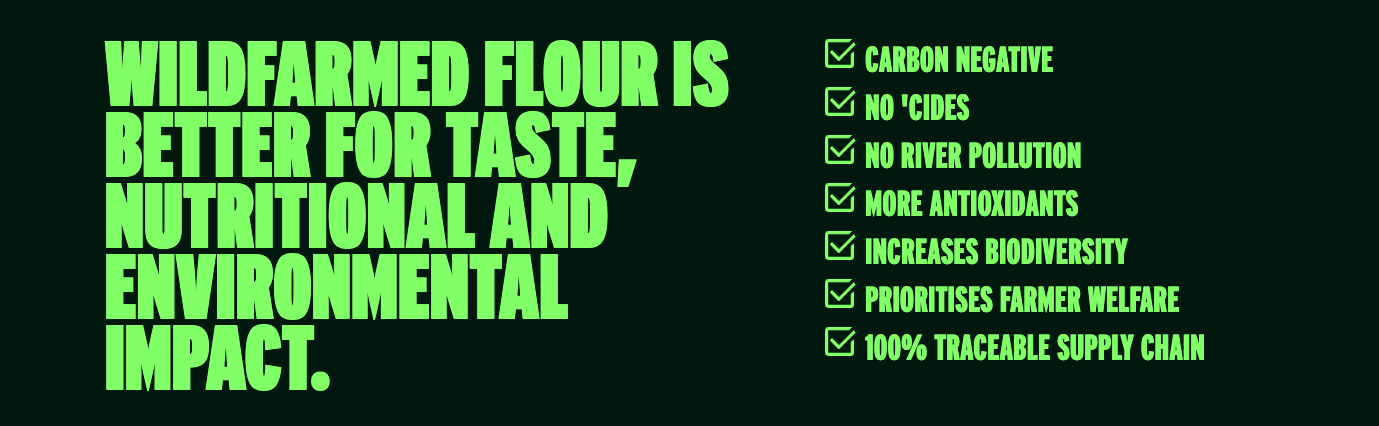
The Wildfarmed team knew early on they would have to go to market differently to create better farmer economics. In Edd's words, they needed to "marry up the entire supply chain," so they decided against a traditional B2B approach with all white-label sales. Even today with over 400 customers, they've still never done a white label sale. They built a unique B2B2C model instead.
By attaching the Wildfarmed brand name to their wholesale ingredients instead of doing white-label sales, they’re able to boost brand awareness and build in extra margin through to the end product. Flour may be the number one ingredient in bread, but it typically accounts for less than 10% of a loaf’s retail cost (even less with pizza).
“We set up a B2B2C play, not just a B2C play, B2B play. We've never done a single white-label sale. So everybody who has ever bought our flour has either promoted our brand in-store, on social, or on their website. It makes sense because they’re paying more for it, so it justifies the higher end product cost to their consumer.” – Edd
And their brand story? It’s a message of life and hope.
“A lot of messaging around sustainability is incredibly negative. If you look at our Instagram, we approach things with a light heart. Most people don’t know that their greatest point of agency in the climate crisis and their health crisis is their food choices. From the beginning, we'd always planned to be a consumer product. So we've spoken to consumers from the outset.” – Edd
Breaking into CPG
Wildfarmed, like other brands before it, hopes to break into CPG by introducing something new in a well-established, “slightly dusty” area of the supermarket that has 98% penetration. In 2024, they’ll be launching sliced loaves (think Dave’s Killer but regenerative sourdoughs, baguettes, etc.), with packaging that’s (no surprise) full of life.
“Everyone's told the same story in the same way since forever. I think you gotta come in have a point of view. We have a story to tell and can sell at a price point that’s higher than you’re used to but still affordable. You just have to give people a reason to feel good about buying your product and demonstrate it’s higher quality and good for your health.” – Edd
50% Market Share for Regen
For Edd, scaling regenerative all comes down to human connection and the collective power of a group of individuals. You can have a tremendous impact when you get everyone in the supply chain – from the farmers to the bakeries to the customers – engaged, excited, and working together to build critical mass.
"We're gonna make a scalable change through human relationships. You know, like that's what brand is, right? If we're going to get into the human relationship with food, the brand is the way to do it." – Edd
You can check out the full episode with Edd Lees @ Wildfarmed HERE.
Subscribe to future episodes of the ReGen Brands Podcast on your favorite podcast platform using the buttons below. You can help support our mission of growing regenerative CPG brands with a 5-star rating!
Stay engaged in the conversation by subscribing to our weekly newsletter, The ReGen Brands Weekly, and connecting with us on LinkedIn (Kyle & AC).
Your support of the show and these brands truly means the world to us. Thank you!
This ReGen Recap was produced with support from Kristina Tober