
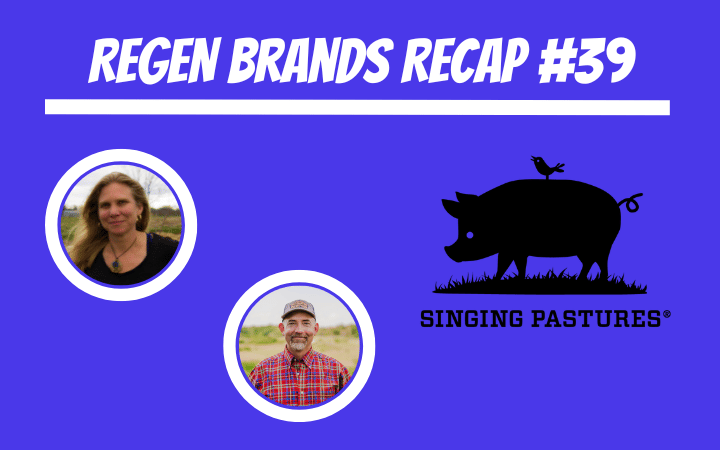
Holly & John Arbuckle @ Singing Pastures
Wildly Regenerative Pork Snacks
Holly and John Arbuckle are the Co-Founders of Singing Pastures. Singing Pastures is supporting regenerative agriculture with their regenerative, pastured pork snack sticks and soon-to-launch salami products.
The Brand
Singing Pasture’s hero product line is Rome Sticks, a line of pasture-raised pork snack sticks available in three flavors. They are also launching a variety of salamis (including bourbon & bacon, and red wine & garlic). They are primarily an e-commerce business through their own site, Thrive Market, Misfits Market, and Imperfect Foods; however, they are aggressively expanding their retail grocery footprint this year.
View this post on Instagram
Livestock Love
Growing up on a farm in the Midwest, John spent much of his childhood raising pigs conventionally. When he and Holly got married, they took on the livestock reins and focused on regenerative farming. Initially they relied on small-scale sales distribution, selling pork directly to customers at farmers' markets as well as to local restaurants and grocery stores. After attending an industry conference, the Arbuckles saw their opportunity: amidst a sea of grass-fed beef sticks was a need for variety, and pastured pork was the answer.
“I can’t fix anything mechanically but I can make decisions that contribute to the health of our ecosystem. If we look at the ecosystem in which we live as a giant living organism, then every being is a part of it. I’m focused on the biological mechanisms, knowing that I can help the mineral cycle, the solar collection of the leaves, the water cycle, wildlife. I can fix that – not with a tractor, but with animals and an electric fence.” – John
A Regenerative Opportunity
15 years ago, long before “regenerative” had the cache it does today, John and Holly were raising their pigs using rotational grazing. They wanted their pigs eating as much forage as possible, recognizing the positive effects it had on the land. Turns out, that approach was also good for the pork.
“We started sending samples to meat science laboratories, originally with the intent to measure our pork chops for tenderness, moisture holding capacity, and the like. They also tested for nutrient density – and we were blown away. Our omega-three content is just climbing through the roof – proving the merit of pigs rotating on pasture and eating some well-managed grass.” – John
The Arbuckles have watched their farm change and regenerate, with the land becoming more drought and flood-resistant and wildlife diversity restored. By tapping into regenerative, the Arbuckles were also able to create a more viable business for their farm, plus the 40 other farms from which they source.
“When we bought our farm in 2018, it was an overgrazed dairy farm. Five years later, we’ve seen a tremendous change in the soil. We've seen grassland bird populations explode. We didn’t ‘fix it’; we changed our strategy, giving nature the opportunity to rebound. We can see all the gloom and doom stories out there about degrading ecosystems, but it’s nice to know that in a short period of time, the reverse is also possible.” – Holly
View this post on Instagram
The Hard Truth About Farming
Both Holly and John think it’s important for people to understand how hard farming is today, and what people can do to support farmers. Approximately 82% of income on small farms across America comes from off the farm (source). Most small farms can’t make it on farmers' markets alone because they don't live close enough to an affluent customer base. Both conventional and regenerative farmers are at the mercy of volatile commodity markets, influenced by factors well beyond their control.
To ensure their own success, the Arbuckles realized they had to find a way to get a premium price for their premium product.
"Selling a CPG product is a fancy way to keep my husband farming because you can tell that he really, really likes farming. So this became a product to be able to help create a viable farm. It was a way to get our product to the populations of people that would enjoy them and want to buy them." - Holly
“You can make more money selling beer than you can selling hops, right? So we decided to become stakeholders in CPG because otherwise, we’re always at the mercy of commodities and that downward pressure on price point. Farmers really need a seat at the table.” – Holly
Natural but Systemized
Rotational grazing has tremendous environmental benefits, but it takes a highly planned approach when it comes to pigs.
- As “rooters”, pigs can be extremely destructive to the land. The Arbuckles use humane septum nose rings that allow the pigs to follow their natural, inquisitive instincts while also limiting soil disturbance.
- Pigs are most happy with new sights and smells, and rotational grazing provides those new pasture environments.
- Every 45 days, the pigs are moved to one of their 22 paddocks where the grasses have regrown and are showing seed heads, and shade structures are erected and moved every 36 hours.
- In addition to grass, the pigs receive supplemental feed through cheese waste from a nearby cheese company, and barley from a nearby brewery – keeping both waste products from landfills.
“We get three or four grazing cycles in the span of a year. Every single time we do that, the grass is gonna rebound better than it was before. We will have given more than we took. That's the heart of the regenerative movement. Whether it's in your land, your human interactions, your co-manufacturer, or your packaging, people, – you have to be giving more than you're taking.” – John
View this post on Instagram
The Problem with Labels
Holly believes consumers are focused on health benefits as a primary message, but the opportunity for regenerative messaging comes when they dig deeper into what eating healthy means. Unfortunately, labels are problematic. On one hand, large-scale organic farms can use a ton of tillage, which is destructive to the soil. On the other hand, Singing Pastures uses waste byproducts that aren’t certified organic (but provide a holistic cycle of regeneration), so their end product can’t be certified organic even though their land is.
“I agree with the outcomes-based approach, but who’s going to pay for it? If we continue to put all that on the farmer or rancher who already has razor-thin profit margins, is that fair? We need something that’s easier for the consumer to understand that also provides details on how the farms and supply chains work – people want proof.” – Holly
"So what happens with us and everybody else is that you get excited about this and then you want to tell everybody everything, right? You wanna talk about soil, you wanna talk about water, you wanna talk about wildlife, you wanna talk about carbon, and so on and so on. But the consumer doesn't have the bandwidth to hear 10 different bullet points. And what I have come to is that people recognize pasture-raised more than they recognize the word regenerative. And that message also tells the consumers 'what's good for me,' right? Because a lot of times they're looking for health benefits. So that's what we're focusing on as our primary messaging." - Holly
Our Path to 50% Market Share 4 Regen
Like many others, Holly and John hoped the local food movement in the 1990s would restore local and regional agriculture, but the country has too many low-income and rural places to sustain it. Consumer choice and education are going to be critical to large-scale regenerative adoption.
Also important is changing how our food system works. As Holly explained, the food system got to where it is because of the policies we adopted and the "corporate capture" of government. We set up laws that give more influence to larger agriculture corporations and squeeze farmers, focusing on profits at the cost of labor, the environment, and human health.
The Arbuckles believe we need to separate the corporations and regulatory agencies and restore focus on protecting the consumer.
John also believes we need to restore farming systems on a medium scale, allowing for fair trade, sophistication not complication, and a lot more fun. He adds that we need to increase the availability for CPG sourcing from farms like his which can be a better alternative than the commodity model.
“Joel Salatin talks about how America does micro farming well – like six pigs to the farmers market – and then the Walmart kind of farming well. There should be some middle ground.” – John
"CPG is going to play a giant role in this. Because if somebody is getting paid 25 cents a pound for their live pig weight at the sale barn then that person will not be thinking that the earth is a large macro organism that we need to care about in a way that increases the nutrient density of the food. There’s a big difference between raising a commodity and raising food, and I would like to see farmers raise food. CPG is when you get out of selling at the sale barn and selling a commodity to raising and selling food." - John
You can check out the full episode with Holly & John from Singing Pastures HERE.
Subscribe to future episodes of the ReGen Brands Podcast on your favorite podcast platform using the buttons below. You can help support our mission of growing regenerative CPG brands with a 5-star rating!
Stay engaged in the conversation by subscribing to our weekly newsletter, The ReGen Brands Weekly, and connecting with us on LinkedIn (Kyle & AC).
Your support of the show and these brands truly means the world to us. Thank you!
This ReGen Recap was produced with support from Kristina Tober