
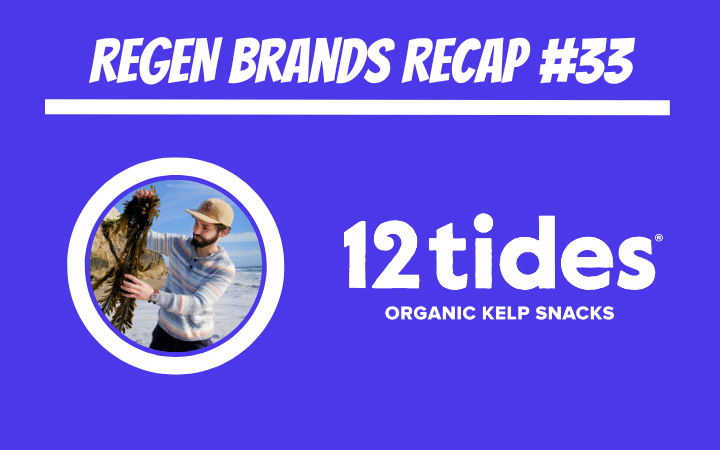
Pat Schnettler @ 12 Tides
These Kelp Chips Regenerate The Ocean
Pat Schnettler is one of the co-founders of 12 Tides. 12 Tides is supporting regenerative aquaculture with its kelp chips made from regenerative and organic kelp farmed in Maine and Alaska.
The Brand
12 Tides makes ocean-positive foods with kelp from regenerative ocean farms. They currently have 5 certified organic, kelp chip SKUs featuring regeneratively farmed kelp as the key ingredient. Their products can be found in 1,100 retailers including Whole Foods, plus online at Amazon, Thrive Market, Imperfect Foods, Misfits Market, Good Eggs, and more.
View this post on Instagram
The Journey
Conservation runs in the Schnettler family with Pat's Mom and both siblings working in the space. Inspired by his sister and her involvement in seafood regulations, Pat launched his career pursuing a variety of seafood projects as an investor, consultant, and operator – including supervising massive vessels fishing for the pollock in Alaska, to a brackish water shrimp farming project in Indonesia, and more. After seeing all the “dark corners” of the global seafood market, Pat was driven to the intersection of the oceans and the food system, with the goal of making both more sustainable.
“I saw two ways of doing that. One was to try to make these horrifying industries a little less bad. Or, two, pursue this idea of regenerative ocean farming, producing nutrient-dense food with zero inputs and having a net positive impact on the surrounding marine ecosystems. And while regenerative was in its infancy and maybe a longer road to change, I thought that was more compelling for me than kind of the ‘do less bad‘ notion.” – Pat

A Deep Dive
In 2016, there were just a handful of kelp farmers in the U.S., with the bulk of the industry being supported by government or academic research institutions. Recognizing his skill set wasn’t suited to kelp farming, Pat was determined to create high-value end markets for kelp farmers. Through his sister, he acquainted himself with pioneers in the space.
“I was always pretty aware of and excited about the potential that it had, you know, both for marine ecosystems and for coastal communities that have been largely dependent on declining legacy seafood industries…States like Maine and Alaska that are most reliant economically on seafood support the creation of this new kelp farming industry.” – Pat
Taste Matters
Recognizing that kelp was a new experience for U.S. consumers and a failed first try could doom it forever, Pat went through a ruthless product development process. He started with chips, a low barrier to entry, selling at farmers' markets primarily to get product feedback. After months of tweaking the product and trying different flavor profiles, he had customers lining up to buy his kelp chips before the market even opened. That’s when he knew it was time to launch, and in 2020, they hit store shelves. When it came to scaling the brand, Pat pulled in the talents of his Co-Founder, Lindsey Palmer, who had previously worked on branding and marketing at AlterEco.
“We couldn’t launch something mediocre and then hope to fix it later. With chips, consumers aren’t dedicating a whole meal to kelp. They don’t have to trust somebody to cook with it or pair it with something else and then maybe screw it up. The idea of eating something right out of the bag was appealing. So we focused on our flavor profile, working off the unique characteristics of kelp to create a texture and flavor unlike any other snack food. When people do try us for the first time and like us, it’s not easy to just go back grab that other bag of chips.” – Pat

A Kelpy Ingredient
Kelp grows incredibly fast and, in the process, absorbs carbon from the ocean at a similar pace, mitigating oceanic acidification on a localized level. Kelp also absorbs excess nitrogen and nutrient pollution that runoff from terrestrial agriculture, and provides food and shelter for all sorts of marine life (kelp farms see a 30 to 40% increase in both biodiversity and abundance of marine life). Kelp is also enormously resource-efficient and virtually input free, using no fresh water, pesticides, fertilizers, or arable land. In addition to it's sugar kelp farming for their products, 12 Tides is working with non-profits to re-introduce giant kelp to its natural ecosystem, restoring balance to areas that have seen an almost 90% decline in wild kelp populations from climate change and commercial fishing.
It's clear that kelp is a massive win in terms of human and planetary health - so how do we get consumers to eat more of it?
“It goes back to the very first thing I said: you have to have products that taste good. You can only have so many core competencies as a company, and product quality is number one, particularly because we manufacture our own products. We’re also designing products within trends that we think will be longer-term trends. We’re also using sustainability and kelp storytelling to distinguish ourselves from everything else on the shelf. We want to drive brand loyalty, keep people engaged and excited and looking for our product every time they go to the store.” – Pat
View this post on Instagram
A Winning Retail Playbook
12 Tides attributes its success to a reliable playbook. They’ve built a community of loyal "superfans" at every single retailer. They’re selective about their retailers and rely on demos, brand ambassador engagements, and creating relationships with retail employees to drive trial and repurchase. Once they set up that flywheel of repeat purchases, they get more placements, end cap displays, and case-stack deals. And they never pursue a new region or big retailer until they’ve created that flywheel at the vast majority of stores they are already in. Where and how the product is merchandised is also a key to success.
"And our goal is to get those 20-30 people. You don't need a lot of people per store. It's like 20 or 30 people. They're going to come in every single week and buy like 1-3 bags, and make you a good velocity brand in the set. - Pat
“12 Tides falls into that sweet spot between the general chip aisle and the better-for-you, alternative ingredient snacks like kale and plantain chips. We try to stay out of the ethnic food aisle, where a lot of seaweed products end up. Our products have a much different kind of flavor profile, textural profile, and use case than what people will shop for in that aisle." - Pat
Our Path to 50% Market Share 4 Regen
Most regen brands, Pat believes, have captured a subset of consumers based on a general interest in regenerative food ingredients – whether it’s wheat, beef, or kelp. The goal is to build off that overlap in values across all regenerative brands, so consumers can move beyond that one brand they really love to fill an entire grocery cart with regenerative products. It’s also going to take connecting consumers back to the values of regenerative products through education. For example, 12 Tides loves sharing information about the brand’s connection to the ocean and coastal communities and helping to preserve that thing we all love (the ocean).
We want to continue to develop products that use the unique flavor and textural profile of the seaweeds that our farmers grow here in the US., and make really unique and tasty products that help grow kelp as an industry in the US. Whatever we can do to help grow the idea of eating products that have a net positive impact on the oceans and help encourage people to think about the impact that their daily life choices have on the oceans.” – Pat
“We need to bring people into the journey, and regenerative brands can do that better than other food brands. We need to spend money educating the consumer on regenerative benefits so they want to fill their carts with these ecologically positive products – lessening the burden on the individual brands.” – Pat
You can check out the full episode with Pat from 12 Tides HERE.
Subscribe to future episodes of the ReGen Brands Podcast on your favorite podcast platform using the buttons below. You can help support our mission of growing regenerative CPG brands with a 5-star rating!
Stay engaged in the conversation by subscribing to our weekly newsletter, The ReGen Brands Weekly, and connecting with us on LinkedIn (Kyle & AC).
Your support of the show and these brands truly means the world to us. Thank you!
This ReGen Recap was produced with support from Kristina Tober