
Nicole Dooling-Frey & Michael Frey @ Mariah Vineyards
The World's First Land To Market Verified Vineyard
Nicole Dooling and Michael Frey are the second-generation operators of Mariah Vineyards and the creators of Dirt Wine. Mariah Vineyards is supporting regenerative agriculture as the world’s first Land To Market Verified regenerative vineyard.
The Brand
Founded by the Dooling family in 1979, Mariah Vineyards is located on 90 acres in Mendocino County, California, sitting 2,400 ft above the fog line and five miles above the ocean. With over 100 inches of rain a year, battered by severe storms and constant wind, the rich, well-draining soils offer a completely unique growing environment that contributes to their unique fruit.
The vineyard name was inspired by the song “The Wind Mariah” from Paint Your Wagon, Nicole's dad’s favorite movie. The family originally planted Zinfandel grapes, selling their fruit to multiple wineries including Kendall Jackson and Fetzer. It wasn’t until Brown-Forman purchased their Zinfandel grapes to make a high-end wine that the Mariah name gained notoriety.
Today, in addition to Zinfandel, the vineyard grows various clones of Pinot Noir, Chardonnay and Sauvignon Blanc, and sells their grapes to multiple California wineries including La Rochelle, Dogwood & Thistle and Bee Hunter. They also produce their own wines under the Mariah brand, available online.
“Farmers are really the bottom of the whole food chain. To have a contract with the option to sell your product is critical. Every year is different, with different tonnages, and every year weather really matters. Having other vineyards or brands buy your fruit is a great safety net.” – Nicole
View this post on Instagram
Wine Plays by Different Rules
A legal term, “appellation” indicates the protected geographical region where wine grapes are grown. And in the wine industry, vineyards are paid on where they grow, not how they grow. While it’s typical in Europe for the farmer to also be the winemaker, in the U.S., most brands purchase fruit without farming it. When a consumer purchases a bottle of wine, for example from a vineyard in Napa Valley, the grapes used to make the wine could come from anywhere. A single vineyard designate, however, as dictated by U.S. law, verifies that at least 95 percent of the grapes used in that wine come from that site.
That’s why single vineyard designate wine is so important to Mariah – to preserve what’s truly unique about their fruit.
“Wine is really dependent on appellation. Growers are always looking at how to get a premium, to elevate their fruit. If we have the cleanest, nature-positive fruit, how do we get a premium out of that? That’s why we went down the path of Land to Market Verification – it allows us to differentiate our fruit in this ocean of wine.” – Michael
View this post on Instagram
Building the Mariah Brand
In 2007, the Brown-Forman contract expired and the family decided to make their own wine under the Mariah name. Federal law, however, dictates that to actually produce wine, a winery must be bonded (i.e.,“bonded” means a brick-and-mortar establishment that produces and stores its own wine also has a permit from the Alcohol and Tobacco Tax and Trade Bureau (TTB)).
Nicole’s mom started making Mariah branded Pinot Noir with a bonded winery, but became frustrated with the challenges of making, marketing, distributing and selling their own wine. Flash forward to 2017, on a trip to Peru with Nicole, they met Michael Frey. Michael returned to California to help the Dooling family on their vineyard, where their love for each other and the land began.
“To see how Michael looked at this place, how truly unique it is, how nobody farms their own land anymore, makes their own fruit – I realized how special it was. He really shifted my perspective.” – Nicole
A Regen Journey
Sometimes the best ideas are shared over food. Over lunch, their friend Paul Dolan suggested the new couple attend the 2018 Regenerative Earth Summit in Boulder, CO. As a long-time pioneer in regenerative agriculture and organic viticulture, Paul's recommendation was not taken lightly.
At the summit, between Nicole staring down Will Harris (of White Oak Pastures) in a group bonding exercise, to talking with folks from the Savory Institute and Mad Agriculture, the couple was immediately inspired to get on the regenerative bandwagon. They partnered with Land to Market and Savory Institute and became a pilot vineyard and perennial cropping system.
For years, Dan Dooling had been dry farming with permanent cover, but they still practiced some cultivation (tillage) and had never integrated animals into their systems. They replaced the cultivation with a specific mower that could achieve the same results - keeping the grass low to prevent frost issues and insect migration into the canopy. They also increased the biodiversity of the cover, adding legumes to fix nitrogen and other perennial covers to create a pollinator habitat. Lastly, they introduced grazing animals into their vine row management.
The results have been impressive. Now they're working with John Kempf's Advancing Eco Agriculture to perform soil testing and SAP analysis. As Kempf says, "healthy plants build healthy soil," which is a paradigm switch from the typical refrain of "healthy soil builds healthy plants." If a plant is photosynthesizing on a really high level, it feeds the microbes that build soil health.
“In a farmer’s mind, the property has to look maintained, it has to be clean, but nature doesn’t look like a golf course. The more diverse the background, the more diverse below ground, the more species the better – all doing different things for the vines. Just like our bodies, soil functions at an optimal level when you feed it well.“ – Michael
View this post on Instagram
Adding Transparency
Over 70 additives are regularly used in winemaking – everything from yeast and sulfur to gelatin and even the toxin velcorin. There’s no transparency around ingredient labeling, and there are also sustainable labels that permit glyphosate spraying. Many vineyards rely on chemicals to fight against mildew outbreaks. Couple all that with the ambiguity around grape sourcing, and consumers just don’t know what’s in their wine.
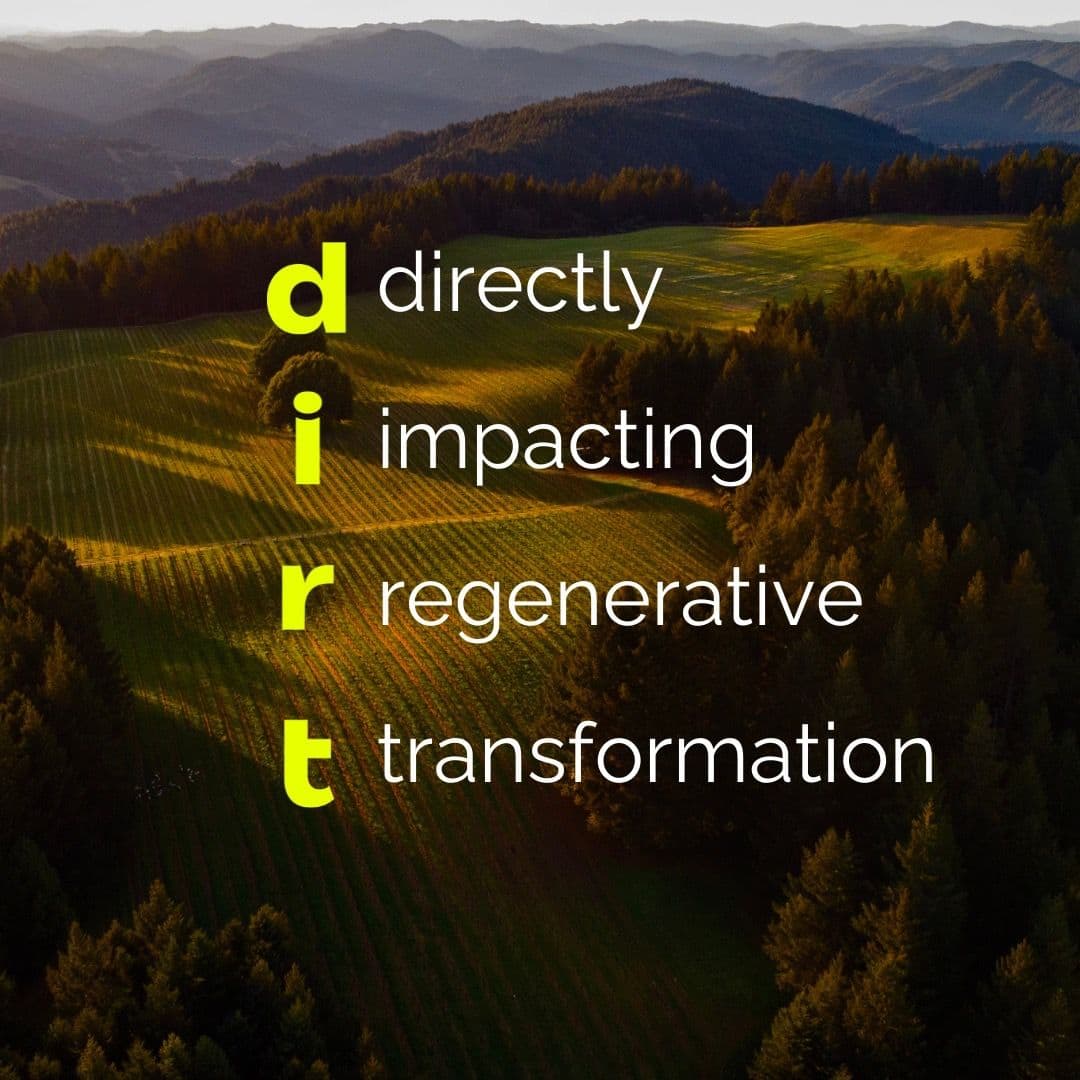
Inspired by the purity of their vineyard and fruit quality, Nicole and Michael have introduced Dirt Wine and are working toward a more transparent process that tracks wine from soil to glass. They’re looking at nutrient density and the impact of healthy soil on terroir.
“It’s ironic that an industry that speaks so highly about terroir somehow hasn’t really focused on the dirt. The dirt, or soil, is where things are grown and we need transparency around that. To create transparency, you have to disrupt a little bit too.” – Nicole
Credit: Dirt Wine
Our Path to 50% Market Share 4 Regen
Consumption drives the market, and Nicole and Michael believe we have to create radical transparency so consumers can choose the brands that are doing good. They, like so many others, care about their health. But too often consumers opt for their health over that of the planet. If we can trigger people’s understanding of farming and the processing of food, and remind them that food is medicine, we can get them to demand more from what they’re consuming.
"There's a lot of stuff that we've learned during our growing career and our experience in the wine industry that we think is a disservice to consumers. So we think it's time that somebody speaks up and is disruptive. We believe that there has to be transparency out there if we want to change the food system on a broad scale." - Michael
You can check out the full episode with Nicole & Michael @ Mariah Vineyards HERE.
Subscribe to future episodes of the ReGen Brands Podcast on your favorite podcast platform using the buttons below. You can help support our mission of growing regenerative CPG brands with a 5-star rating!
Stay engaged in the conversation by subscribing to our weekly newsletter, The ReGen Brands Weekly, and connecting with us on LinkedIn (Kyle & AC).
Your support of the show and these brands truly means the world to us. Thank you!
This ReGen Recap was produced with support from Kristina Tober